E-Paper



How Himalayan Heritage Walk spurred restoration project of George Everest’s house in Mussoorie
After the restoration is completed by December 2021, part of the Everest House would be converted into a Cartographic Museum.

 Prefer HTon Google


It took a heritage walk for close to four years, including that of senior Indian Administrative Service officers, to renovate and restore the heritage bungalow of Sir George Everest, the former surveyor-general of India, who who initiated the survey for measuring the height of Mount Everest, the peak named after him.
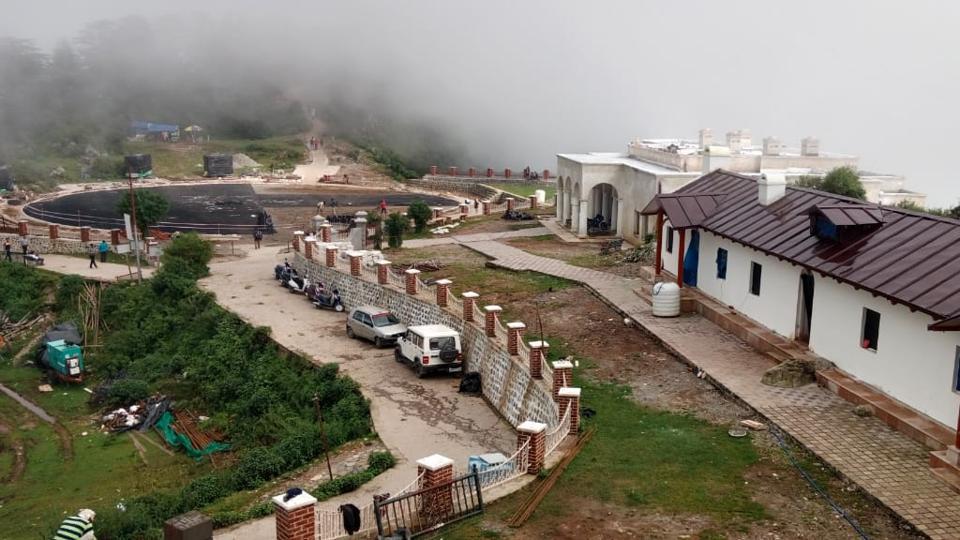
After the restoration is completed by December 2021, part of the Everest House would be converted into a Cartographic Museum, Uttarakhand government officials said.
George Everest House and laboratory, where he lived for eleven years, is located at Park Estate near Hathipaon, about 6 kilometres from Gandhi Chowk in Mussoorie. He bought the Park Estate, where this house was already built in 1833, and lived there for almost a decade before retiring and returning to England in 1843.
But, years of neglect resulted in many parts of the building losing their traditional charm with some portions crumbling.
Getting the attention of policymakers towards the heritage bungalow in Mussoorie was not easy. So, anthropologist Lokesh Ohri, who is also the convenor of the Indian National Trust for Art and Cultural Heritage (INTACH), Uttarakhand chapter, decide to organise a heritage walk through their group called “Been There Doon That”.
The walk used to be conducted on July 4 on Sir George Everest’s birthday.
“Over two years ago, we conducted a walk through Landour for the reunion of the 1986 batch of IAS officers. After the walk, a very senior IAS officer asked me if they can do something for Mussoorie. We suggested that a group be formed that would focus on the conservation of Sir Everest’s house,” Ohri recalled.
The group was formed and after some time, the then additional secretary, tourism, Neeraj Jyoti Khairwal asked Ohri to send a proposal for conservation of the bungalow. As Ohri had a plan ready, he immediately sent the proposal to Khairwal.
“And this is how the restoration project for Sir Everest’s home came to the forefront,” Ohri said.
On how the restoration work is being carried out, Yugal Kishore Pany, deputy director Uttarakhand Tourism Development Corporation said the restoration project was taken up under Asian Development Bank funding.
“The project is focussing not only on the restoration of the House but also improving the whole area and making it attractive for tourists. Over one-kilometre-long pathway to the house has been given a heritage look by using cobbled stones,” he said.
Pant said they are very careful in renovation and restoration as they wanted it to gel with construction materials used originally. “There is one observatory in the bungalow where George Everest used to make triangulation measurement of the Himalayan peaks. We are developing some glass-domed huts there on the premises where tourists can clearly see the night sky,” he said.
Pant said a cartographic museum is also being developed where cartographic equipment and information about such scientific instruments and procedures would be put on display. “We have also sought the help of experts from Survey of India based in Dehradun. The whole restoration project would be completed by December,” he said.
Ohri said he was satisfied with the restoration work and was happy that a cartography museum is also being built under the ₹24 crore restoration project. He added that the heritage building has immense historical and scientific value.
According to the Survey of India, Sir George Everest (July 4, 1790 –December 1, 1866) was a British surveyor and geographer who served as the Surveyor General of India from 1830 to 1843. For his contributions, Mount Everest, the highest mountain on Earth which was earlier called Peak XV, was named in his honour. He worked on Great Trigonometric Survey and was largely responsible for surveying the meridian arc from the southernmost point of India north to Nepal, a distance of about 2,400 kilometres from 1806 to 1841.