
 E-Paper



Uttarakhand: Climate change, snowless winters threaten Auli’s skiing identity
No snowfall has led to negligible tourist footfall and put major winter events, including the national skiing and snowboarding championships, at risk

 Prefer HTon Google


Auli, the popular skiing destination in Uttarakhand’s Chamoli district, is facing an unusually snowless winter, raising serious concerns over the impact of climate change on winter sports, tourism and the region’s identity. Large stretches of its slopes remain bare, with brown earth visible where thick snow cover is usually expected at this time of year. The absence of snowfall has led to negligible tourist footfall and put major winter events, including the national skiing and snowboarding championships, at risk of cancellation.
“This is the fourth time in the last five years that the championship is likely to be cancelled,” said Parveen Sharma, secretary of the Uttarakhand Winter Games Association. “Even if it snows now, it won’t last because warming has already begun. If this continues, Auli will lose its place on the world map as a skiing destination. Completely dependent on natural snowfall, Auli is now paying the price of shifting weather patterns. Global warming is impacting us directly. Nature is no longer favouring us,” he said.
Originally developed as a paramilitary base, Auli later emerged as a premier skiing hub, drawing tourists and professional athletes. Located at an altitude of around 2,800 metres and surrounded by oak and coniferous forests, it offers views of Himalayan peaks such as Nanda Devi. With snowfall failing, authorities are exploring higher-altitude alternatives like Gorson, an alpine meadow about 3–4 km away at roughly 3,050 metres. However, Sharma said developing Gorson would be difficult due to forest cover and environmental constraints.
“While winter games are organised in Solang Valley and Gulmarg, Auli has a global identity. We have internationally approved courses and globally recognised standards,” Sharma said.
According to the India Meteorological Department (IMD), Uttarakhand has recorded no rainfall so far in December and January, and even high-altitude areas remain snowless. IMD Dehradun director CS Tomar said western disturbances have been near normal in frequency but weak in intensity. “These systems carried limited moisture and largely followed a northward track. As a result, Jammu and Kashmir received some snowfall, while Himachal Pradesh and Uttarakhand saw weak weather activity,” he said.
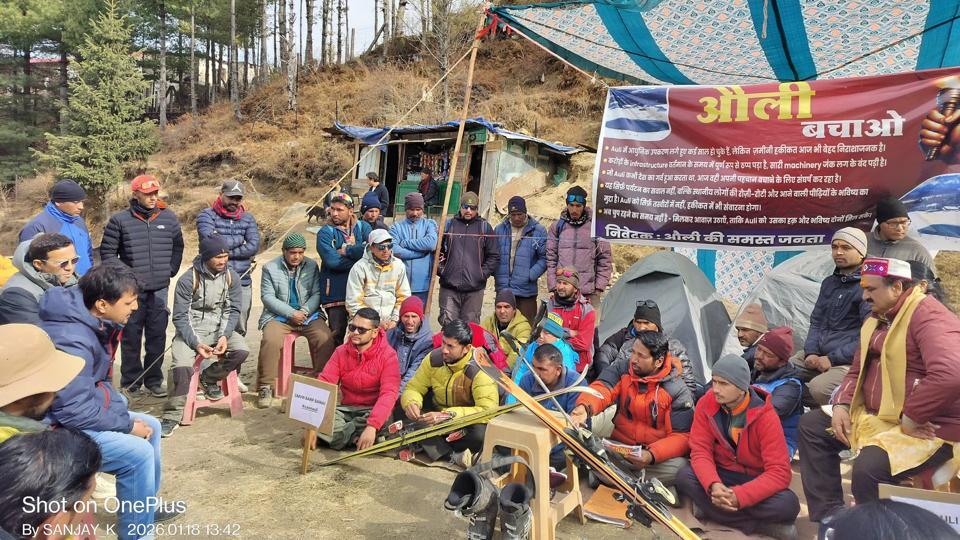
Local residents and tourism stakeholders have protested under the banner of Auli Bachao, demanding that long-idle artificial snowmaking machines be activated. “Auli’s identity is under threat,” said Santosh Kunwar, founder of the Auli Skiing School, calling for a technical review and revival of the snowmaking system and the long-shut ice skating rink.
The downturn has severely hit local businesses. “Almost all bookings made in December for January were cancelled,” said Chandra Prakash, an employee at a resort in Auli. Environmentalist Hemant Dhyani termed the snowless winter “an alarming indication”, warning that unregulated construction, deforestation and commercial activity were aggravating climate impacts in the Himalayas.


