E-Paper



Uttarakhand HC seeks Centre, state’s response on petitions on Joshimath, Chamoly
Three petitions in the Uttarakhand high court raised questions over the Joshimath land subsidence crisis and rehabilitation, and the people still missing in the February 2021 Chamoly glacial debris outburst

 Prefer HTon Google


The Uttarakhand high court on Tuesday directed the state and central governments to file their responses on three petitions that raised questions over the Joshimath land subsidence crisis and rehabilitation, and the people still missing in the February 2021 Chamoly glacial debris outburst.
The petitioner Ajay Gautam, a Delhi-based social activist who appeared in person in the cases, blamed rampant constructions and lack of a planned sewer system for the Joshimath crisis and sought immediate rehabilitation of affected people. He also sought a search of 122 people still missing in the Chamoli tragedy.
A division bench of chief justice Vipin Sanghi and justice Alok Kumar Verma directed the governments to file their responses within six months.
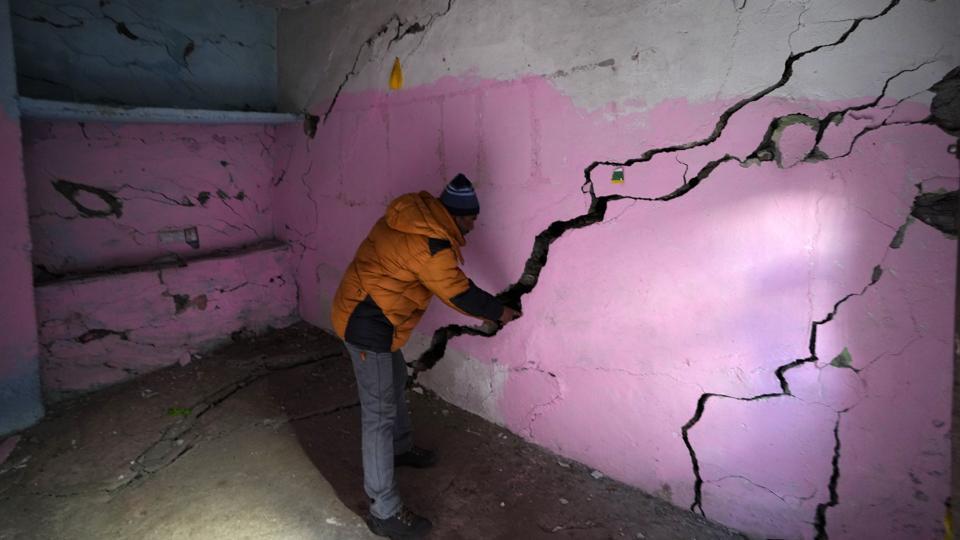
Joshimath, the gateway town to the Badrinath shrine, was declared a landslide-subsidence zone in January after cracks developed in houses and hundreds of families had to be evacuated to safer areas. Over 868 buildings have been damaged due to land subsidence, and 995 people of 296 affected families have been living in relief camps or rented houses since January.
Also Read |A dire warning from Joshimath
“Currently the population of Joshimath is between 22,000 to 25,000, and it increases during the Char Dham yatra period when it swells to nearly 2 Lakhs. There is absolutely no civil infrastructure to deal with or handle such a huge population. And multi-storeyed buildings have been allowed to crop up there, Also, there is no planned sewer system in Joshimath. After 2000, authorities allowed constructions to mushroom there without understanding the highly sensitive ecology of Joshimath. To add fire to the fuel, explosives have been used to construct roads and tunnels in the name of development works in the area”, Gautam said in his petition.
The petition has sought immediate steps to rehabilitate the land-subsidence-affected people constituting a committee of experts for suggesting appropriate remedial measures to save Joshimath and Karanprayag and stopping all types of constructions and ongoing projects till experts give their opinion on whether they should be permitted or not.
Also Read | Policies and People | Joshimath crisis: Invest in mountain-specific planning
The second petition filed by Gautam alleged that the safety of people has been compromised by carrying out rampant blasting, cutting the roads, and constructing tunnels during Char Yatra in the all-weather road project, Rishikesh- Karanprayag Railway project and NTPC’s Tapovan Vishnugad power plant.
“During construction of these projects, dust, boulders, and rocks are making their way into Alaknanda river and other rivers which ultimately results in muddying clean water of sacred Gangam,” he said.
The petition has sought framing of strict guidelines for blasting and road cutting keeping in mind the safety and security of tourists/pilgrims/residents and ensuring no muck is thrown into rivers during any kind of construction.
Also Read | Apathy compounds Joshimath’s tragedy
The third petition sought the search of 122 people still missing in the Chamoly tragedy, when a glacial debris outburst eroded the banks of the Alaknanda river flowing beneath the Joshimath town, with experts saying that it is likely one of the contributing factors for land subsidence.
Gautam said out of 204 people killed in the Chamoli tragedy, 84 bodies, and 37 human body parts have been recovered so far, while 122 are still missing.
“I have also sought directions that a committee of experts should be constituted like the one ordered by HC in 2019 for suggesting ways, means, and technology for the searching people still missing in the 2013 Kedarnath tragedy.”
The court has fixed August 2 as the next date of hearing in the three petitions.