Delhi breathed season’s worst polluted air on Monday with a heavy layer of pollutants blocking sunlight, causing a thick haze to envelop the city with experts sounding a health emergency for the vulnerable population including the elderly, children and those with comorbidities.
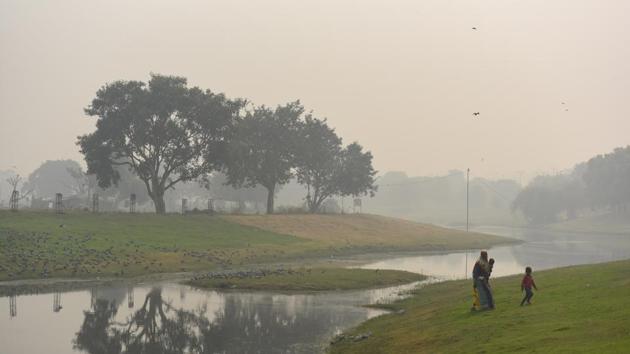
The average air quality index in Delhi was recorded at 477 on a scale of 500, the highest since November 3 last year, in the severe zone. This was the fifth consecutive day when Delhi’s air was in the severe category. The last time that Delhi had a such a long spell of polluted air in November was in 2016 and 2017, when the air remained in the severe category for six days.
However, by late evening, the AQI deteriorated to 500 at five places -- Mundka, Najafgarh, Rohini, Drawrka Sec 8, Punjabi Bagh, according CPCB’s Sameer app. The overall AQI in the evening stood at 491.
Doctors warned that exposure to such high levels of air pollution continuously over days is linked to higher hospital admissions and people reporting with respiratory and cardiovascular complications.
Weather scientists and pollution monitoring agencies have warned that an immediate relief was unlikely as meteorological conditions are not ideal for disperal of pollutants and farm fires are raging in the neighbouring states of Punjab and Haryana.
{{/usCountry}}Weather scientists and pollution monitoring agencies have warned that an immediate relief was unlikely as meteorological conditions are not ideal for disperal of pollutants and farm fires are raging in the neighbouring states of Punjab and Haryana.
{{/usCountry}}It is, however, unclear if strict measures under the Graded Response Action Plan (Grap) such as stopping all construction activities, introducing the odd-even road space rationing scheme, and stopping the entry of trucks into the city completely, will be implemented or not.
At 416, the AQI was in the lower-end of the severe category on Sunday.
Scientists on Monday said the farm fires from the neighbouring states of Punjab and Haryana are choking the national capital because of calm winds. Kuldeep Shrivastava, head of regional weather forecasting centre, said the wind speed in Delhi was less than 5 km per hour.
“Due to the low wind speed, the smoke and pollutants cannot be dispersed which is why the condition is severe. Wind direction will switch to easterly direction and this will be a transitional phase when winds are usually calm. There may be marginal improvement in air quality on November 12 and 13, but if firecrackers are burst then condition will remain same or worsen,” he said.
Around 5,000 instances of farm fires were reported in Punjab and Haryana on Monday, contributing 38% of PM 2.5 load in Delhi, according to System of Air Quality and Weather Forecasting and Research, Indian Institute of Tropical Meteorology.
Vijay Soni, scientist at India Meteorological Department (IMD)’s air quality division, said, “Around 5,000 instances of farm fires were reported in Punjab and Haryana contributing to the air quality being in the severe category on Monday. The air quality is likely to be in the severe category till Tuesday. If the winds become easterly tomorrow, then we can expect some improvement. As per our forecast, winds will start blowing from northwest on Tuesday,” he said.
“There is anti-cyclonic wind circulation in the lower levels and subsidence of air in large parts of northwest India presently. Both are linked to slow winds and accumulation of pollutants. We have been seeing a very large number of crop stubble fire points. The combination of these factors is leading to air quality index (AQI) hovering between very poor and severe categories for the past five days,” explained RK Jenamani, senior scientist, national weather forecasting centre.
The AQI is likely to be in the upper-end of very poor category on Friday and Saturday before turning severe around Diwali on November 15 and 16, according to ministry of earth sciences.
Sagnik Dey, associate professor at the Institute of Technology-Delhi, said the spell of polluted air will cause problems to those infected by Covid-19.“This time around, doctors have also pointed out that high pollution levels are bad for Covid-19 transmission as well. However, more than the acute exposure, the health burden is larger for chronic exposure – which refers to the pollution levels that people of Delhi are exposed to all year round. That needs immediate attention,” he said.
He explained that chronic exposure is linked to multiple health outcomes such as heart diseases, stroke, lung cancer, and also Type 2 diabetes, according to some studies.
“All these eventually lead to mortality and different morbidities. One way to reduce the chronic burden is to control these pollution peaks. For instance, if we control the October-November pollution peak, we can reduce the annual PM 2.5 exposure by 15-20%,” he said.
Stay updated with all top Cities including, Bengaluru, Delhi, Mumbai and more across India. Stay informed on the latest happenings in World News along with Delhi Election 2025 and Delhi Election Result 2025 Live, New Delhi Election Result Live, Kalkaji Election Result Live at Hindustan Times.
Stay updated with all top Cities including, Bengaluru, Delhi, Mumbai and more across India. Stay informed on the latest happenings in World News along with Delhi Election 2025 and Delhi Election Result 2025 Live, New Delhi Election Result Live, Kalkaji Election Result Live at Hindustan Times.