E-Paper



3 landfills have cost Delhi ₹450 cr in environmental damages: Study
Experts considered factors such as the leachate generated over time and the legacy waste accumulated at the landfills and the violations of solid waste management rules to calculate the damage to the environment.

 Prefer HTon Google


Delhi’s three landfill sites – Bhalswa, Okhla and Ghazipur -- have cost more than ₹450 crores in environmental degradation to the national capital so far and with no noticeable progress being made to reduce the millions of tonnes of waste at these dumping sites, according to a study by a team of experts that was submitted to the National Green Tribunal in January last year.
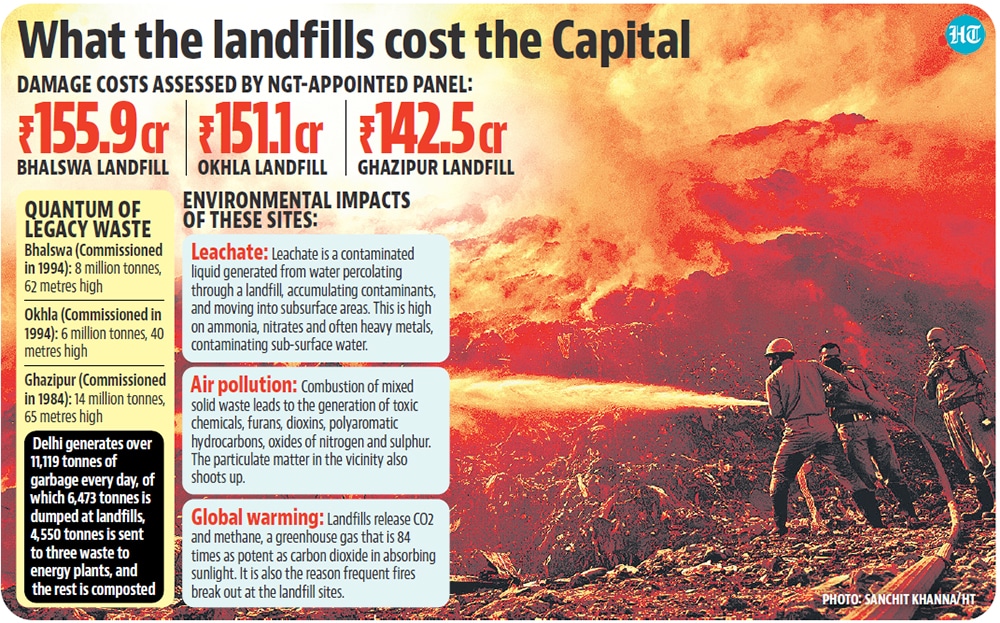
The study conducted by experts from National Environmental Engineering Research Institute (NEERI), the Central Pollution Control Board (CPCB) and IIT-Delhi assessed the damage due to Bhalswa was worth ₹155.9 crore, Okhla caused ecological damaged to the tune of ₹151.1 crore and Ghazipur has led to an environmental damage of ₹142.5 crore. The experts considered factors such as the leachate generated over time and the legacy waste accumulated at the landfills and the violations of solid waste management rules to calculate the damage to the environment.
The Bhalswa landfill site was commissioned in 1994 and has accumulated 8 million tonnes of legacy waste, with the site exhausting its capacity in 2006. The Okhla site was commissioned in 1994 and holds 6 million tonnes of legacy waste, with the site exhausting its capacity in 2010. The Ghazipur site is Delhi’s oldest and was commissioned in 1984, and has already accumulate 14 million tonnes of legacy waste. In 2019, following an order by the National Green Tribunal (NGT order), the three municipal corporations started carrying out bio-mining and bio-remediation. However, with fresh dumping still continuing, the pace of clearing inert legacy waste has remained slow.
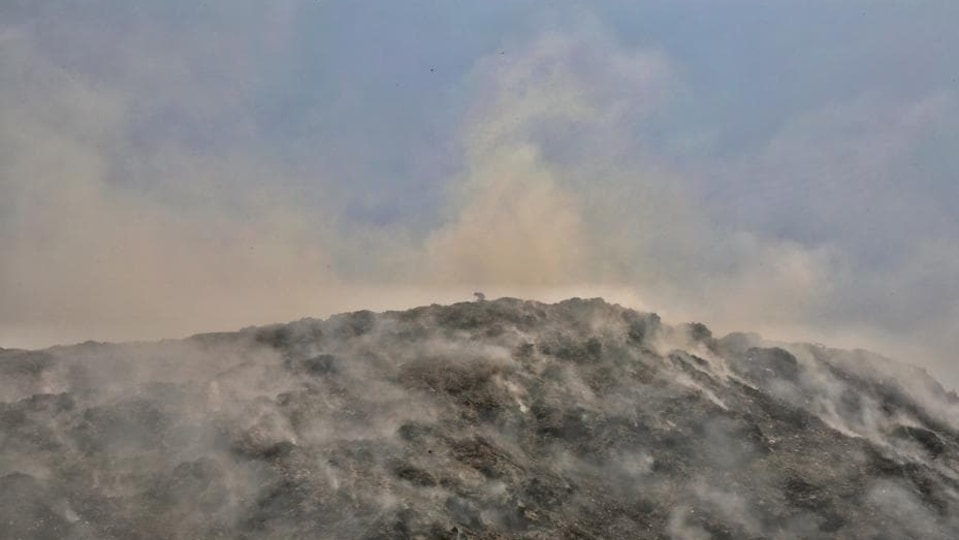
Leachate polluting groundwater
“High level of chemical oxygen demand (COD) & Iron (Fe) reported in groundwater at all three sites, which may be due to leachate from the dumpsite. Chlorides, total dissolved solids (TDS), total soluble solids (TSS) and turbidity was reported in surface water body (Bhalswa lake) located within a radius of 0-1 km from Bhalswa site, which may be due to leachate from the dumpsite,” the committee had said in its groundwater and water analysis.
Leachate was found to be reaching as far as 3 to 5 kilometres away from Ghazipur, with high COD values reported at Sanjay Lake too, the report said.
COD is an indicative measure of the amount of oxygen that can be consumed by reactions in a measured solution. The most common application of COD is to quantify the amount of oxidizable pollutants found in surface water (lakes and rivers) or wastewater.
“Even a small amount of landfill leachate and highly concentrated heavy metals can pollute a large volume of surface as well as groundwater, making it unfit for consumption. These leachates and heavy metals can ultimately enter food chain and in the long run, can affect natural and human resources,” the study said.
Air carrying pollutants all around
These landfill sites are also a big source of air pollution, with contaminants from these sites travelling to as long as 5 kilometres away, aided by strong winds. Even when the landfill is not burning, these landfill sites are a constant source of greenhouses gases such as carbon dioxide, oxides of nitrogen and sulphur, toxic chemicals, furans, dioxins and unburnt hydrocarbons, and most importantly, methane, which is said to be 84 times as potent as carbon dioxide, in absorbing the sun’s rays.
People near these landfills breathe some of the worst air in the city, experts have said.
While the NGT-formed expert committee was unable to find a direct correlation between air pollution within a 5-km radius of the dumpsite and the activities occurring there, these landfill fires are often seen to have an impact in terms of air quality at the nearest ambient air quality monitoring stations.
Following Tuesday’s landfill fire breaking out at Bhalswa, the hourly PM 2.5 and PM 10 concentration spiked to nearly 9-10 times the national safe limits in the early hours of Wednesday at the Jahangirpuri air quality monitoring station, the nearest station to the site and located less than 5kms away from the landfill.
Nearest ambient air quality monitoring stations to these landfill sites also feature among the list of 13 pollution hotspots in Delhi, official data shows. Jahangirpuri station is closest to Bhalswa, Anand Vihar station is near Ghazipur, the Okhla Phase-II station is located near Okhla landfill site -- and all three locations feature in the list of pollution hot spots drawn by the Delhi Pollution Control Committee.
Anumita Roychowdhury, executive director, research and advocacy at the Centre for Science and Environment (CSE), said even when these landfills are not on fire, they release pollutants into the ai. “The data from these ambient air quality monitoring stations is evident and it underlines the fact that waste management is an important step towards tacking air pollution,” she said.
Richa Singh, programme officer, Waste Management Programme, CSE said that calling the three sites ‘landfills’ would be inaccurate, as they are without any proper leachate management system or a gas sucking system, and added that the three are “dump sites” that were built without adequate planning and are now constantly damaging the environment.
“These major fire incidents are being captured, but these landfill sites are burning almost throughout the year with minor fires or smoke breaking out from one corner or the other and this process of mixed waste catching fire releases dioxins and furans which are carcinogenic in nature, along with polyaromatic hydrocarbons which are also carcinogenic. There are long-term health impacts including breathing problems for those regularly breathing such air near the landfill sites,” she said.
Dipankar Saha, former head of the air laboratory at CPCB said landfill sites have been found to be much warmer since they release large number of greenhouse gases, including CO2 and methane. “There is a lot of activity occurring at a landfill site naturally, including the release of dioxins and furans, but the release of greenhouse gases means their impact is not limited to the neighbourhood or the city, but they are a nationwide problem,” he said, and added that long-term planning is required to phase out these dump sites.