A 6.2 magnitude (M) earthquake struck Nepal while its tremors were felt across north India, including Delhi and the National Capital Region, Bihar and Uttar Pradesh on Tuesday at 2.51pm.
According to an initial assessment by the National Center for Seismology, the depth of the earthquake was 5km. The epicentre was in Dipayal in western Nepal, about 434km northwest of Kathmandu and 500km from Delhi.
Two aftershocks of M3.6 and M3.1 also occurred within a 10km radius of the mainshock. “The area is seismically very active and associated with collisional tectonics where Indian plate subducts beneath the Eurasian Plate,” a report by NCS released on Tuesday evening said.
“When the depth is high but the magnitude is relatively low, a very large area is likely to feel the tremors. However, the opposite is also true as is in the current case, where the depth is low but the magnitude is so high that tremors were felt here. It was felt for 10 to 15 seconds,” said JL Gautam, head of office at NCS.
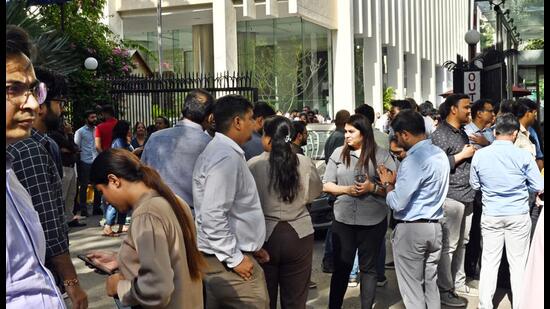
Meanwhile, residents in high rises and those in tall office buildings rushed downstairs in panic. “The tremors increased gradually. We thought it will subside, as it usually happens in Delhi. But this was definitely a little scary,” said Ishika Gupta, a resident of Gurugram.
{{/usCountry}}Meanwhile, residents in high rises and those in tall office buildings rushed downstairs in panic. “The tremors increased gradually. We thought it will subside, as it usually happens in Delhi. But this was definitely a little scary,” said Ishika Gupta, a resident of Gurugram.
{{/usCountry}}“The occurrence of earthquakes in the region is attributed mainly to the tectonic settings of the Himalayas comprising Himalayan Frontal Thrust (HFT), Main Boundary Thrust (MBT) and Main Central Thrust (MCT) besides several local faults and geological demarcated lineaments... the neighbouring states of India that felt earthquake fall under the seismic hazard zones V and IV,” the report said. Delhi falls under zone IV, which makes it a severe intensity zone.
The recorded earthquakes according to the earthquake catalogue of NCS revealed that the region was vulnerable to “moderate to large” earthquakes with varying magnitude for the last 13 years.
Before the mainshock on Tuesday, there were three prominent events recorded on November 9, 2022, of M6.3, January 24, 2023, of M5.8, and February 22, 2023, of M4.4 which occurred within 50 square km. These were also felt with “slight to moderate” intensity in the Delhi-NCR and other neighbouring states.
The Himalayan region, seismically one of the most active continental regions, experienced at least four M 8 earthquakes during an active phase from 1897 to 1952, according to research. The region is currently in a seismic quiescence phase, and enough strains have been accumulated. However, none of the research makes it easier or accurately predict when and where an earthquake might occur.
Stay updated with all top Cities including, Bengaluru, Delhi, Mumbai and more across India. Stay informed on the latest happenings in World News along with Delhi Election 2025 and Delhi Election Result 2025 Live, New Delhi Election Result Live, Kalkaji Election Result Live at Hindustan Times.
Stay updated with all top Cities including, Bengaluru, Delhi, Mumbai and more across India. Stay informed on the latest happenings in World News along with Delhi Election 2025 and Delhi Election Result 2025 Live, New Delhi Election Result Live, Kalkaji Election Result Live at Hindustan Times.