
 E-Paper



A battle for Delhi’s soul in the glare of streaming services, multiplexes
The dawn of the 21st century brought with it the multiplex — a convenient, climate-controlled experience that often nestled inside shopping malls

 Prefer HTon Google


In the hushed darkness, just before a projector whirrs to life, you can almost hear it — the whispers of a million shared memories. It’s the rustle of samosas being passed down a row in crinkled newspaper, the clink of chilled glass bottles of Limca or Goldspot shared between siblings, and the collective cheers and whistles in a hall as a hero makes his entrance. For generations of Delhiites who came of age before the turn of the millennium, this was a sacred weekend ritual. This was the single-screen cinema experience.
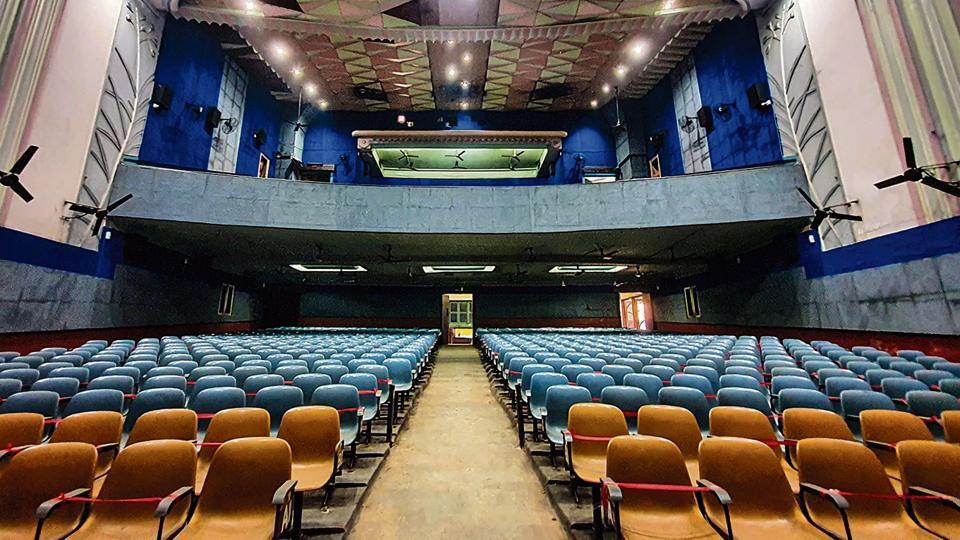
These were not just buildings of brick and mortar; they were the epicentres of family life, where the dreams of millions were projected in 70mm glory. This is where generations marked time with Sunday matinées, first dates trembled in the dark, and families formed core memories that would be reminisced over decades.
Today, in a city once dotted with nearly 70 such palaces of dreams, only four surviving single-screen theatres stand as sentinels to a bygone era: Delite in Daryaganj, Liberty in Karol Bagh, Amba near Shakti Nagar, and Gagan in Nand Nagri.
They are more than just theatres; they are repositories of nostalgia, monuments to resilience — a part of the very soul of Delhi. They are the final reel in a story that began with the birth of a nation and is now flickering, against the glare of multiplexes and the convenience of streaming services.
A fading marquee
The dawn of the 21st century brought with it the multiplex — a convenient, climate-controlled experience that often nestled inside shopping malls. It offered a sense of luxury and choice that the old halls could not. Then came the back-to-back blows of demonetisation, which slashed cash-dependent sales overnight, and the Covid-19 pandemic, which shuttered theatres for months and trained an entire population to find its entertainment at home on OTT platforms.
One by one, the iconic marquees faded away.
The most lamented loss was perhaps Regal Cinema in Connaught Place, which first opened its doors in 1932 and for decades hosted not only Bollywood and Hollywood premieres, but also theatre and cultural performances. It shut down in March 2017, with its owner announcing plans to replace it with a multiplex – a fate that has been shared by dozens of others. The storied Ritz at Kashmere Gate, the charming Moti in Chandni Chowk, the bustling Sheila in Paharganj have all faded into memory, their doors shuttered, buildings repurposed or simply standing as hollowed-out shells.

“The story of the single-screen cinemas forms an important part of Delhi’s heritage,” explains Arjan Singh Seble, a 22-year-old from the family that once owned The Seble and Raaj Cinema. “For nearly 50 years, they were the prime and affordable source of entertainment for people in the city.”
Arjan’s study of Delhi’s single-screen theatres reveals a history intertwined with the nation’s birth. Before Partition, cinema ownership in Delhi and Bombay was dominated by leading Muslim families, most prominent of them being halls such as Jubilee, Majestic, and Ritz. But Independence changed everything. Families like the Sahanis, who migrated, established new bastions like Odeon and Rivoli. The influx of refugees brought new artists, new audiences, and a new cinematic language. “The influx of refugees in the Capital brought change in how India saw cinemas… As the industry evolved, so did the content; it transformed from mythological movies to romance or social dramas that critiqued the evils prevalent in society,” added Arjan.
Delite: The crown jewel of Daryaganj
Amid the persistent honking and winding chaos of Daryaganj, where the scent of sizzling street food hangs in the air, stands Delite Cinema. Its art-deco façade, with two modest but gleaming wooden doors, stands as sanctuary for the city’s cinephiles. Step across its threshold, however, and the city’s relentless noise fades, replaced by the gentle hum of a different era.
Chandeliers glisten above marble top tables. The air carries a faint fragrance — not of popcorn alone, but, as you later learn, an imported perfume delicately infused into the central air-conditioning for decades. The soft glow from wall mouldings illuminate a corridor that is a veritable museum of modern Indian history. Black-and-white photographs show the theatre’s founder, Brij Mohan Lal Raizada, shaking hands with Pandit Jawaharlal Nehru, smiling with president Sarvepalli Radhakrishnan, and posing with legends like Raj Kapoor. The story goes that a young Raizada, smitten by a movie hall in Calcutta, returned to Delhi with a dream. In 1954, he opened Delite with Raj Kapoor’s Angarey to a houseful audience.

“It’s central, safe, and connected. Even if the film is average, our footfall remains strong,” said Janmayjai Verma, the affable manager for over a decade. Yet, in the hierarchy of Delite’s loyal staff, he’s still quite new — most employees have been here far longer.
The massive pillars inside the hall, once just architectural elements, now feature foldable tabletops for snacks. LEDs have been subtly woven into the vintage aesthetic.
But the heart-stopping relic is the original cage lift, with its collapsible steel grill, which still shudders gently between floors, maintained at considerable expense purely for legacy.
The building seats 959 moviegoers, 154 in the balcony, and the rest spread between upper, central, and lower stalls. Tickets range from a modest ₹93 for the front row, to ₹235 for the balcony. But ask any regular, and they’ll tell you it’s not just about the price. It’s about the feeling of walking into a space that hasn’t forgotten its soul.
“Very few buildings had a lift at the time this theatre started,” Verma says. “Our owner specifically asked that this lift be maintained as a legacy of his visionary father... Ours was the first theatre in Asia with a Dolby Atmos sound system, but the dining room furniture is from the 1950s.”
For patrons like Shantanu Garg, a trader from Model Town, Delite is a lifelong ritual. “I come here almost every week... It feels like home now. I even have my favourite spot on the balcony.” In an age of instant gratification, Delite remains an ode to slowness, a place where the city pauses, and stories are given room to breathe.
Gagan: The struggling heart of Nand Nagri
If Delite is the polished aristocrat, Gagan in Nand Nagri is the gritty survivor, its resilience etched into its walls. In August 1982, when Dharam Kanta lit up its giant screen, Gagan became the pride of northeast Delhi, its 982 seats vibrating with the energy of the neighbourhood. Today, the same hall often echoes with emptiness.
On a weekday afternoon, a screening of Jolly LLB 3 was played to an audience of 11. The economics are brutal. “Running four shows daily costs us around ₹30,000 — covering electricity, movie rights, upkeep of the equipment, and salaries of about 20 employees,” explained Vijay Singh, the second manager and the theatre’s longest-serving employee. “But the hall generates just ₹6,000 to ₹8,000. Yet, the owner is in no mood to shut it down because he considers us his family.”

The theatre wears its struggles openly: dogs loiter on staircases and the non-AC building turns humid in the summer. The ticket prices are the lowest in Delhi — still ₹120 for the Balcony — but even then the crowds are thin. The survival strategy rests on the blockbuster lifeline.
With the hall surrounded by neighbourhoods with dense Muslim population, the theatre comes alive with the release of films coinciding with festivals like Eid or Diwali, or any Khan-starrer blockbuster. “Films like Jawan, Pathan and Saiyaara are massive crowd-pullers,” Singh said.
But a handful of mega-releases, he said, is all they need to keep afloat. “The revenue from five or six big-starrer movies a year is all we need to keep our business running. We manage to sell out all seats for weeks.”
For 51-year-old Malkeet Singh, a neighbourhood local, Gagan is still part of the neighbourhood’s life. “Almost all staff members of the theatre know me by my name. I’m a frequent visitor who comes to watch almost every movie that is released in this theatre. I don’t remember the date, but ‘Dosti’ was the first movie I watched with my parents... Serpentine queues, laughter, and clapping... now they are just memories.”
Amba: North campus crowd-puller
Closer to Delhi University’s North Campus, Amba Cinema thrives on a different currency: youth. Here, the nostalgia is not for a distant past, but for the one being made right now. College-goers troop in after lectures, chattering noisily, their backpacks slung over shoulders, popcorn tubs in hand. The tickets are cheap, the snacks cheaper, and the atmosphere forgiving of teenage exuberance.
“We bunk classes for matinées, celebrate birthdays here, even come after exams,” said Puneet Singh, a DU political science student. “It’s close and cheap. We can’t afford a multiplex every time. Sometimes, we just want to hang out together.”
The seats have been upgraded, but the front three rows are the original black plastic ones. The tiles are still old and the wooden panels timeless. On the balcony floor, a curious old wooden box filled with soil and ash stands near the entrance — a relic from an era when it served as a spittoon for paan-chewers before they entered the hall. “Some still use it,” the manager said.

The business, he admits, fluctuates, but a good movie every couple of months is enough. The post-Covid recovery has been slow but steady. For DU students, Amba is not just a theatre; it’s a cheap date, a stress-buster, and an air-conditioned escape for when classes must be bunked.
Liberty: The sole star of Karol Bagh
In the labyrinth of Karol Bagh, Liberty Cinema stands as a solitary landmark. Started in 1956, its advantage is its location — there is no other cinema, single-screen, or multiplex within a 5km radius. This has ensured a steady stream of loyal locals, families for whom a Friday film at Liberty is a tradition.
The interiors are simple but inviting, with a spacious lobby and a concession stand serving samosas with steaming chai. Almost everything looks new — seats, carpets, sound — except for one charming anachronism. Like Amba, Liberty has held onto its spittoons. Old copper ones mounted on wooden stands stand near dustbins on every floor, a reminder of habits of older audiences.

“Every Friday, people line up just like the old days. The theatre has been upgraded over the years to make sure people have a good experience as we get a lot of families,” said the theatre’s manager. The capacious 959-seater has witnessed history, both glamorous and grim. It was once frequented by stars like Raj Kapoor and Dharmendra, and was also one of the theatres rocked by bomb blasts in 2005.
Raminder Singh, a 43-year-old resident of Patel Nagar, has been a patron for 25 years. “I’ve witnessed the ups and downs of this theatre and the changes it has undergone. But it’s still the best affordable place for cinema in the area. Its old-world charm is something that continues to attract movie lovers.”
Curtain call
In Delhi, the single-screen hall serves as the crucible where a new, post-colonial Indian identity was forged and reflected back to itself. This resilience is reflected in what is perhaps the last of their kind.
In a defiant tone, the management of all four theatres insist they have no plans to surrender. They have found their niches: Delite with its heritage appeal, Liberty with its geographic monopoly, Amba with its student base, and Gagan with its blockbuster grit. They break even, sometimes even turn a profit, sustained by a clientele that still yearns for the traditional way.


Stay updated with all top Cities including, Bengaluru, Delhi, Mumbai and more across India. Stay informed on the latest happenings in World News along with Delhi Election 2025 and Delhi Election Result 2025 Live, New Delhi Election Result Live, Kalkaji Election Result Live at Hindustan Times.


