Hospitals across the city continued to battle an acute shortage of liquid medical oxygen for the fourth consecutive day on Friday, with one facility reducing at least 150 beds from its capacity, another moving court, some others asking patients to leave, and several more sending distress messages to the city’s new control room to handle oxygen supply logistics.
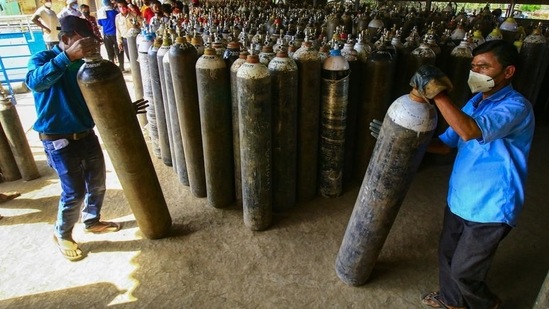
According to officials, at least 24 hospitals reached out to the control room set up by the Delhi Disaster Management Authority, which began functioning on Friday to coordinate urgent oxygen supply delivery and routing. The problem, which first began on Tuesday, has remained acute despite the Union government announcing enhancements in the city’s daily oxygen dispatches on Wednesday.
The Delhi government-run Rajiv Gandhi Superspeciality hospital in Tahirpur, which faced supply problems for the past two days, on Friday reduced the number of beds from 500 to 350. The DDMA control room had allocated the hospital a quota of 6,000 cubic metres of oxygen. With almost all its beds full, the hospital was using up 8,000-9,000 cubic metres of oxygen.
“For the last two days, the oxygen reached us just minutes before we would have dipped into our reserves. Now, the government has allocated us a quota of 6,000 cubic metres which will not be enough to manage all the 500 beds because all are beds are like ICU and use up a lot of oxygen. So, we have reduced the number of beds,” said a senior doctor from the hospital, asking not to be named.
A second doctor confirmed the situation, saying: “Over the last two days we stopped new admissions and have been discharging stable patients to reduce the numbers.”
{{/usCountry}}A second doctor confirmed the situation, saying: “Over the last two days we stopped new admissions and have been discharging stable patients to reduce the numbers.”
{{/usCountry}}In addition to reaching out to the DDMA control room, several hospitals sent SOS messages to government officials, health minister and on Twitter.
Chief minister Arvind Kejriwal raised the issue in his meeting with the PM. “People in major pain due to oxygen shortage. We fear a big tragedy may happen due to oxygen shortage and we will never be able to forgive ourselves. Despite being a CM, I am not able to help the people of Delhi. I request you with folded hands to direct all CMs to ensure smooth movement of oxygen tankers coming to Delhi,” he said during the meeting.
In the morning, an official at Sir Ganga Ram said 25 of the “sickest” Covid-19 patients had died in the last 24 hours, and the lives of another 60 were at risk due to the oxygen supply, before the head of the hospital issued a statement to say the fatalities were not due to the shortage.
“The staff strength of the control room is 10 for an eight-hour shift. The control room has been entrusted with ensuring the quickest supply from sources within the city. Till 6pm, we received 24 calls from hospitals in the city which told us that their oxygen stock would not last for two hours. All distress calls were resolved,” said a senior government official who did not wish to be identified.
In Max and Max Smart hospitals in Saket, officials said Friday was a tense day with stocks running precariously low at least thrice, with emergency replenishments arriving in the nick of time.
The hospital raised the first SOS around the same time as Sir Ganga Ram hospital in the morning. While Sir Ganga Ram Hospital received 2,000 cubic metres of oxygen, both the Max hospitals together received 2,000 cubic metres. The hospitals had over 700 patients, of which 550 were Covid-19 patients.
Both Max hospitals and Sir Ganga Ram ran short of oxygen again at night, before receiving replenishments with minutes to spare.
“The hospitals started running low on oxygen and the doctors were on the edge again in the afternoon. And, then again now,” said a Sir Ganga Ram hospital staffer at around 9 pm. The hospital in the morning had decided to stop admissions across its centres in Delhi-NCR, but then rescinded the order.
Batra hospital in Tughlakabad Institutional Area too reported a tense day, and approached the Delhi high court in the morning. After an SOS message, the hospital received an emergency supply of 700 litres of oxygen as their tanks were about to run dry at 02:30 pm. One-and-a-half hours later, the hospital received another tanker of oxygen, which was first meant to deliver oxygen at 10pm the previous night.
“They were supposed to give us 4,000 litres of oxygen but they gave us only 1,700 litres. We need around 7,000 litres of oxygen a day. And, in the last 30 hours we have received only received 1,000 litres of oxygen,” said Dr SCL Gupta, medical director of the hospital. “We had to cancel all non-emergency surgeries. A patient had travelled here from Kashmir for a heart surgery that is extremely important; we had to send him back,” he said.
By night, the hospital was again running low on stock. The Delhi HC asked hospitals and nursing homes to first approach the nodal officer at the control room.
Holy Family hospital, which had to raise an alarm on Thursday, sought help on Friday morning as well after which it received an emergency 500 litre of oxygen. “All our staff was waiting in the ICU with bated breaths looking at the oxygen monitor to see whether the levels were running low, whether they had to take over. We had also put the oxygen cylinders in the manifold room so that it could take over if the oxygen ran out. But, with the unprecedented use of oxygen, we did not know how long these could run,” said Dr Sumit Ray, medical superintendent of the hospital.
For the second day in a row, Aakash hospital too had to raise an alarm. The hospital received 14-hours of supply 2.5 hours after they ran out. “We have been managing with cylinders we have; getting them refilled and using them again,” the hospital spokesperson said.
The situation was more serious for Indian Spinal Injury Centre, which has at least 100 beds on oxygen cylinders, which they ran out of. “We managed to get 18 cylinders through our contacts. Now, we are moving more of our patients to the central gas pipeline run by the liquid medical oxygen where we have stock till morning,” said Jasleen Kaur, the hospital’s head of marketing and communications.
Late on Friday, Jaipur Golden hospital issued an SOS on social media saying it had run out of oxygen and switched to oxygen cylinders that the hospital estimated would last for 30 minutes. The hospital has received news that a tanker was being diverted from BSA hospital.
After receiving almost no oxygen in 24 hours, officials at Metro hospital in Preet Vihar said they were thinking of discharging patients. “We have been running using refilled cylinder so far. We are waiting to hear from our oxygen supplier, if we do not hear from them soon we will have to ask the patients to look for beds elsewhere,” said a senior official from the hospital, asking not to be named.
Stay updated with all top Cities including, Bengaluru, Delhi, Mumbai and more across India. Stay informed on the latest happenings in World News along with Delhi Election 2025 and Delhi Election Result 2025 Live, New Delhi Election Result Live, Kalkaji Election Result Live at Hindustan Times.
Stay updated with all top Cities including, Bengaluru, Delhi, Mumbai and more across India. Stay informed on the latest happenings in World News along with Delhi Election 2025 and Delhi Election Result 2025 Live, New Delhi Election Result Live, Kalkaji Election Result Live at Hindustan Times.