Delhi is a city written in footsteps—of emperors and exiles, revolutionaries and refugees. Every bylane is a verse from a forgotten poem, and every intersection, a story to explore.
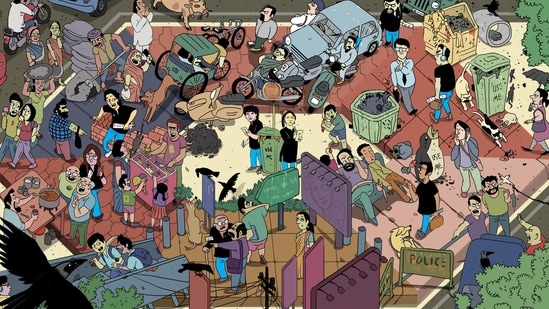
And once, it welcomed you to walk.
Avdesh Kumar, now joint proctor at Delhi University, remembers the magic of those walks in the 1990s. Every evening, he and a friend would stroll back from college, watching the sun cast golden hues over the streets before slipping into dusk. “If a bus
Delhi is a city written in footsteps—of emperors and exiles, revolutionaries and refugees. Every bylane is a verse from a forgotten poem, and every intersection, a story to explore.
And once, it welcomed you to walk.
Avdesh Kumar, now joint proctor at Delhi University, remembers the magic of those walks in the 1990s. Every evening, he and a friend would stroll back from college, watching the sun cast golden hues over the streets before slipping into dusk. “If a bus didn’t come, we’d just walk one or two kilometres to the next stop. It felt effortless and gave us time to laugh, talk, and feel the city,” he said.
Writer Rakshanda Jalil recalls cycling to school through the hush of the morning, with trees forming green canopies and monkeys darting out from the Ridge. “There was greenery on all sides. It was a comfortable walk,” she said. “Even though Delhi has never been fully friendly to women, there was a certain ease then. We all looked over our shoulders, but walking still felt natural.”
Through the 1950s to the 1990s, walking wasn’t just a means of travel in Delhi—it was a way of life. Neighborhoods like Karol Bagh, Lajpat Nagar, and Kamla Nagar were built with mixed land use in mind—homes nestled next to markets, parks within walking distance, and DTC bus stops around the corner. Government colonies such as RK Puram and Defence Colony had tree-lined paths, pedestrian underpasses, and green buffers that separated footpaths from fast-moving roads.
Vandana Menon, a resident of Siddhartha Extension, remembers walking to New Friends Colony. “There was space—no encroachments, no cars parked all over. Walking was a joy. Later, I also loved walking from Bharti Vidya Bhawan on KG Marg to the UPSC chatwala. Lots of people walked there—it was part of the rhythm of the city,” she said.
But starting in the late 1980s and into the 1990s, the car population exploded. Flyovers, expressways, and ring roads replaced shaded boulevards. And slowly, the city stopped making room for the walker.
Now, in this Capital of contrasts, just walking is a gamble with life.
The grandeur of Mughal boulevards and the colonial order of Lutyens’ design now stand in sharp contrast to broken pavements, encroached sidewalks, and high-speed urban chaos. In the rush to become a global metropolis, Delhi has left its walkers behind.
The Supreme Court recently reiterated a truth Delhiites know all too well but rarely see honoured on the ground: the right to walk is fundamental, guaranteed under Article 21 of the Constitution—the right to life. But for millions in this city, it’s a right exercised with hesitation, fear, and far too often, injury.
Despite its reputation for having some of the best road infrastructure in the country, Delhi has failed to provide safe and accessible footpaths.
The numbers paint a grim picture.
According to Delhi Police data, pedestrians form 43% of road crash fatalities. The number of pedestrians injured in crashes increased from 1,777 in 2022 to 1,941 in 2023—a steady rise that underscores a city at war with its most basic form of movement.
Every day, millions take to the streets not in cars but on foot, traversing chaotic intersections, jumping over construction debris, sidestepping hawkers, and squeezing between vehicles.
Historian and former chairperson of the Centre for Historical Studies at the Jawaharlal Nehru University (JNU), Mridula Mukherjee, who has lived her entire life in Lajpat Nagar, recalls a city once built for walkers.
“Even as kids, we walked across the road to Defence Colony all the time—whether to meet friends or to shop. Within the colony, children played on the streets all day. Now it’s unimaginable to even think of walking. The wide roads are choked with vehicles all day,” she said.
To test the infrastructure on the ground, the HT team walked a 550-metre stretch in Lajpat Nagar, from Lal Sai Market to PGDAV College. Though part of Delhi government’s “streetscaping” project that promised “European-style public plazas,” the reality was far from it.
The footpath was too high in places, obstructed by garbage elsewhere, and abruptly severed by a large power unit. A faded zebra crossing marked an unsafe passage across Ring Road, which led directly into a fenced green space, blocking any exit.
Ask Sunita Sharma, a 56-year-old homemaker in Karol Bagh, and she’ll take you back to a more walkable Delhi of the 1980s.
“You could walk from Patel Nagar to Connaught Place without stepping onto the road. Footpaths were continuous and smooth. Now, it’s like an obstacle course. Between scooters on the sidewalk and garbage piles, I prefer a rickshaw—even for short distances,” she recalled.
Ironically, Karol Bagh itself was ground zero to Delhi’s flagship pedestrian push.
In 2016, Ajmal Khan Road in Karol Bagh was declared vehicle-free as part of a Union ministry of housing and urban affairs (MoHUA) project to curb congestion and pollution. The 1.7 km stretch was to be turned into a so-called “open-air mall”, completely devoid of motorised traffic. But within months, cars and two-wheelers returned, parking brazenly on pedestrian paths. The plan failed before it could walk.
In Saket, one of Delhi’s most affluent neighbourhoods, pedestrians fare no better.
Manisha Luthra, a teacher at a private school, describes the ordeal. “There are footpaths, but they are either too narrow, broken or dug up. Outside Select Citywalk mall, the path is smooth. But go a hundred meters in any direction, and you’re on your own.”
Ajay Sahai Jasra, a member of the Press Enclave RWA, said that they have made multiple complaints about footpaths in the past few years, but pedestrians remain unsafe. “Footpaths in our area are either broken, encroached upon by vendors, or have shopkeepers spilling onto them with hoardings or parked vehicles. Walking is a daily hazard,” he said.
The HT team walked a little more than a kilometre along Africa Avenue, a key road in south Delhi with residential and commercial buildings. Though there is a well-marked service lane and a dedicated sidewalk, every inch of the footpath was either occupied by parked cars or roped off with chairs and barriers to prevent parking—forcing pedestrians onto the road.
Then another walk, along a 1.2-kilometre stretch from Ashram metro station to New Friends Colony, offered mixed results. While some sections were walkable, other sections were only navigable by able-bodied pedestrians. At one spot, a stone fence consumed the entire footpath. At crossings, slopes were missing, wires jutted out, and the constant flow of traffic made passage dangerous.
Similarly, a walk from Kashmere Gate metro to Chandni Chowk—barely 1.85 kilometres—took over 35 minutes. At the start, near the metro station, there was no footpath – just a loose corridor of rickshaws carving out pedestrian space. Streetlights didn’t work. Motorcycles were parked across the pavements. Construction debris and dangling wires narrowed the way.
This isn’t a story of central Delhi alone. From Okhla to Rohini, Seelampur to Dwarka, the pattern repeats.
Either there are no footpaths, or what exists is hijacked—by parked vehicles, temporary shops, construction debris, or even government infrastructure like utility poles.
In areas like Azadpur, hawkers occupy every inch of the sidewalk, again forcing pedestrians onto the busy street buzzing with speeding commercial vehicle. In parts of East Delhi, drainage work has obliterated footpaths for months.
Even where sidewalks exist, they often exclude the elderly, disabled, and parents with strollers.
But there are some exceptions.
The New Delhi Municipal Council (NDMC) zone—which covers Connaught Place, parts of Lutyens’ Delhi, and select central government areas—features relatively well-maintained sidewalks, street furniture, and crossings. But the NDMC spans only a sliver of Delhi’s 1,484 square kilometres, catering largely to bureaucrats and politicians who commute by private vehicles, rarely stepping out on foot.
Elsewhere, maintenance is shared between 14 different agencies: the Delhi Development Authority (DDA), the Public Works Department (PWD), the Municipal Corporation of Delhi (MCD), traffic police, and others.
This jurisdictional maze ensures no one is fully held accountable.
DDA recently announced an overhaul of pedestrian infrastructure in Dwarka, promising IRC-compliant footpaths, solar lights, and barrier-free design.
DDA recently announced an ambitious plan to overhaul pedestrian infrastructure in Dwarka, promising footpaths, solar lighting, and barrier-free design, based on standards set by the Indian Roads Congress (IRC). But residents know better than to trust such claims.
“Storms last month uprooted trees and caused cave-ins. Many of the fallen trees still lie by the road. No repair work has begun,” says Pawan Mehta, a resident of Dwarka Sector 4.
A 2023 report by the road-owning agency PWD itself revealed that 44% of Delhi’s roads lack pedestrian pathways altogether, and only 26% of those that exist meet the standards set by IRC.
As per IRC:103-2012 guidelines, footpaths should be at least 1.8 metre wide to allow for two wheelchairs to pass each other. Surfaces are mandated to be continuous, non-slippery, and free from any encroachment. Ideally, they should be at-grade with property entrances and have tactile paving for the visually impaired. Ramps with gentle slopes should be provided at all crossings to ensure universal accessibility.
Based on HT’s walk tests, not a single street in the city was complying with all of these norms.
What experts say
Urban mobility expert Sarika Panda Bhatt, co-founder of the Raahgiri Foundation, believes Delhi’s problem isn’t one of money or space—but intent.
“There’s no lack of funds or space in most parts of Delhi. The issue is that pedestrians are at the bottom of the planning hierarchy. Roads are widened for cars, flyovers are built for speed, but pedestrians and cyclists who actually form the majority on roads, are ignored. A well-designed footpath with greenery, seating, and continuity not only ensures safety but also encourages walking, reduces pollution, and makes the city liveable,” she said.
Traffic safety expert Geetam Tiwari, who leads the Transportation Research and Injury Prevention Centre at IIT-Delhi, believes rethinking road design could save lives.
“You can’t have 60 km/h zones near residential areas or schools. If we redesign intersections, reduce corner radii, and give priority to pedestrians at crossings, safety will improve drastically.”
She also points to “Vision Zero”—an urban design philosophy that aims at zero traffic deaths by designing forgiving infrastructure—is gaining traction globally. Delhi also needs to have the political and bureaucratic will to design better infrastructure, including good footpaths, she added.
Legal interventions like the Supreme Court’s order are welcome, but without implementation, little will change. There is also a deeper cultural shift needed.
“We associate walking with poverty,” says OP Agarwal, distinguished fellow at NITI Aayog and former CEO of WRI India. “Policy is shaped by those who drive. Cars are aspirational. Walking is what you do if you have no choice. That mindset filters into how our roads are designed.”
But in an age of climate crisis and urban health emergencies, walking is no longer a fallback—it’s a necessity. Studies globally have shown that walkable neighbourhoods lead to lower carbon emissions, improved public health, and stronger social ties.
One Subscription.
Get 360° coverage—from daily headlines
to 100 year archives.
Archives
HT App & Website
Stay updated with all top Cities including, Bengaluru, Delhi, Mumbai and more across India. Stay informed on the latest happenings in World News along with Delhi Election 2025 and Delhi Election Result 2025 Live, New Delhi Election Result Live, Kalkaji Election Result Live at Hindustan Times.
Stay updated with all top Cities including, Bengaluru, Delhi, Mumbai and more across India. Stay informed on the latest happenings in World News along with Delhi Election 2025 and Delhi Election Result 2025 Live, New Delhi Election Result Live, Kalkaji Election Result Live at Hindustan Times.