E-Paper



Canal repair done but supply remains affected in parts of Delhi
Repair work at Munak Canal completed after 40 hours, but water supply still affected in areas like Dwarka. Haryana released water to Delhi after canal breach.


Officials from the Delhi Jal Board on Saturday said the repair work at Munak Canal was completed around Friday midnight after about 40 hours of non-stop work. However, supply remained affected in some areas, including Dwarka, Palam, Matiala, Sadh Nagar, Ranhola, and Madhu Vihar, among others.
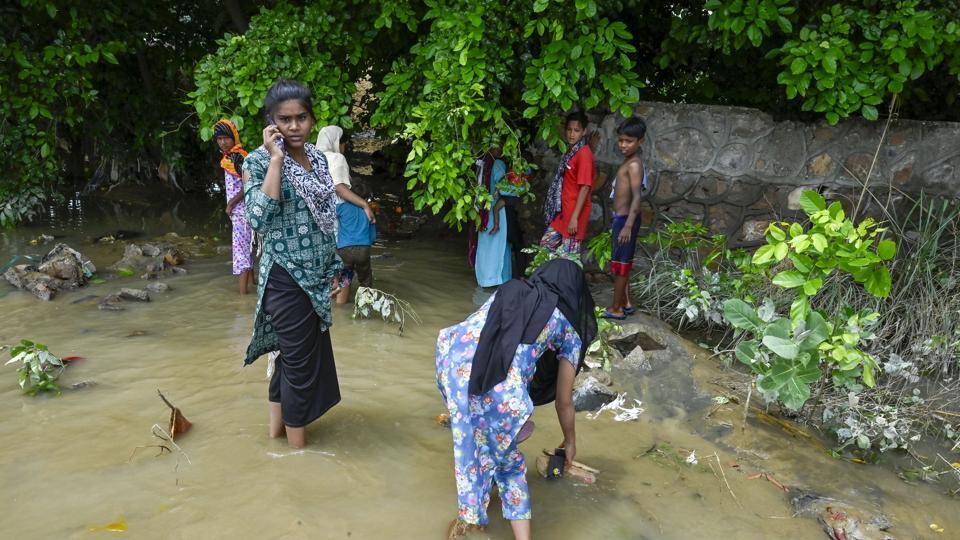
Water minister Atishi said that Haryana released water from the Kakroi head around 11am on Friday, reaching Delhi by afternoon. It takes about four to five hours for the water Haryana releases to reach Delhi. Following a sudden breach at the carrier-lined canal (CLC) branch of the Munak canal late on Wednesday night, several blocks of the JJ colony in Bawana were flooded in waist-deep water.
“The repair work, including reinforcement, concreting, etc., was completed by midnight on July 12. Since a minimum of eight hours was required for curing, the Haryana irrigation department conducted a fitness test at the site on Saturday morning after the curing period and released water from the Kakroi regulator (40km above the Delhi border) at 11am. The scheduled water supply in the command areas of the Dwarka plant will commence from Sunday morning smoothly,” said a DJB spokesperson.
Supply remained affected for the second consecutive day with around 100 million gallons per day (mgd) less water production. While DJB did not officially release its daily summer bulletin on water production on Saturday, an official said about 898mgd was produced in Delhi — marginally higher than the season’s lowest production of 888mgd on June 21. The shortage was due to lower production at the Haiderpur, Nangloi and Dwarka plants, affected by the CLC breach.
Residents said there was no update from authorities. “We knew that there will be supply issue but there was no update... we kept waiting for the supply to resume even by evening. The helplines don’t work and nobody responds to contact numbers given online,” said Alakshendra Mishra, a resident of Dwarka Sector 8.
DJB’s statement added that along with the canal repair, pending work of shifting of 200mm air valve along the Dwarka raw water line was also started at the site on Friday by the National Highways Authority of India for the completion of the Urban Extension Road II. “Pumps were deployed to empty the twin 1500mm water pipeline. Thereafter, shifting of air valves and all related work was also completed by NHAI by Saturday morning,” the DJB spokesperson added.
The canal accounts for about a third of Delhi’s water supply through four water plants, and its breakdown slashed the supply in large parts of northwest and southwest Delhi, especially Dwarka, Palam and its surroundings.
CLC supplies around 500 cusecs of water every day to Delhi. The breach resulted in the closure of operations at the Dwarka water treatment plant. Officials added that the water released by Haryana reached Delhi by late afternoon and the operation of the Dwarka WTP was restored by evening.