
 E-Paper



CAQM defers ELV fuel ban to Nov 1, expands it to NCR
The decision comes just a week after the directive took effect, following strong objections from the Delhi government over apparent technical challenges and legal inconsistencies.

 Prefer HTon Google


The Commission for Air Quality Management (CAQM) in National Capital Region and Adjoining Areas on Tuesday amended its order banning the refuelling of end-of-life vehicles (ELVs) in Delhi, deferring its implementation to November 1. The decision comes just a week after the directive took effect, following strong objections from the Delhi government over apparent technical challenges and legal inconsistencies.
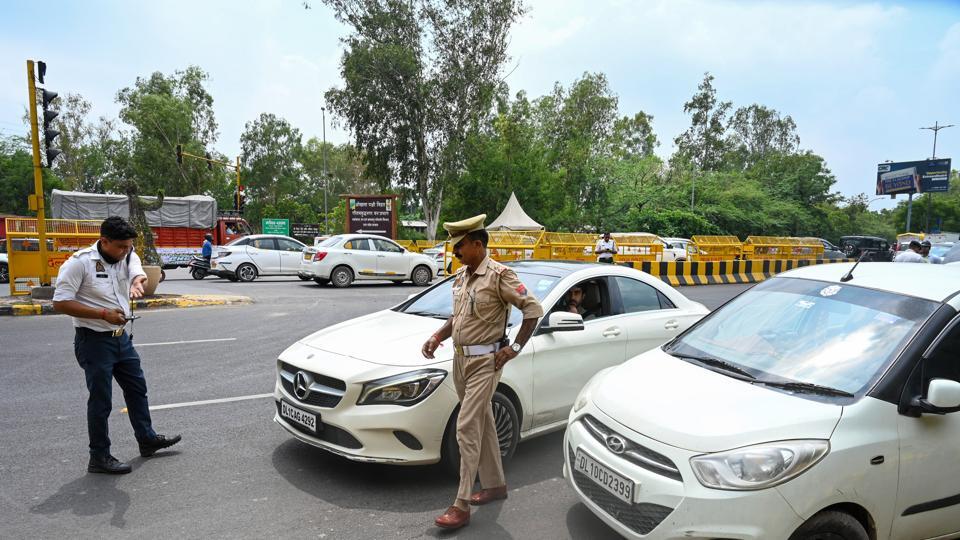
The fuel ban—initially enforced in Delhi alone—will now be rolled out simultaneously in five other high-vehicle-density NCR districts: Gurugram, Faridabad, Ghaziabad, Gautam Budh Nagar, and Sonipat. The rest of NCR will follow from April 1, 2026.
The changes were made during CAQM’s 24th general meeting with representatives of all NCR states in attendance.
The reversal came after the Delhi government last week requested the direction be put on hold, citing operational difficulties in enforcement and lack of coordination among NCR states.
In its revised order, CAQM acknowledged “technical glitches” in Delhi’s Automated Number Plate Recognition (ANPR) system, including sensor failures, poor camera placement, and integration issues with vehicle databases across NCR.
“[The Delhi government] … has brought to the attention of the commission some operational and infrastructural challenges … stating that while it is fully aligned with the commission’s objective to phase out older, polluting vehicles… the ANPR system lacks the requisite robustness, with issues related to technological glitches, camera placement, working of sensors and speakers, and that the system is not yet fully integrated with the database of NCR states,” CAQM said in a statement on Tuesday.
It added that Delhi officials had argued that restricting the ban to the city would simply push fuel purchases across the border into neighbouring towns, undermining the measure’s intent.
“The commission, in view of the concerns raised by Delhi government, and after detailed deliberation of all issues raised … has decided to partially amend [the direction],” the statement said.
CAQM also said that the Delhi chief secretary flagged legal ambiguities in enforcing ELV thresholds locally while identical vehicles remain legal in the rest of the nation, calling it a violation of equitable treatment under the Motor Vehicles Act, 1988. The chief secretary in his letter also questioned the criteria for defining ELVs, stating aspects such as vehicle fitness, actual emission performance, or usage were not being considered, adding this was adding to the hardship of the middle class.
However, CAQM reiterated that ELVs—diesel vehicles older than 10 years and petrol ones older than 15—remain illegal in Delhi-NCR under National Green Tribunal (NGT) and Supreme Court orders. “It is pertinent to mention that while ELVs are deregistered… and they cease to have any legal sanctity… and must be impounded once identified, regardless of detection method,” the commission said.
The Delhi government, which welcomed the extension, also plans to approach the Supreme Court to seek a review of the age-based ELV ban, chief minister Rekha Gupta had said on Sunday. The government has argued that scrappage should be linked to actual emissions, not arbitrary age limits.
Gupta, speaking Sunday, criticised the one-city rollout. “Delhi cannot have different ELV rules than the rest of the country,” she said.
Delhi environment minister Manjinder Singh Sirsa echoed the position, saying that the extension will provide a big relief to Delhi residents.
“We are glad CAQM has understood the ground realities. The relief till November will allow us time to push for a more rational emissions-based policy. We will also approach the SC and NGT with data and studies to support our case. The 80,000 vehicles scrapped under the AAP regime were done without a scrapping unit in Delhi. We will investigate where they were scrapped and expose any scam.”
CAQM’s original directive had seen patchy enforcement.
On day one, ANPR cameras flagged 98 ELVs; 80 were impounded. But the momentum fizzled—only seven were seized the next day, and none thereafter.
The revised timeline was also welcomed by fuel dealers. Nishchal Singhania, president of the Delhi Petrol Dealers Association, said, “This buys us time to fix technical issues, prepare citizens, and ensure uniform enforcement across NCR. Otherwise, fuel sales in Delhi would’ve suffered, with people refuelling across the border.”
The decision also sparked political sparring.
Aam Aadmi Party (AAP) leader Atishi accused the BJP-led Delhi government of staging a drama. “Writing to CAQM—another BJP-controlled body—was just theatrics. If the BJP is serious, let them pass a law protecting 10-year-old vehicles. We’ll support it. Else it proves their nexus with scrappers and vehicle dealers,” she said.
Delhi BJP president Virender Sachdeva hit back: “Atishi and Kejriwal sat on this issue for a decade. Their failure to challenge the NGT ban forced us to act. Calling our SC appeal a ‘drama’ only shows the AAP’s anarchic mindset.”
The Motor Vehicles Act, which governs vehicle scrappage norms, allows for exemptions based on roadworthiness and emissions. Delhi’s current blanket ban on older vehicles—regardless of condition—has been criticised by experts as unfair to the middle class, especially when other cities allow such vehicles with fitness certificates.
[MAYBE ADD EXPERT COMMENT?]



Stay updated with all top Cities including, Bengaluru, Delhi, Mumbai and more across India. Stay informed on the latest happenings in World News along with Delhi Election 2025 and Delhi Election Result 2025 Live, New Delhi Election Result Live, Kalkaji Election Result Live at Hindustan Times.


