
 E-Paper



Centre's panel submits report defining Aravalli Hills, seeks curbs on new mining leases
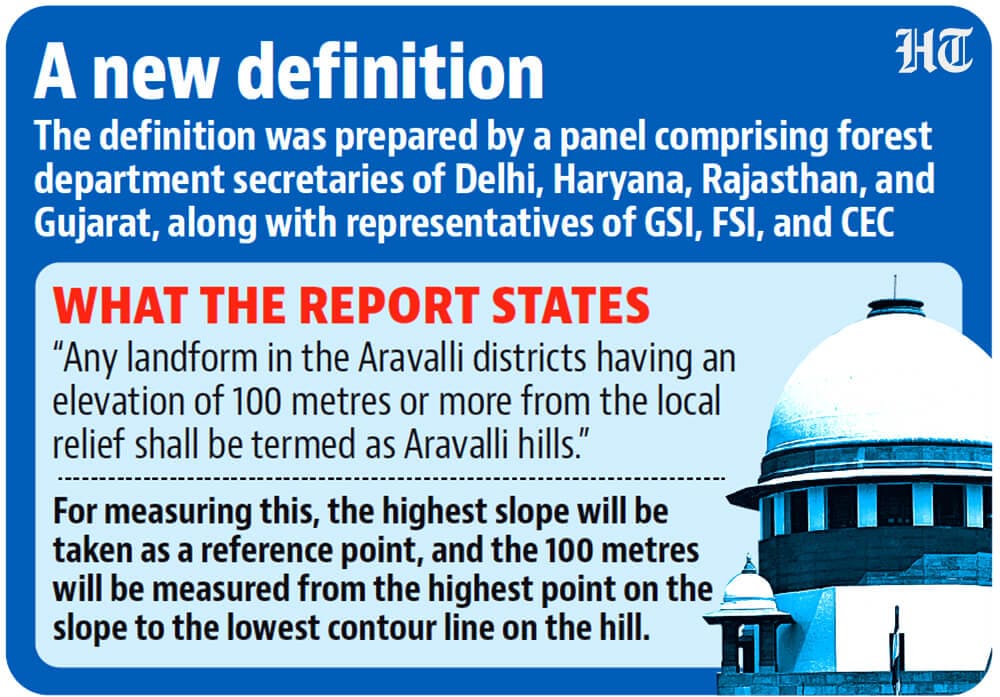
The report states “any landform in the Aravalli districts having an elevation of 100 metres or more from the local relief shall be termed as Aravalli Hills.”

 Prefer HTon Google


More than a year after the Supreme Court entrusted the Centre with the task of defining the Aravalli Hills and Ranges to curb illegal mining, a high-level committee headed by the Union environment secretary has submitted its report to the court, proposing that any slope with a height of more than 100 metres, measured from the top, will qualify as Aravalli hills.
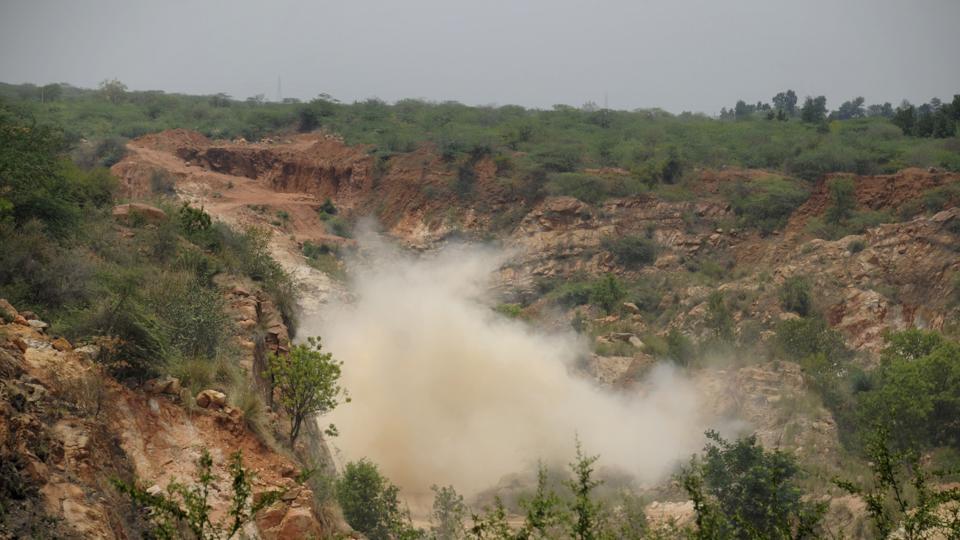
The report — the first such exercise to lay down a uniform definition for the Aravalli Hills — further recommends that to ensure sustainable mining in the Aravalli Hills and Ranges, no new mining lease, except in the case of critical, strategic, and atomic minerals, should be allowed.
A bench of Chief Justice of India (CJI) Bhushan R. Gavai and Justice K. Vinod Chandran agreed to consider the report on November 11 and take up objections raised by states to its recommendations.
The new definition has been prepared by an eight-member committee comprising forest department secretaries of Delhi, Haryana, Rajasthan, and Gujarat, along with representatives of the Geological Survey of India (GSI), Forest Survey of India (FSI), and the Central Empowered Committee (CEC), which assists the court on forest and environment issues.
The report states: “Any landform in the Aravalli districts having an elevation of 100 metres or more from the local relief shall be termed as Aravalli Hills.” For measuring this, the highest slope will be taken as a reference point, and the 100 metres will be measured from the highest point on the slope to the lowest contour line on the hill.
“The entire landform lying within the area enclosed by such lowest contour, whether actual or notionally extended, together with the hill, its supporting slopes, and associated landforms irrespective of their gradient, shall be deemed to constitute part of the Aravalli Hills,” it adds.
The committee further defined the Aravalli Range as “two or more Aravalli Hills located within a proximity of 500 metres from each other, measured from the outermost point on the boundary of the lowest contour line on the two hills.”
The report requires the concerned states to demarcate the Aravalli Hills and Ranges based on these criteria, with assistance from the Survey of India (SOI).
After marking the extent of the Aravalli Ranges, the committee recommended that to ensure “sustainable mining”, no new mining leases — except for critical, strategic, and atomic minerals — be allowed within the designated Aravalli Hills and Ranges. It further proposed that core or inviolate areas be identified within these ranges where mining should be completely prohibited.
The committee said the mountain system plays a vital role in maintaining the environmental stability of northwestern India. The Aravallis, among the oldest fold mountain ranges in the world, originated more than 2.5 billion years ago during the Precambrian era. The report described them as geologically stable, deeply eroded, and shaped over millennia by natural processes rather than ongoing tectonic activity.
It also recommended that state governments adopt environmental safeguards and regulatory measures for existing mining leases.
Senior advocate K. Parmeshwar, assisting the court as amicus curiae, informed the bench that Rajasthan and Delhi have supported the committee’s new definition of the Aravalli Ranges, while Haryana has raised objections. “Haryana does not agree with the new definition. Going by the same, more mining will take place in Rajasthan. The state wants that instead of height criteria, the age of rocks should be considered,” he told the court.
The Haryana government said it would like to present its response to the report. The amicus added that Rajasthan has already auctioned mining leases and is seeking renewal of 124 leases, even as mining remains suspended in the Aravalli Hills and Ranges.
On May 9, 2024, the Supreme Court had directed the Centre to frame a uniform definition for the Aravalli Hills within two months. The deadline was extended several times, with the last extension granted on August 12, along with a warning that failure to submit the report would invite contempt proceedings against the committee members. The report was finally submitted on October 13.
The bench was informed that the lack of a uniform definition had contributed to the depletion of the hills. Some states defined a no-mining zone as 100 metres from the Aravalli slopes, while Rajasthan banned mining on isolated hills up to a height of 100 metres. Haryana, however, had no definition in place.
The Supreme Court had first banned mining in the entire Aravalli region in 2002. Yet, the FSI’s 2018 report documented rampant illegal mining, pointing to the disappearance of 31 hillocks across over 3,000 sites in Rajasthan and Haryana. Both the Central Empowered Committee (CEC) and the FSI have endorsed the view that the definition of the Aravalli Hills should include the hills themselves along with a uniform 100-metre-wide buffer zone in the downslope areas.

Stay updated with all top Cities including, Bengaluru, Delhi, Mumbai and more across India. Stay informed on the latest happenings in World News along with Delhi Election 2025 and Delhi Election Result 2025 Live, New Delhi Election Result Live, Kalkaji Election Result Live at Hindustan Times.


