
 E-Paper



Centre to soon declare winners of country’s highest science award
The Centre is likely to announce country’s highest science award, Shanti Swarup Bhatnagar (SSB) Prize for Science and Technology 2022, by this weekend or early next, said people familiar with the matter, adding that the government was also considering instituting its own Nobel Prize like award — Vigyan Ratna — for scientists from all science disciplines


The Centre is likely to announce country’s highest science award, Shanti Swarup Bhatnagar (SSB) Prize for Science and Technology 2022, by this weekend or early next, said people familiar with the matter, adding that the government was also considering instituting its own Nobel Prize like award — Vigyan Ratna — for scientists from all science disciplines.
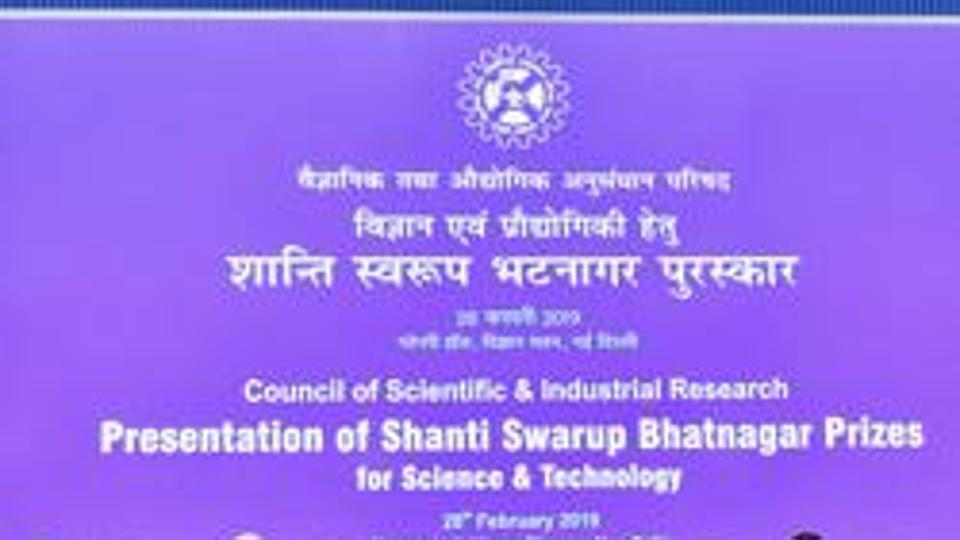
“The SSB award is among the top science honours in the country, and should be announced either over the weekend or latest by early next week,” said a senior central government official, requesting anonymity.
This year, Council for Scientific and Industrial Research (CSIR) is celebrating eight decades of its foundation day, falling on September 26.
In a press release issued on Monday, ministry of science and technology said that CSIR will have a celebration of eight decades of its foundation soon with several commemorative activities and prizes to be announced.
“The award announcement is usually made on CSIR’s foundation day but this year due to unavoidable circumstances, the announcement was delayed. In a few days the events will be celebrated and names should be out,” added the person.
However, the contours of the award are likely to be changed with the government considering either to award a lump sum amount instead of a monthly remuneration to the winner for their entire research work or to put a cap of 15 years.
The award is named after CSIR founder director, Dr Shanti Swarup Bhatnagar, and awarded annually for notable and outstanding research, applied or fundamental, in biological sciences, chemical sciences, earth, atmosphere, ocean and planetary sciences, engineering, mathematical, medical, and physical sciences.
The ministry of home affairs is in the process of transforming government awards and decorations regarding which home secretary, Ajay Kumar Bhalla, held a meeting with representatives of ministry of science and technology, earth sciences, and health and family welfare on September 16.
The home ministry on Friday released minutes of the meeting in which it mentioned that at least 100 awards and several fellowships were being considered for phasing out in the field of science and technology, and a new Nobel-like award to be instituted.
“…one Nobel Prize like award (Vigyan Ratna) could be instituted for scientists in consultation with the Principal Scientific Advisor to Government. This award may be open to all science disciplines...,” the home secretary suggested in the meeting.
A brief presentation of the awards under department of scientific and industrial research was made during the meeting. There department gives away seven awards.
“Shanti Swarup Bhatnagar award is a high stature award and hence, it may be continued. As regards, the monthly remuneration given under Shanti Swarup Bhatnagar award, a proposal for giving lump sum amount in place of monthly remuneration was considered but no final decision was taken. It was also agreed that duration of the monthly remuneration may be capped at 15 years,” read minutes of the meeting, accessed by HT.
About the other six awards, it was suggested either to discontinue them or merge with other awards.
Department of science and technology has currently 211 awards under it, of which four are national awards, 97 private endowments awards, 54 lecture, scholarship, fellowship based awards, and 56 internal awards.
In the meeting it was decided that all private endowments awards will be discontinued. “Department may start a new scheme for scholarship/fellowship with suitable honorarium with full justification and detailed guidelines. The internal awards may be discontinued and wherever required, these awards may be merged in the proposed schemes for scholarship/fellowship..,” read the minutes.
Department of atomic energy gives 25 performance based awards, and 13 non-core domain awards. After a detailed discussion, it was decided to discontinue all the awards and “a new award of very high stature may be instituted for scientists in the field of atomic”.
The three internal awards conferred by ISRO under department of space will also be discontinued, and a national-level award of high stature will be instituted in the field of space science, according to the minutes.
While the National Biotechnology Innovation Award under department of biotechnology has been allowed to continue, the other six fellowships that are categorised as awards currently will be converted into full-fledged fellowships with proper justification and detailed guidelines.
Out of the four awards given my ministry of earth sciences, three awards will be discontinued and one award— Dr. Anna Mani Award for Women Scientist— will be merged with awards given to women by other departments like ministry of women and child development.
Most of the 37 awards from department of health research, under Union health ministry, will also be discontinued, and a new award of high stature in medical field could be instituted.
All departments have been asked to take necessary action as per the decisions taken in the meeting and submitted the report to ministry of home affairs within 10 days. There will be a review meeting soon held by the PMO in this regard, mentioned the home secretary in the meeting.
A section of experts, however, believe that phasing out of government awards may not be a bad idea.
“The government thinking in principle may be right that there are too many awards. Many a time when awards are established these are established with a high aim, but with time they tend to get diluted. Sometimes wrong candidates tend to get selected which is worse than good candidates not getting it. To find truly deserving candidates is a challenge; most of the time a significant number of winners don’t make the grade, and over time the quality of winners gets diluted,” said Dr Avadesha Surolia, senior biologist and professor, Indian Institute of Science.
“Instead of awards, government should ensure timely release of funds for research as most prestigious awards globally aren’t given by governments but philanthropic organisations,” he added.

Stay updated with all top Cities including, Bengaluru, Delhi, Mumbai and more across India. Stay informed on the latest happenings in World News along with Delhi Election 2025 and Delhi Election Result 2025 Live, New Delhi Election Result Live, Kalkaji Election Result Live at Hindustan Times.


