
 E-Paper



Delhi: Complexity stalls push for colony regularisation
MCD's property regularization process in 1,511 unauthorized colonies faces hurdles due to high fees and complex requirements, with a high rejection rate.


Even as the Municipal Corporation of Delhi (MCD) has launched an online portal and issued a standard operating procedure (SOP) for regularising properties in 1,511 unauthorised colonies, officials and stakeholders said the process remains cumbersome.
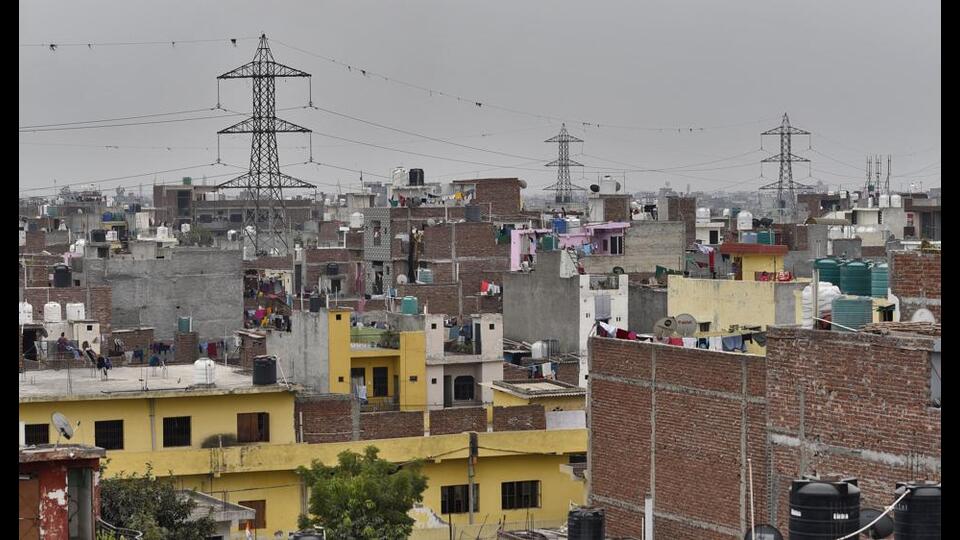
High penal floor area ratio (FAR) charges and extensive documentation requirements, including structural safety certificates, mean applicants must navigate a complex financial and procedural framework, officials said.
A senior government official said properties are being regularised on an “as is, where is” basis, but applications must still meet multiple conditions.
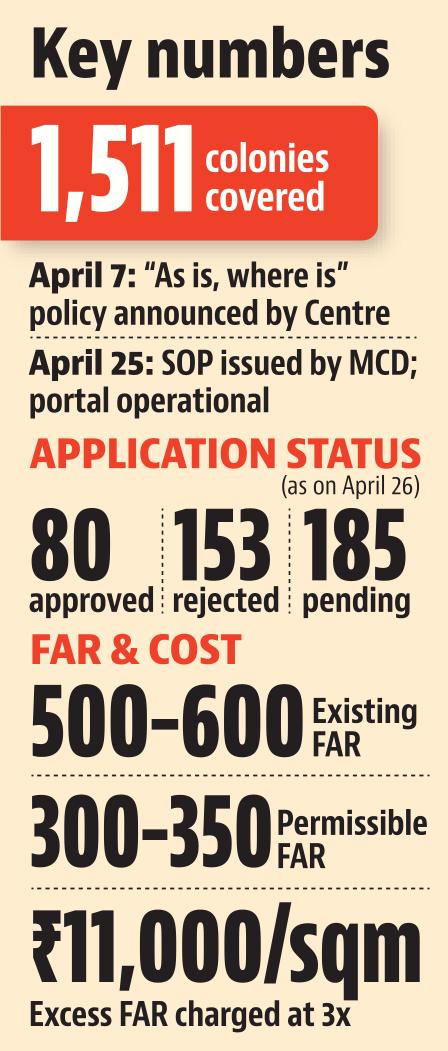
Data from the Swagam portal on April 26 shows that 80 applications have been approved so far, while 153 have been rejected and around 185 remain pending, indicating a high rejection rate. The MCD had been using the portal earlier, but applications from unauthorised colonies have now been integrated into the system.
Under the SOP issued on April 25, applicants can register on the MCD’s Swagam portal by submitting basic details, address and legal documents. After selecting the “Online Building Plan System”, users must choose “Regularization”, enter colony details and the PM-UDAY case ID, following which the system will auto-fetch relevant data.
The MCD mandates that building plans be prepared, signed and stamped by a registered architect, with penal FAR clearly marked. “A structural stability certificate must be issued by an empanelled engineer and endorsed by the owner. Clear photographs of the property showing the overall view must also be uploaded,” the document states.
The Union government on April 7 announced that colonies would be regularised on an “as is where is” basis, with land use deemed residential except for small convenience shops. It added that during redevelopment, land equivalent to 50% of right-of-way deficiency must be surrendered to meet minimum road width norms, and excess FAR will attract penal charges at three times the standard rate.
An MCD official, requesting anonymity, said the policy overlooks ground realities. “There is large-scale commercial activity in unauthorised colonies. The assumption that only small convenience shops exist is incorrect. When 567 colonies were regularised in the 1990s, it was expected that owners would correct deviations and pay penalties, but that did not happen. This may see a similar outcome,” the official said.
A second official flagged the cost burden. “Most buildings have an FAR of 500–600, sometimes higher, while only 300–350 is permitted. Applicants will have to pay three times the additional FAR charges, which is about ₹11,000 per sqm. In the past, there has been clear reluctance to pay such amounts,” the official said, adding that ensuring structural safety of buildings constructed without approved plans will be a major challenge.
Ranbir Singh Solanki of the Madhu Vihar Residents’ Welfare Federation said the charges are unaffordable. “People bought these plots 30-40 years ago for a few hundred rupees per yard. Why should they now pay ₹11,000 per sqm? Many are labourers, domestic workers and daily-wage earners who built these homes with their savings. Meanwhile, others occupy government land and receive free utilities,” he said.
“It will be impossible for many to pay these charges or obtain structural certificates. We have submitted layout plans six times, but the issue resurfaces as an election promise every five years,” he added.
The civic body said a timeline has been set — GIS surveys within seven days, rectification of deficiencies within 15 days, and issuance of conveyance deeds within 45 days. No physical verification will be conducted, as data from the PM-UDAY portal will be automatically integrated. Once regularised, properties can be registered through the National Generic Document Registration System (NGDRS) in coordination with the revenue department.
(MCD response awaited)


Stay updated with all top Cities including, Bengaluru, Delhi, Mumbai and more across India. Stay informed on the latest happenings in World News along with Delhi Election 2025 and Delhi Election Result 2025 Live, New Delhi Election Result Live, Kalkaji Election Result Live at Hindustan Times.


