E-Paper



Delhi cracker ban turns to ashes, violations go undeterred
Officials and residents conceded that firecrackers were burst, while data shared by the Delhi Police suggested there was little enforcement of the ban: there were 23 cases registered relating to the use and sale of firecrackers in the last 24 days.

 Prefer HTon Google


Citizens flouted the Supreme Court-endorsed ban on the use of any firecrackers during Diwali on Monday, according to residents as well as sound and air pollution data from sensors across the Capital, which barely averted a bad air crisis on Tuesday due to a fortuitous turn in the weather.
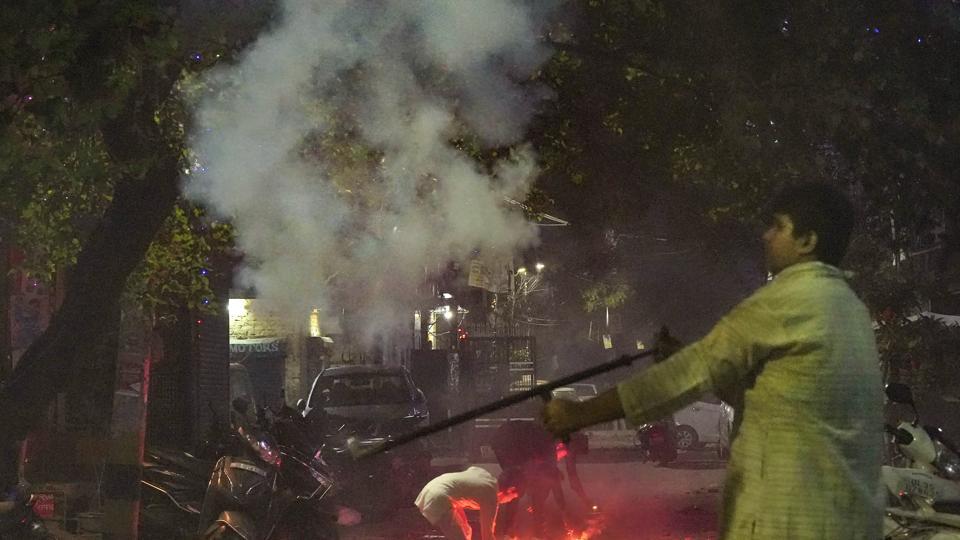
Officials and residents conceded that firecrackers were burst, while data shared by the Delhi Police suggested there was little enforcement of the ban: there were 23 cases registered relating to the use and sale of firecrackers in the last 24 days.
Also Read| Positive signs, but long way to go: Delhi CM on pollution fight after Diwali
The inaction came even as other data sources backed up what was clear for anyone in Delhi to hear: the ban was flagrantly violated. For one, the Delhi Fire Service said that they received 201 calls related to fire incidents on Diwali evening, 49 more than last year.
Two, according to the Delhi Pollution Control Committee’s Delhi Diwali analysis report, densely populated residential areas of Karol Bagh, Lajpat Nagar and Patparganj recorded some of the highest noise readings, with most being noisier than usual evenings.
“The report helps analyse which locations were the loudest and which complied with the noise norms. In most cases, it helps indicate instances of firecrackers being burst and being burst at a large scale,” a Delhi government official said on the DPCC report, asking not to be named.

At Karol Bagh, the hourly average noise level hit 88.2 decibel (db) as 9pm, the highest of any of the stations. At Lajpat Nagar, which recorded the second-highest, this number was 84.8db at 10pm. These were followed by Jahangirpuri (81.8db) and Patparganj (81.5db) – the four cities were the only ones to breach the 80db level.
Prolonged exposure to sounds louder than 80db – which is similar to being exposed to the sound of a vacuum cleaner constantly -- can cause hearing damage. Since these numbers were hourly averages, the peak sound levels are expected to have been higher.
The report said the readings were indicative of firecracker use since the values recorded were higher than normal readings. “Before Diwali day, the range was observed with a maximum value of 71.2 dB(A) at Karol Bagh,” the report said.
Three, the sound levels correlated with pollution readings in areas where data from both sort of sensors were available. At Nehru Nagar in Lajpat Nagar – II, the peak of ultrafine particle pollution (PM2.5) clocked in at 943 microgram per cubic metre (ug/m3) of air, more than 15 times the safe limit of 60ug/m3. For comparison, when winds picked up in the afternoon on Tuesday, this number was at a low of 58ug/m3 at 4pm.
At Patparganj, where readings were not consistently recorded, the peak PM2.5 value was at 789ug/m3. This too plummeted to 85ug/m3 the following afternoon.
“Some crackers went off at night, and though it was less than last year, the complete ban on fireworks was definitely not followed,” said 29-year-old Patparganj resident Anant Chakravarty, who works at a start-up.
Delhi Police spokespersons did not respond to for a comment on the lax imposition of the ban, nor did they reveal specific data on arrests made or FIRs filed on Diwali day for the use of firecrackers. Delhi Police does not come under the Delhi government, and reports to the Union government.
The Delhi government had in September announced a complete ban on the production, sale and use of all types of firecrackers till January 1, 2023, including on Diwali, a practice it has been following for the last two years.
Also Read| Strong winds, lower farm fires help Delhi avert air disaster
The ban has since been backed by the Supreme Court, which has on multiple occasions rejected petitions challenging it, including as recently as earlier this month.
But the continued flouting of the order represents the political and social divide over an issue that also has a strong religious context. Delhi Bharatiya Janata Party (BJP) leader Kapil Mishra appeared to endorse the use of firecrackers, saying on Twitter that the “selective ban against Hindu festivals will never work”, while sharing a video of fireworks dotting the skyline of the national capital. “This will happen whenever unsuccessful governments and judiciary will pin the blame for pollution on children. Happy Diwali. Thank You Delhi,” he said in a tweet.
Experts said the ineffectiveness of the complete firecracker ban represents a challenge for the future, especially since this year’s improvement was mostly due to the weather.
“When the time comes for people to be responsible citizens and be a part of the solution, they don’t do it. Most people who broke the law and burst firecrackers clearly don’t care about their children or the elderly, or even their own quality of life,” said Bharati Chaturvedi, founder and director of Chintan Environmental Research and Action Group, who said the authorities too are “equally responsible”, news agency PTI reported.
Environmentalist Bhavreen Kandhari said the police and the Delhi Pollution Control Committee (DPCC) need to “take action” and “set a precedent” for the future. “There was a ban and many many flouted it, even outrightly challenging the enforcing agencies to take action,” she said, according to PTI.
The AQI reading, as per the 4pm bulletin, eventually turned out to be better on the day after Diwali — a first since the system was started in 2015 — dropping from 312 on Monday to 303 on Tuesday.