
 E-Paper



Delhi govt begins planning for 80km elevated Ring Road redevelopment
The 80km project aims to decongest Delhi’s arterial routes with underpasses, cycle tracks, and Metro integration to cut travel time and emissions.

 Prefer HTon Google


Taking one step closer to executing the ambitious elevated Ring Road project, the Public Works Department has roped in AECOM India Pvt Ltd for undertaking feasibility studies, traffic analysis, and preparing the Detailed Project Report (DPR), Delhi government functionaries have said.
The corridor has also been divided into six phases, including Azadpur Flyover– Hanuman Temple (ISBT) (9.5 km); Chandgi Ram Akhara – Majnu Ka Tilla (2.5 km), Hanuman Temple (ISBT) – DND Flyover (11.5 km), DND Flyover – Moti Bagh Metro Station (10.5 km), Moti Bagh Metro Station – Rajouri Garden (10 km); Rajouri Garden–Pacific Mall (Pitampura)– Azadpur Flyover (13.5 km). The planning work is expected to be completed in 24 weeks, the agency has said, adding that the timelines have been fixed in four monthly cycles.
“To ensure efficiency and targeted intervention, the entire corridor has been divided into six development phases, covering Delhi’s most vital arterial stretches,” a PWD official said.
“Together, these segments will comprehensively address congestion, improve traffic management, and strengthen public mobility across north, south, and central Delhi,” the official added.
PWD minister Parvesh Verma said, “The Mahatma Gandhi Ring Road is not just a transport corridor but it is Delhi’s backbone. Our idea is to make this corridor safer, and faster.”
“This project marks a decisive step toward creating a connected and efficient capital where every citizen benefits from better design and smoother travel. This project will reflect the government’s commitment to modernizing infrastructure through data-driven, environment-conscious planning.”
In June, HT had reported that the Delhi government was considering developing an elevated corridor stretching 80km above the existing Ring Road, at a cost of ₹7,000-8,000 crore, to tackle worsening traffic congestion on the capital’s arterial routes. At the time, experts said such a move could instead create construction chaos and fail to address the root causes of Delhi’s traffic woes that are better addressed by improved public transport.
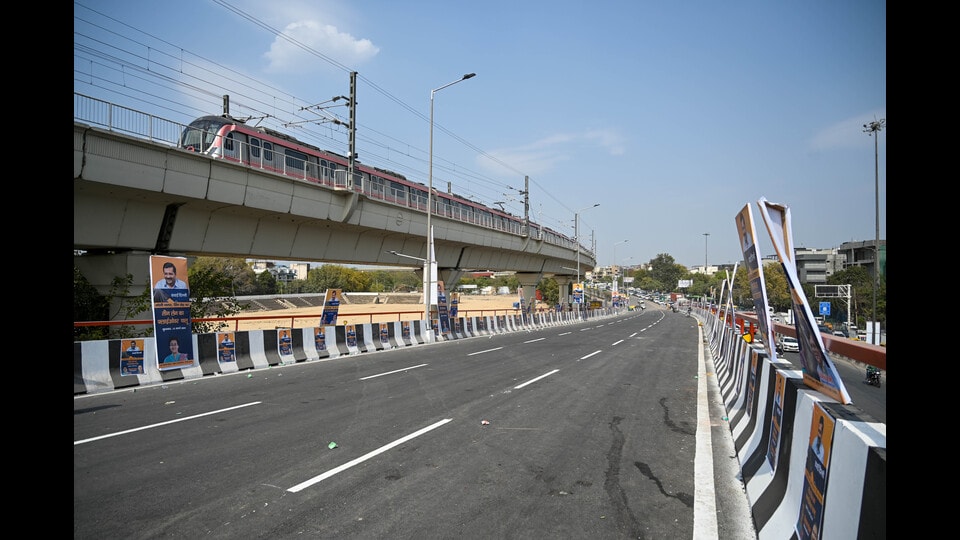
PWD has now said that the redevelopment and modernisation of the Mahatma Gandhi Road Corridor (Ring Road) aims to enhance connectivity, decongest major intersections, and promote sustainable urban transport through elevated corridors over existing ring road.
AECOM is a subsidiary of the global infrastructure consulting firm AECOM, a US-based company, has been tasked to undertaken traffic and mobility pattern analysis across all major intersections and choke points on Ring Road, undertake environmental and social impact assessments, geotechnical and structural investigations and explore innovative engineering solutions, including grade separators, underpasses, pedestrian-friendly zones, and signal optimization on the corridor. “It was also make plans about integration of the corridor with Delhi Metro and public transport networks,” the official quoted above said.
AECOM’s mandate includes preparing a DPR equipped with 3D models, cost estimates, and phase-wise implementation strategies. “As per the agreement with the firm, the first six weeks will focus on preliminary surveys, topographical mapping, and junction/service road assessment; weeks 7–12 on environmental clearance, land acquisition studies, and geotechnical testing; Weeks 13–18 on finalising conceptual design preparation and traffic modeling and last six weeks (week 19–24) on submission of the DPR with financial, and implementation frameworks.
Verma said that the government’s focus is to reduce travel time, fuel consumption, and vehicular emissions while enhancing overall road safety and user experience. The consultancy project will include real-time traffic simulation models, use of green construction materials, dedicated pedestrian and cycle tracks and enhanced safety infrastructure.
“Once completed, the redeveloped Mahatma Gandhi Road corridor is expected to significantly reduce travel time across all stretches, ease congestion at critical intersections such as ISBT, Moti Bagh, and DND; and boost economic activity by improving connectivity between industrial, commercial, and residential zones,” he added.

Chief scientist and head of the traffic engineering and safety division at the Central Road Research Institute (CRRI), S. Velmurugan, had earlier said the concept had merit but required careful engineering. “Historically, the Ring Road was always meant to be an elevated corridor. The decision to build it at grade level, with piecemeal flyovers later, compromised its efficiency.”
He cautioned that construction could create chaos without proper planning. For instance, he said, loops, like the one near AIIMS, “will be difficult as a lot of vertical development has already been done along the Ring Road. Origin destination study of traffic flow is also needed to ensure ramps only at required places”.
“The current alignment serves millions of commuters daily and is lined with hospitals, markets and residential colonies. Without proper diversion routes and traffic management, this project could turn into a nightmare during execution which can take years, considering the scale of the project.”


Stay updated with all top Cities including, Bengaluru, Delhi, Mumbai and more across India. Stay informed on the latest happenings in World News along with Delhi Election 2025 and Delhi Election Result 2025 Live, New Delhi Election Result Live, Kalkaji Election Result Live at Hindustan Times.


