E-Paper



Xiaomi Redmi Note 17 showcases how pragmatism helps find a value sweet spot
When component costs are dictating new smartphones, Xiaomi has found a way to optimise a strong experience from what was available

 Prefer HTon Google


If left unchecked, the smartphone space risks geopolitical uncertainty and the supply chain’s bill of materials dictating what phones will be like for the foreseeable future. Of course, when the accountants start to dictate product roadmaps and specifics, personality is lost. If ever there was a risk of a similar trajectory at Xiaomi India, I’m glad to report that the product’s chosen ones have overruled any such direction changes. Even in a decidedly tough balancing act with thinning margins, Xiaomi has delivered a Redmi Note 17 that runs a fairly new Qualcomm Snapdragon chip, a fair leap to a 8,000mAh battery capacity which is the highest ever for this line, and a large 6.9-inch screen that’s also largest in any Redmi Note phone till date.
Two variants of the Redmi Note 17, that is 6GB+128GB and 8GB+128GB, with prices staring ₹24,999. It is mostly good value, but to be honest, I’d have preferred the option of 256GB storage for the 8GB memory spec—it may be difficult to make do with a potentially fast filling internal storage, after a couple of years. Important to note there is a memory card slot, that is compatible with cards up to 2TB capacity, and that does become relevant. You’ll be using the second SIM slot for a memory card, but that’s a minor tradeoff.
Costs are primarily the reason why Xiaomi has gone with a Snapdragon 4 series chip instead of a Snapdragon 6 series one—the Redmi Note 17 runs the Snapdragon 4 Gen 4 while the Redmi Note 15 that was released at the turn of the year, deployed Qualcomm’s Snapdragon 6 Gen3 chip. Another chip of a similar ilk, would’ve run a real risk of dragging the price tag upwards of ₹30,000—for context, the Redmi Note 15 is still retailing for ₹28,999 onwards. On the Snapdragon 4 Gen 4, the Redmi Note 17 becomes one of the first phones, alongside sibling Poco M8 Power (this also gets dual SIMs and a dedicated microSDXC slot).
Real-world performance will genuinely surprise you. This handles most apps and multitasking with absolute ease. This isn’t the fastest silicon around, but you get more than enough grunt to make things worthwhile. One of the key reasons isn’t exactly the clock speed (that’s where most would immediately look), but what Xiaomi have done to ensure baseline performance is maintained/ the graphite cooling layer, which is now a substantial 10,416mm square, plays its part in keeping the innards cool—a pleasant change from a couple of years of seeing phones heat up at the drop of a hat.
There is 8GB of RAM, and though one could always argue for 12GB instead, the current economic climate simply doesn’t allow for another dent in the margins. And that is where I must point out gaming isn’t the Redmi Note 17’s strongest point and while it doesn’t give up, there will be some balance required in terms of keeping down the visual elements to keep up game smoothness. Even then, some frame drops will be noticeable at times, as the graphics try to keep up.
Another thing Xiaomi has done is something called the Long-Term Fluency Engine, an AI algorithm that defines performance over time. As with anything that is supposed to understand your behaviour, give it some time to understand how app responsiveness and interface smoothness varies in due course. In my tests of the Redmi Note 17, it is unlikely the phone learnt enough about me to fully deploy this. That said, Xiaomi is shipping this with HyperOS 3 on Android 16—and there’s a promise of 4 years of OS updates and 6 years of security patches.
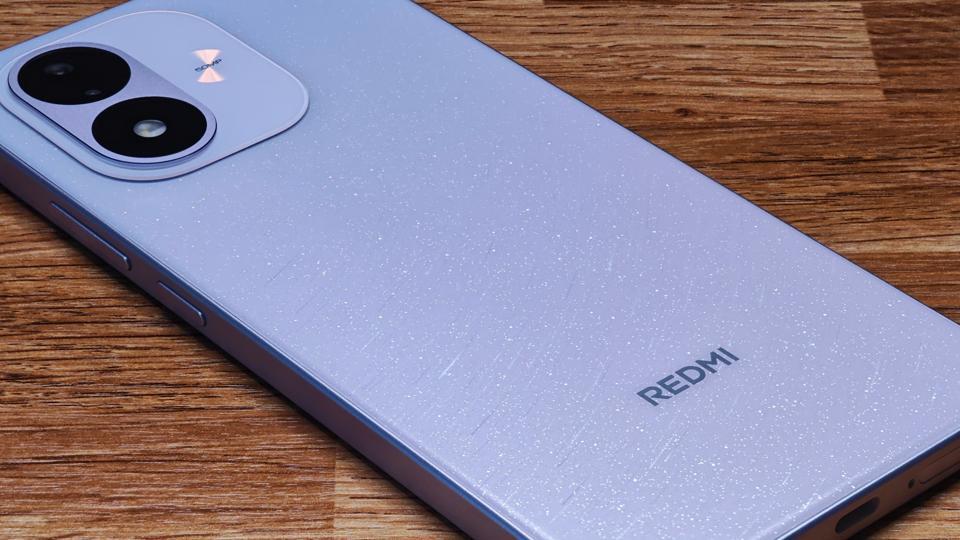
There is quite something to be said about the troika of a 6.9-inch display, a mammoth 8,000mAh battery and still a very agreeable overall balance that tips the weighing scales at 225 grams. In fact, the Redmi Note 17 feels surprisingly light for such a footprint. And well balanced. Xiaomi had kept things simple with design, with a slab like persona and good ergonomics for a large phone. That said, simple doesn’t mean boring at all. The Starlight Purple colorway, for instance, has a gorgeous self pattern representing shooting stars across a dimly lit sky.
The mention of the 8,000mAh battery must bring forward a simple question about mileage between having to reach for the charger. The simple reading from my time with the Redmi Note 17 is this will easily last two days on a single charge with moderately heavy usage. Maybe a bit more, if there is some variance of camera usage or video playback. This sort of stamina is the return to the good old days of a couple of decades ago, when phone chargers were an afterthought—once in a couple of days, you’d reach for them.
To be honest, the photography performance of the Redmi Note 17 impressed me more than I had expected. It is a collective of a 50-megapixel wide sensor which generates a lot of data to work with, algorithms that do justice to that data, and influence of learnings from the Leica finesse over the years. Photos it clicks, outdoors and indoors are impressively detailed with nice welcoming colours. Skin tones in particular look natural, and the 2x in-sensor zoom allows for some amount of zooming in without losing detail due to cropping. Xiaomi’s AI intervention is minimal, leaving that to your choice during edits.
Across the three key highlights of the Redmi Note 17—that is the really large 6.9-inch screen, a mammoth 8,000mAh battery, and the choice of a Snapdragon 4 Gen 4 silicon—Xiaomi has done more than enough to underline the value proposition of the Redmi Note 17. This isn’t the flashiest in terms of performance or specs, but that’s exactly what makes it an understated performer. It is difficult to get a phone right at around the ₹25,000 price point in the present supply chain scenario, but Xiaomi has managed quite well with what was available.