The Capital will grow through a two-pronged strategy of redeveloping existing built-up areas, and opening new urban extensions through planned development to accommodate a projected population of nearly 32 million people, according to Delhi’s 2047 Master Plan, which the Union government is likely to notify this week.
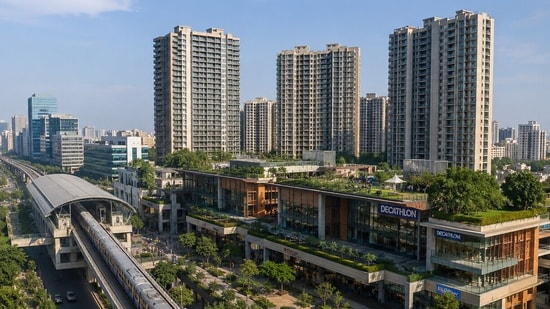
It focuses on rebuilding existing neighbourhoods, regenerating unauthorised colonies and other unplanned settlements, and creating denser, infrastructure-led urban extensions, proposing higher floor area ratios (FAR) for about four million new houses that Delhi will likely need for this burgeoning population.
The plan also links development to the availability of essential public services, including roads, public transit, sewerage, electricity and digital connectivity.
Also Read | Delhi Master Plan 2047 builds on rental housing for migrant population
“The… infrastructure-first approach seeks to prevent unplanned growth and ensure that new communities receive urban services from the beginning,” says the plan, which the Delhi Development Authority (DDA) approved last week.
That clause essentially looks to plug a glaring gap in DDA’s efforts to expand the city – its housing projects in Narela and Bawana met with tepid responses, with buyers and residents complaining of a severe lack of essential infrastructure.
Experts pointed out that building these services were crucial
{{/usCountry}}That clause essentially looks to plug a glaring gap in DDA’s efforts to expand the city – its housing projects in Narela and Bawana met with tepid responses, with buyers and residents complaining of a severe lack of essential infrastructure.
Experts pointed out that building these services were crucial
{{/usCountry}}“Authorities need to keep in mind challenges related to water quality, security, ensuring adequate greening and public space network for reducing urban heat effect; priority for pedestrians and non-motorised transport users while developing road infrastructure and grounded measures towards better air quality. Vertical growth is only possible if civic infrastructure is also accordingly developed,” said Prerna Mehta, associate director, urban development, WRI India.
The plan identifies Delhi’s ageing planned residential areas as a major source of additional housing capacity. These include cooperative housing societies, DDA colonies, plotted developments, resettlement colonies, rehabilitation colonies, government housing and private group housing.
Many of these areas have ageing housing stock, under-utilised plots and low-density development despite existing roads and infrastructure. Instead of expanding only into new areas, the plan proposes using these serviced areas more intensively.
Also Read | DDA clears Delhi 2047 plan, opens door to development in 70 villages, parts of Yamuna floodplain
“The Plan promotes redevelopment of ageing housing stock, under-utilised plots and areas under low-density where infrastructure already exists,” it says, adding that redevelopment would “create additional housing while improving roads, utilities, public spaces and community facilities.”
The proposed regeneration model illustrates the scale of this densification. In the plan’s illustrative example for a planned area, existing ground coverage is shown at 30–40%, with average FAR of 150–200. Under the proposed redevelopment model, FAR rises to 300, ground coverage is reduced to 30%, green/open area is set at 30%, and building height can reach G+9.
Regeneration will be undertaken only after identifying areas requiring upgradation and potential for development. Road Network Plans are to be prepared with local bodies and landowners/residents, while reorganisation and pooling of properties will be permitted to facilitate redevelopment.
“The idea is to bring together smaller plots and build vertically with lanes and bylanes on the sides in both planned and unplanned areas, following all safety and building norms. This is similar to the ‘blocks’ in residential areas in many other countries like the UK and USA,” said a DDA official.
For regeneration schemes generally, the plan permits a maximum FAR of 1.5 times the base FAR, while amalgamation and reconstitution of plots will be allowed. It also requires Road Network Plans; service-providing agencies will be responsible for augmenting services wherever required, subject to applicable charges.
Also Read | Construction, redevelopment, rentals: Delhi’s 4 million house plan
The densification strategy extends to unauthorised colonies, urban villages, slums and jhuggi-jhopri (JJ) clusters. These unplanned and unauthorised areas often have poor building conditions, inadequate physical and social infrastructure and poor accessibility, even as many have evolved into high-density, mixed-use settlements.
For unauthorised colonies, regeneration schemes can be undertaken over a minimum 2,000 sqm area. The proposed norms allow a base FAR of 350, with separate FAR provisions for amenities. Ground coverage can go up to 50% in smaller regeneration schemes and 40% in larger ones. In urban villages, the plan recognises that rapid densification, vertical redevelopment and plot subdivision have already taken place without corresponding augmentation of infrastructure and public spaces. It proposes area improvement plans, road widening, improved physical and social infrastructure, rejuvenation of water bodies and development of local green areas.
For slum and JJ clusters, the plan proposes a three-fold strategy of in-situ rehabilitation, relocation and in-situ upgrading/area improvement. Its in-situ rehabilitation model permits FAR of 500 for both the rehabilitation and remunerative components.
Stay updated with all top Cities including, Bengaluru, Delhi, Mumbai and more across India. Stay informed on the latest happenings in World News along with Delhi Election 2025 and Delhi Election Result 2025 Live, New Delhi Election Result Live, Kalkaji Election Result Live at Hindustan Times.
Stay updated with all top Cities including, Bengaluru, Delhi, Mumbai and more across India. Stay informed on the latest happenings in World News along with Delhi Election 2025 and Delhi Election Result 2025 Live, New Delhi Election Result Live, Kalkaji Election Result Live at Hindustan Times.