Women applying for the Delhi government’s Lakshmi Yojana welfare programme must ensure that children in their family are vaccinated in line with government norms, including the HPV jab for girls aged above 14, and applicants must consent to the use of their personal information for “monitoring and evaluation”, according to the scheme’s standard operating procedure (SOP), the latest in a long line of caveats the state prescribes for eligibility.
The protocol and application form also requires applicants to sign off on their personal data being shared “with other authorities”, including “banking partners or other stakeholders associated with the scheme”, as well as to undertake an online pledge for centrally backed social causes such as “Ek Pedh Maa ke Naam”, “Swachh Bharat” and “No To Single-Use Plastic”, or other programmes prescribed by the government.
Government programme linked to vaccination
“All children should be vaccinated as per Government prescribed schedule in the family, including HPV vaccine (more than 14-year-old girl child),” says the SOP, in the “Responsibilities of Beneficiaries & Conditionalities for Beneficiary Family” section, which lays down a range of requirements for applicants.
Women are required to sign an undertaking on similar lines in the application form: “I will ensure that all children in the family are vaccinated, including the HPV vaccine for girls above 14 years of age.”
The declaration is a rare instance of a government programme being directly linked with a vaccination requirement. To be sure, the jabs are not mandatory to submit the application for the Delhi Lakshmi Yojana. However, officials said applicants may be asked to furnish proof or for responses on the status of vaccinations during the verification process.
{{/usCountry}}The declaration is a rare instance of a government programme being directly linked with a vaccination requirement. To be sure, the jabs are not mandatory to submit the application for the Delhi Lakshmi Yojana. However, officials said applicants may be asked to furnish proof or for responses on the status of vaccinations during the verification process.
{{/usCountry}}Also Read I Delhi govt study finds gaps in senior citizen pension scheme
A Delhi government official said, “The scheme targets the section of society that does not have a favourable opinion of vaccinations. This exercise is aimed at creating awareness about vaccination.”
The SOP comes months after the Centre on February 28 rolled out a nationwide HPV (Human Papillomavirus) vaccination programme, which intended to around 11.5 million girls across India and 160,000 in Delhi against the infection.
Dr Chandrakant Lahariya, senior physician and health policy expert, said inoculations have always been voluntary in India.
“If the government has said the applicant should ensure the family is vaccinated, it is not an issue. No vaccination in the country is mandatory. Even the Covid-19 vaccine was not,” he added.
The scheme’s SOP does not specify how vaccination compliance will be verified, nor does it outline what documents beneficiaries will need to furnish to establish that children have received the prescribed jabs.
Petition challenging vaccination inclusion
The Delhi High Court refused to stay the HPV vaccination drive and rejected a petition challenging the jab’s inclusion in the Universal Immunisation Programme (UIP) on the ground that it was being administered to schoolgirls aged around 14 without informed parental consent and without credible data establishing the vaccine’s efficacy or necessity for the target population.
Also Read I 15% women may lose out on Delhi's monthly payout scheme due to 3-child cap
The application form also ropes people in to sign up for a clutch of government awareness programmes. Families with a pregnant or lactating woman have to ensure she is registered on the Centre’s POSHAN Tracker, a digital platform used to track and monitor nutrition and health services for pregnant/lactating women, children and beneficiaries under the Anganwadi system.
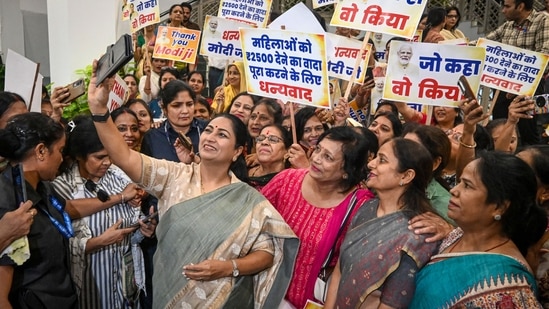
The Delhi Lakshmi Yojana scheme entails a payout of ₹2,500 per month to the eldest woman between the age of 21 and 60 from a household whose total annual income is under ₹2.5 lakh.
Mnadatory requirements reduce candidate pool
The scheme already has a laundry list of requirements and caveats, which would whittle down the potential pool of beneficiaries from the 1.7 million that Delhi’s Bharatiya Janata Party (BJP) government earlier estimated.
A beneficiary, or her husband or parents, must have been residents of Delhi for at least 10 years. Women with more than three children will not be eligible for the scheme. Besides women already receiving financial assistance or pension under any other government scheme, those who pay income tax, file GST returns, are government employees, or belong to families with members employed by the Centre or state governments will be ineligible, according to the cabinet note approved on Tuesday.
Also excluded are families owning a four-wheeler, annual household electricity consumption exceeding 2,400 units and women with a criminal record. Applicants will also have to submit a letter of recommendation from the MP or MLA of their constituency.
The document also makes applicants sign off on the use of their personal information.
Also Read I Vidya Vahini scheme: CM distributes bicycles to 3,000 students
“By applying under DLY, the applicant provides consent for the use of their personal data, including Aadhaar details,” says the SOP.
Authorities may use this information, the protocol adds, for “monitoring, evaluation” and it may be shared with other authorities, including “banking partners or other stakeholders associated with the scheme.”
According to government officials aware of the matter, all major welfare schemes are linked to the Aadhaar card.
“The Aadhaar linkage is necessary to ensure benefits reach the legal beneficiaries. The government also carries out evaluation studies and exercises to weed out ineligible beneficiaries,” said the official.
To be sure, women who opt for the government’s preferred payment model will receive ₹2,500 every month, with ₹1,500 deposited into a recurring deposit (RD) or fixed deposit (FD) and the remaining ₹1,000 credited to a Central Bank Digital Currency (CBDC) wallet. The wallet cannot be used to purchase liquor, paan, gutka, cigarettes, bidis and other intoxicants or for online gaming and gambling.
Stay updated with all top Cities including, Bengaluru, Delhi, Mumbai and more across India. Stay informed on the latest happenings in World News along with Delhi Election 2025 and Delhi Election Result 2025 Live, New Delhi Election Result Live, Kalkaji Election Result Live at Hindustan Times.
Stay updated with all top Cities including, Bengaluru, Delhi, Mumbai and more across India. Stay informed on the latest happenings in World News along with Delhi Election 2025 and Delhi Election Result 2025 Live, New Delhi Election Result Live, Kalkaji Election Result Live at Hindustan Times.