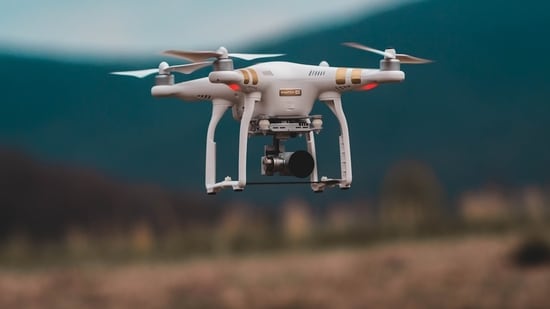
Drones may soon be deployed to spot open burning and construction dust, track waste dumping and encroachments along the Yamuna, monitor vulnerable areas for women’s safety and even act as rapid first responders to emergency calls, as per the Delhi government’s draft drone policy.
It also envisages creating more than 25 drone companies, training at least 5,000 people, and generating over 1,000 jobs over the next five years.
The draft, a copy of which was accessed by HT, was prepared by the Delhi government’s Department of Information Technology. It proposes an indicative expenditure of ₹85 crore during 2026-27 to 2030-31 to build a drone ecosystem covering manufacturing, research, training, testing and government-led deployments.
The government expects the policy to attract more than ₹100 crore in investments and generate over ₹250 crore in revenues from drone and allied activities.
Also read: Delhi govt plans drone, semiconductor policies rollout by September-end
Drones to boost surveillance and emergency response
Among the proposed priority applications is surveillance of vulnerable and high-footfall areas, with Delhi Police and the home department potentially using drones for situational assessment and emergency response.
{{/usCountry}}Among the proposed priority applications is surveillance of vulnerable and high-footfall areas, with Delhi Police and the home department potentially using drones for situational assessment and emergency response.
{{/usCountry}}The policy proposes using drones for real-time monitoring of air pollution hotspots, industrial emissions, construction dust and open burning.
For the Yamuna, drones could identify pollution sources, waste dumping, encroachments, and changes in river conditions. Municipal bodies could deploy them to monitor waste accumulation, landfill sites and sanitation operations.
Also read: Delhi air quality panel asks Isro to improve accuracy of models that detect stubble fires
The government also plans to facilitate dedicated drone flight-testing sites through public-private partnerships, subject to regulatory compliance. It proposes at least 10 remote pilot training organisations, multiple skilling centres and centres of excellence in academic and technical institutions.
A major industry attraction will be financial incentives. The draft provides for a capital subsidy of up to 20% of fixed capital investment, capped at ₹5 crore per unit, for eligible manufacturing, assembly, maintenance, repair and overhaul facilities, R&D centres and RPTOs.
Eligible units could also receive up to 100% reimbursement of net SGST for a defined period, lease-rental support of up to 50% for three years and other assistance for exhibitions, patents, testing and certification.
Support proposed for skilling and research
The policy proposes training-fee support of up to 50%, capped at ₹5,000 per trainee, and a ₹5,000 stipend for trainees in government institutions. It also provides for grants of up to ₹20 lakh for targeted R&D projects and up to ₹20 lakh for establishing centres of excellence.
The policy will not create a separate drone regulatory regime. All operations will continue to be governed by central regulations, including the Drone Rules, 2021, and directions of competent authorities.
The policy’s indicative budget rises from ₹1 crore in 2026-27 to ₹33 crore in 2030-31. Of the ₹85-crore estimated requirement, ₹29 crore is earmarked for fiscal incentives, ₹15 crore for skilling and talent development, ₹13 crore for centres of excellence and research, and ₹10 crore each for testing infrastructure and government pilot projects.
The draft policy will remain applicable for 2026-27 to 2030-31, unless the government modifies, withdraws, or extends it.
Also read: Delhi air quality improves to 71 but the clean air may not last with changing rain activity
Policy targets jobs across drone sector
The draft proposes to support job creation across multiple segments, including drone operations,
manufacturing, maintenance, data analytics, and service delivery.
Among the incentives, the draft proposes reimbursing ₹1 per unit of electricity consumed for up to two years from the commencement of operations, subject to a maximum of ₹1 lakh per annum per unit for drone companies.
It proposes up to 100% exemption from stamp duty, registration charges, and layout approval charges under applicable frameworks.
The policy envisages up to a 50% subsidy on land or built-up space lease rentals for up to three years for eligible drone manufacturing units.
Also read: Treat the Yamuna as a river, not a drain
Policy follows push for wider drone use
An official said the policy came after former Lieutenant Governor VK Saxena directed the Delhi chief secretary to explore replicating drone policies from Telangana and Himachal Pradesh following a deadly blast at the Red Fort last November.
Meanwhile, Delhi Information Technology minister Pankaj Singh told HT, “We plan to bring the policy in public domain by the end of this month following cabinet approval.”
Also read: DPCC initiates process for 13 new air quality stns in Capital
To be sure, the government will first put the policy in public domain for feedback. After analysing public feedback, the policy will be reanalysed and sent to Cabinet for approval, and then to LG Taranjit Singh Sandhu for his nod.
Stay updated with all top Cities including, Bengaluru, Delhi, Mumbai and more across India. Stay informed on the latest happenings in World News along with Delhi Election 2025 and Delhi Election Result 2025 Live, New Delhi Election Result Live, Kalkaji Election Result Live at Hindustan Times.
Stay updated with all top Cities including, Bengaluru, Delhi, Mumbai and more across India. Stay informed on the latest happenings in World News along with Delhi Election 2025 and Delhi Election Result 2025 Live, New Delhi Election Result Live, Kalkaji Election Result Live at Hindustan Times.