E-Paper



Delhi records cleanest December since start of air quality compilation
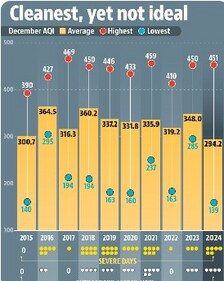
Delhi recorded its cleanest December since 2015 with an average AQI of 294, despite six days of "severe" air, due to strong winds and record rainfall.

 Prefer HTon Google


Strong consistent winds in the first half of December, followed by record-breaking rainfall in the second half of the month has seen Delhi record an average air quality index (AQI) of 294 this month, making it Delhi’s cleanest December since AQI was launched in 2015, according to the Central Pollution Control Board (CPCB) data.
However, an average AQI reading of 294, which is classified “poor” by CPCB standards, is almost three times worse than a ”satisfactory” AQI. Further, the month also recorded six days of “severe” air, when the AQI crosses a reading of 400, leading to stringent curbs on construction, restricted movement of vehicles, hybrid classes and staggered office timings.
CPCB classifies AQI between 0 and 50 as “good”, between 51 and 100 as “satisfactory”, between 101 and 200 as “moderate”, between 201 and 300 as “poor”, between 301 and 400 as “very poor”, and over 400 as “severe”.
Despite the caveats, the average AQI of 294 was a sharp improvement from an average AQI of 348 recorded last December, 319 in December 2022 and 336 in December 2021. The second-best AQI reading was 300, recorded in 2015, according to the data.
Experts said that barring a six-day period of “severe” air in the third week, conditions were mostly favourable for dispersion of pollutants this month.
“Winds were dominant in the first half of December, with limited moisture in the air. This meant we were not recording moderate or dense fog and winds were allowing pollutants to disperse. This kept the AQI in check, until a western disturbance in the third week of December slowed down winds,” said Mahesh Palawat, vice president at Skymet.
Palawat said slow winds led to added moisture and stagnation, but the same spell was followed by a fairly active western disturbance around December 26, which helped Delhi’s air quality again. “This latest western disturbance was much stronger. We saw rain help settle pollutants and strong surface winds post that, which have led to the AQI improving significantly,” he said.
Favourable meteorology
Delhi is set to end the month with 53.5mm of monthly rainfall, making it the fifth wettest December since 1901. This included a single-day spell of 41.2mm on December 28, which was historically Delhi’s second wettest day in December. The only time Delhi had more rainfall in a single day in December was December 3, 1923, when it received 75.7mm of rainfall.
Nights were mostly pleasant, with the average monthly minimum temperature recorded at 8.4°C, the same as the long-period average (LPA) for December. Days were slightly warmer than usual, with the average monthly maximum recorded at 22.8°C, also the same as the LPA. Despite the overall normal and highs, this was still the coldest December in terms of average maximum temperature since 2021, when the monthly average was 22.4°C, according to the India Meteorological Department (IMD).
The air quality showing in December comes on the backdrop of Delhi recording its cleanest first half of December, recording just one “very poor” air day. Delhi’s average AQI between December 1 and December 15 was 238. In all previous years, the average AQI in the first half of December was over 300.
Delhi’s average AQI was 173 (moderate) at 4pm on Monday, an improvement from Sunday’s AQI of 225 (poor).
Sunil Dahiya, lead analyst at the think-tank Envirocatalysts said a lower average AQI was mostly down to favourable meteorological conditions and does not indicate progress in terms of local emissions. “We saw when conditions become unfavourable, the AQI spiked to severe and touched 451. This shows the background emissions were still fairly high in the capital, but strong winds and rain simply kept it at bay,” he said, calling for more action on the ground to tackle different sources of pollution.