
 E-Paper



India’s entrance exams emulate Sorting Hat’s opaque decision-making
Fiction can get away with an unaccountable arbiter. A real education system cannot

 Prefer HTon Google


Remember the Sorting Hat from the halls of Hogwarts in Harry Potter? Eleven-year-olds arriving at Hogwarts were sorted into houses by an ancient, talking hat. No one has ever seen its internal workings. No one could appeal its verdict, question its criteria, or audit its logic. It simply sat on a child’s head for a few seconds and pronounced a decision that shaped the child’s friendships, reputation, and opportunities for years to come. The genius of the process was that it did not need to explain itself. It was magic, and magic demands that everyone has agreed to blindly trust it.
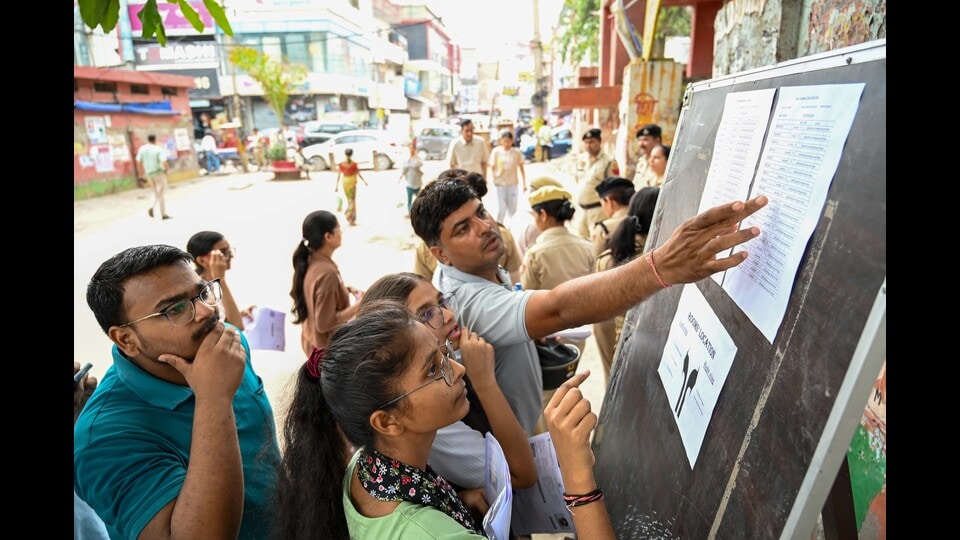
India’s entrance exam systems may resonate with the Sorting Hat’s obscure processes without any of the magic that might justify it.
What actually happens to a Class 12 student today? For twelve years, their teachers have trained them, tested them, and built a rich record of their ability. Then, at the moment of sorting, that entire record is set aside in favour of a single sitting of some centralised national test (CUET for university admission, NEET for medicine or JEE for engineering) administered by an agency the student has never met, scored by a process the student cannot see, and final in a way no classroom grade ever was. Like the Sorting Hat, the exam speaks once, and the room goes quiet.
The allegory would be merely poetic if the stakes were not so real. Roughly 14,488 students died by suicide in India in 2024, an alarming 80% rise over the past decade. “Failure in examination” was recorded as a direct cause in more than 2,000 of those deaths. Behind each of these statistics there was a young person for whom a single test result had become an unbearable verdict on self-worth. This is what happens when a society builds a “sorting hat” that it does not fully understand and then asks its children to stake their futures on it.
Take CUET for example which was introduced in 2022 for admission to Delhi University (DU) and other Central universities. Before CUET, a student’s fate was decided by years of board exam performance. It was imperfect, but at least visible, contestable, and cumulative. Since 2022, board marks have become insignificant for merit calculation at DU. A student who spent two years earning a 98% board score and a student who scraped through with 70% now walk into the CUET hall as equals, and only the Hat, sorry, CUET, decides what happens next.
The government’s rationale for this shift was reasonable enough. Evaluation and grading across the various education boards in India vary wildly with different generosities. A 95% from one state board and a 95% from CBSE d or ICSE do not represent equivalent preparation, and this disparity had been producing an ambitious and unrealistic, near-100% “cut-offs” at some of the top Delhi University colleges. CUET, another ‘One Nation, One X’ policy, was meant to create “a level playing field”.
But read between the lines what this rationale demands of students and parents. It demands to trade a system whose cracks were at least visible (anyone could see that Board A grades were more generous than Board B) and the argument for correcting it by rationalising scores across boards for a system whose internal workings are considerably more obscure. CUET’s scoring is normalised and percentiled by the National Testing Agency using a formula undisclosed to the general public who do not see their own individual paper, do not have access to shift-wise data. CUET does not release a marked, reviewable answer sheet (which the boards do), which can be scrutinised and re-evaluated if needed. The single test is not open to the same kind of institutional or public accountability that two years of school-based board performance is. CUET’s question design, evaluation, and normalisation processes remain largely opaque to the crores who sit for it. When CUET was introduced, the National Progressive Schools Conference, representing schools across the country, wrote to the government objecting that the disparity between boards “could have been addressed differently, by designing a rationalisation structure to bring them in parity”.
This is the heart of the Sorting Hat problem. Fiction can get away with an unaccountable arbiter. A real education system cannot. When lakhs of teenagers are told that their futures depend on an instrument whose inner workings are mysterious and whose difficulty can shift year to year, and whose administering body faces no real consequence for errors, opacity itself becomes a source of psychological harm. Students cannot prepare rationally for a process they cannot see. They cannot appeal a decision they cannot audit. All they can do is submit to it, the way first-years at Hogwarts submit to the hat, and hope for the best.
The difference, of course, is that the Sorting Hat never cost anyone their whole life’s savings or their mental health. Coaching centres have sprung up to demystify this modern oracle. Families that cannot pay for coaching are simply left guessing, competing on unequal terms against those who can afford a coach who whispers hints about what the hat wants to hear.
None of this is an argument for abolishing standardised testing in a country as vast and unequal as India. Some common yardstick is necessary. But a yardstick is not the same thing as a Sorting Hat. A reformed system would treat exams the way a functioning institution treats any high-stakes decision-maker — by publishing the reasoning, allowing scrutiny, keeping some score for the students’ school education, and resisting the temptation to let one exam sitting overrule everything that came before it.
Sushant Kishore teaches English at VIT, Vellore, and Navneet Sharma teaches Education at CUHP, Dharamshala. The views expressed are personal
(This is a Hindustan Times Digital exclusive)


