E-Paper



From meditation to the canvas: How Osho’s vision of conscious living is finding expression through art

 Prefer HTon Google


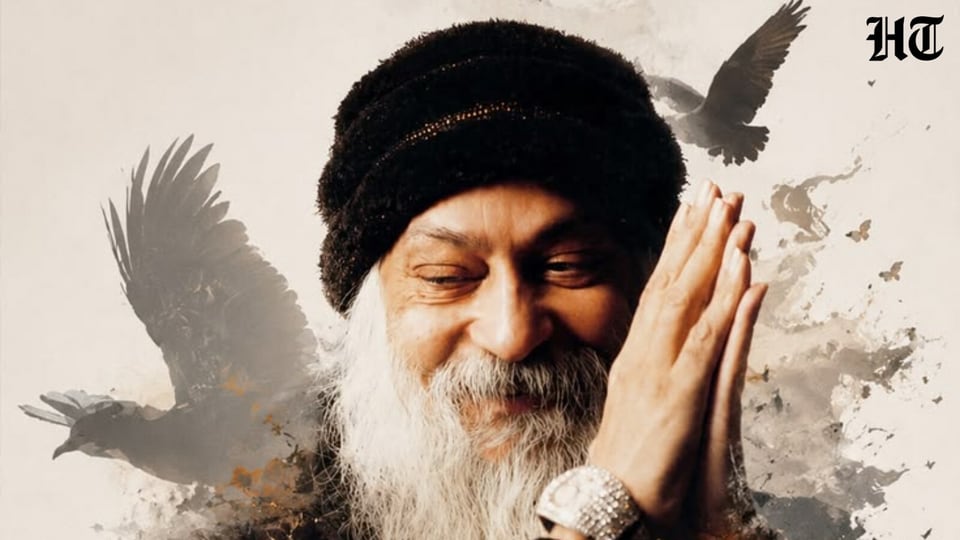
This connection between meditation and creativity also reflects an important part of Osho’s approach.
You may think of meditation as something that asks you to sit still, close your eyes and turn inward. But an inner experience does not always stay quiet. Sometimes, it finds an outlet through music, writing, movement or art.
That idea sits at the heart of The Divine Within, a meditation-inspired art exhibition by Ma Dev Ananti (Alka Singh) at Osho Dham in Delhi. The exhibition, which opened on September 26, brings together paintings shaped by her experiences of meditation, silence and witnessing, offering a glimpse into how an inward journey can take a visible form.
ALSO READ: Overthinking at night keeps you awake? Osho’s teachings on turning the restless mind towards silence
The exhibition was part of the Osho Neo Sannyas Celebration held from September 25 to 27, but its theme extends beyond the three-day gathering. At its center is a question that is familiar to anyone who has tried to make sense of an inner experience: How do you express something difficult to put into words? For Ma Dev Ananti, the answer has been painting.
When silence becomes creative
Her paintings explore the idea of discovering the Divine not as something distant or external, but as an inner presence. Colors, forms, and natural imagery serve as a means of expressing experiences that might otherwise be difficult to explain.
There is no need to treat the paintings as a literal explanation of meditation. Instead, they offer a personal interpretation of what happens when you spend time observing your inner world.
This connection between meditation and creativity also reflects an important part of Osho’s approach. Osho, born Rajneesh Chandra Mohan Jain in 1931, was an Indian spiritual teacher whose work focused extensively on meditation, awareness, individual freedom and conscious living. He died in 1990.
Osho encouraged people to explore creativity as part of their individual expression, and artistic activity became part of life in his communes. Within that framework, meditation was not necessarily something separate from everyday life. It could influence the way you work, create, move and experience the world around you.
Swami Chaitanya Keerti, who facilitated the Neo Sannyas Day program with Ma Jyoti, describes this relationship between meditation and creativity as a natural one within Osho’s vision.
“Meditation and creativity have always had a natural relationship in Osho’s vision. When one becomes more silent and aware, creativity can emerge spontaneously. ‘The Divine Within’ is a beautiful example of how an inner journey through meditation can find expression through art.”
More than sitting in silence
The idea becomes especially interesting when viewed through the lens of Neo Sannyas, which was also explored during the celebration at Osho Dham. Rather than presenting meditation only as a formal practice, the approach emphasises bringing awareness into everyday life.
Ma Dharm Jyoti describes Neo Sannyas as an invitation to live with awareness, freedom and celebration. She also points to creativity as one possible expression of a life that includes meditation.
“Neo Sannyas is an invitation to live with awareness, freedom and celebration. When meditation becomes part of life, it can open new dimensions of creativity and expression.”
That perspective gives The Divine Within a wider context. The paintings are not simply about making something beautiful. They represent an attempt to translate a personal inner experience into something another person can see and interpret in their own way.
Perhaps that is where meditation and art meet most naturally. Both can invite you to slow down, observe more closely and notice what you might otherwise miss.
You do not have to share the same spiritual beliefs to understand the basic impulse behind the work. An experience that feels deeply personal can still find a universal language through creativity. And sometimes, what cannot be said aloud can find its way onto a canvas.
Disclaimer: The spiritual ideas discussed in this article are based on Osho’s teachings and the perspectives of the people associated with the exhibition and are not presented as scientifically facts. Spiritual and meditation practices can have different meanings and experiences for different people and should be approached as matters of personal belief and reflection.