E-Paper



Delhi: Unified MCD spells green plan, to create 20 mini-forests in Capital
The Municipal Corporation of Delhi plans to develop at least 20 mini forests in densely populated areas, especially in the heavily concretized tans-Yamuna region, as part of its annual greening action plan for 20222

 Prefer HTon Google


The Municipal Corporation of Delhi plans to develop at least 20 mini forests in densely populated areas, especially in the heavily concretized tans-Yamuna region, as part of its annual greening action plan for 20222. The horticulture wing of the civic body will plant saplings of 85,000 trees and 520,000 shrubs this year, showed data released by the corporation on Sunday.

A senior municipal official from the horticulture department said due to shortage of space, existing parks, regional offices, schools, dispensaries, roadsides, community centres have been identified for the plantation drive. “In east Delhi, we had carried out Miyawaki plantation near Mayur Vihar around a year ago. We are satisfied with the progress. Five more such Miyawaki mini-forests will be developed in areas such as Welcome, Yamuna Vihar, Sunder Nagari and Nand Nagari,” said the official.
Miyawaki method involves planting two to four trees per square metre. Pioneered by Japanese Botanist Akira Miyawaki, the technique involves growing thousands of native tree species closely together in a small patch of area. In comparison to a conventional forest, a Miyawaki forest is several times denser and grows in two to three years.
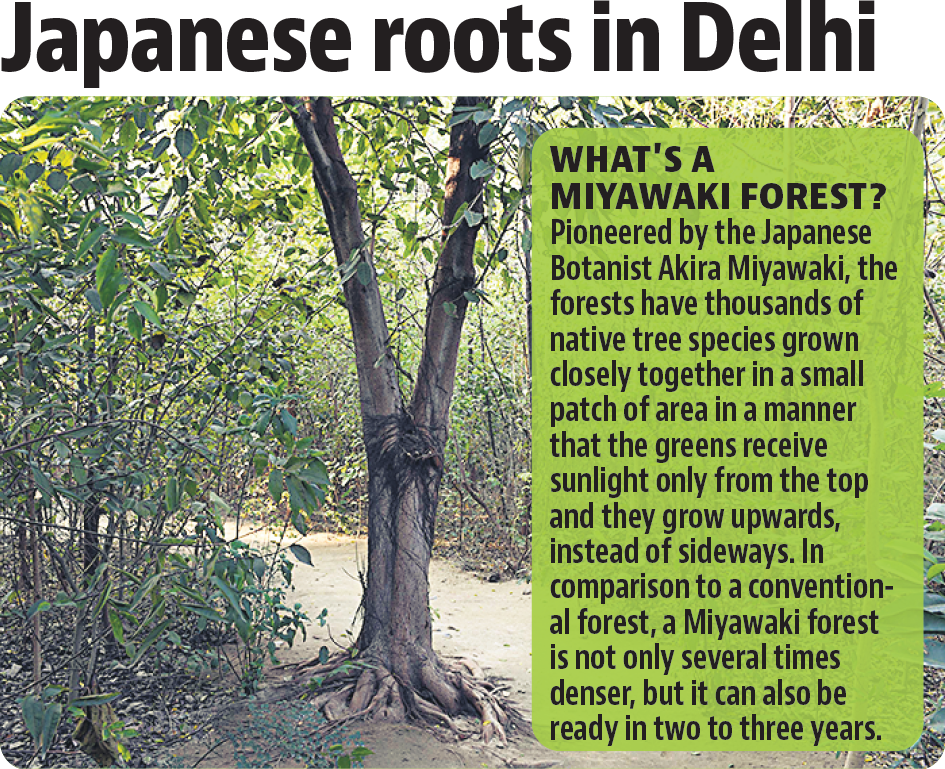
“The horticulture departments of the three corporations developed 17 ‘mini forests’ by planting about 8,000 additional trees last year. These ‘mini-forests’ have been developed at places such as C-2 block Keshav Puram, Shankar Road andf near Azadpur vegetable market. This year ‘mini forests with high density plantation will be developed at 20 locations...Maximum number of high-density plantation hotspots will be developed in Keshavpuram zone, where seven sites have been selected for the project,” said the senior official.
In terms of distribution of the 85,000 new trees, the two zones in east Delhi (Shahadra north and Shahadra south) will get saplings of 20,000 trees, four zones in south Delhi (central, south, west and Najagarh) will get 35,000 plants and six zones in north Delhi are expected to get 30,000 plants.
East Delhi space crunch
The two zones under East Delhi have highest proportion of unplanned areas (over 80%) with relatively fewer parks and green belts, posing a serious challenges to the target of increasing green cover in the area. Out of more than 15,000 parks under MCD, around 15% parks are located in east Delhi.
The civic body will plant saplings of 20,000 trees and 80,000 shrubs in the region. A senior horticulture official from east Delhi said that the corporation will focus on filling the gap between existing trees, replacement of dead trees and increasing the green cover in 92 parks, which have been handed over by the DDA to the EDMC last year.
“In comparison to other parts of the city, the space available in east Delhi is minimum as most of the colonies have come up in an unplanned manner. We can only plant new trees along footpaths, central verges and gaps between boundary walls of parks. No new major road stretches have come up in east Delhi so Miyawaki forest technique is ideal in terms of developing dense mini-forests in existing spaces,” said the official.
C R Babu, head of the Centre for Environmental Management of Degraded Ecosystems (CEMDE), said while the Miyawaki technique can be used occasionally, particularly in densely populated areas, it needs to be carried out simultaneously with plantation drives that focus on a three-canopy forest.
“The Miyawaki technique focuses on planting a large number of trees in a very tightly packed area and in this, the lower-level vegetation gets missed. The canopy growth on the top is also affected and at times, there is insufficient room for growth of roots. This has emerged as an urban concept to add green cover and provide oxygen, but conventional forests are equally important and agencies need to ensure there is a balance between the two,” he says adding that shrubs form a key role in the forest ecosystem by keeping dust under control while providing habitats for insects and smaller reptiles and mammals.