
 E-Paper



Delhi’s Najafgarh drain polluting Yamuna with 2x the sewage: Report
According to Delhi water minister Parvesh Verma, fresh findings indicate that the Najafgarh drain alone now carries around 800 million gallons per day (MGD) of sewage into the river—up from previous estimates of 450 MGD.

 Prefer HTon Google


A new survey of the Yamuna has revealed an alarming truth: the Najafgarh drain, long known to be the river’s biggest polluter, is pumping nearly twice the estimated volume of untreated sewage into the Yamuna. And a significant chunk of this pollution isn’t even Delhi’s doing — it originates in Gurugram.
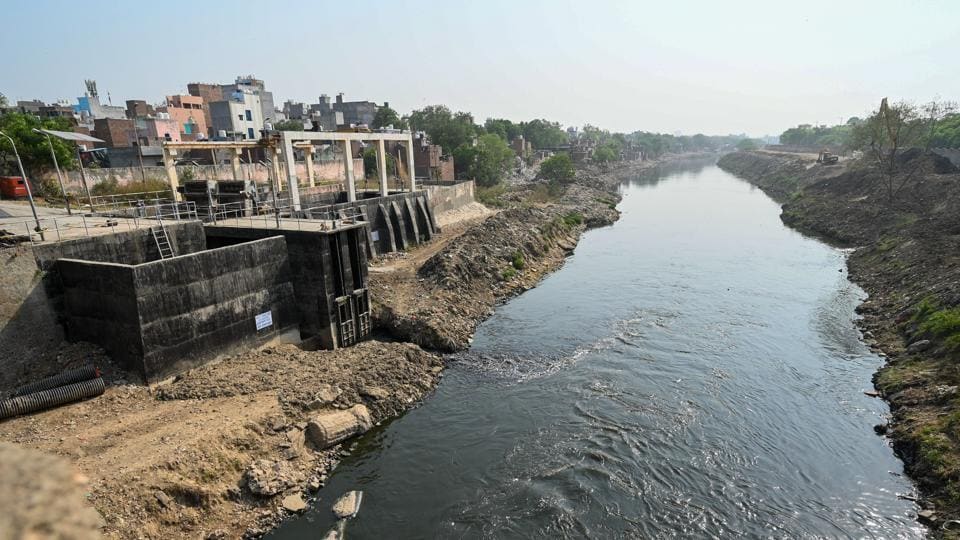
The revelation is part of an ongoing analysis by the Delhi government to assess untreated sewage flow into the Yamuna from the city’s 22 major drains. According to Delhi water minister Parvesh Verma, fresh findings indicate that the Najafgarh drain alone now carries around 800 million gallons per day (MGD) of sewage into the river—up from previous estimates of 450 MGD.
Even more striking is that nearly 250 MGD of that waste is believed to come from Gurugram, through drains such as Badshahpur, before entering Delhi’s already overburdened drainage network.
“This (the actual volume of sewage) is a serious discovery,” Verma told HT. “We are mapping every drain and their catchment areas to understand where the sewage is coming from and how much of it is treated or untreated. The final report will be ready by September or October, and it will help us plan the treatment infrastructure accordingly.”
The most polluted 22km stretch of the Yamuna in Delhi, between Wazirabad and Okhla, receives effluents from dozens of drains, with Najafgarh and Shahdara being the most significant.
Experts said the scale of the problem exposed by the new survey demands a complete re-evaluation of sewage treatment capacities and pollution control efforts across both Delhi and neighbouring Haryana.
Meanwhile, officials of the Gurugram Metropolitan Development Authority (GMDA) confirmed that steps are being taken to stem the flow of sewage into the Najafgarh drain. A senior GMDA official said the authority is upgrading its two main sewage treatment plants (STPs) at Dhanwapur and Behrampore and constructing a new 350 million litres per day (MLD) STP in Sector 107.
A common effluent treatment plant (CETP) for industrial wastewater is also under construction. Additionally, a new main pumping station of 665 MLD capacity will be set up at the Dhanwapur STP, along with additional treatment capacity of 100 MLD each at both existing plants.
“Our aim is to recycle the maximum amount of sewage generated in the city and reduce the burden on downstream systems,” the official said.
On July 11, Union home minister Amit Shah chaired a high-level review meeting on the Yamuna, and directed that drone surveys be conducted of the Najafgarh and Shahdara drains. He also stressed on the need to double Delhi’s STP capacity to 1,500 MGD by 2028 as part of a multi-pronged strategy for rejuvenating the Yamuna.
Delhi currently generates about 792 MGD of sewage, but its 37 STPs can treat only 667 MGD, with only 565 MGD is actually being treated, according to the Delhi Economic Survey. This leaves a gap of 227 MGD -- wastewater that flows untreated into the Yamuna.
Experts believe this shortfall is even greater when factoring in groundwater use, which remains largely untracked in sewage calculations.
Verma said that with land scarcity in parts of Delhi, the city is now planning 40 decentralised STPs to ensure local treatment of wastewater, rather than relying solely on large centralised plants. The upcoming survey, conducted in collaboration with the National Mission for Clean Ganga (NMCG) and WAPCOS, will serve as a blueprint for determining STP locations and capacities based on real-time drainage data.
“The drainage system is extremely complex, with over 350 sub-drains feeding into the 22 main ones. We need to map the source, flow, and BOD (biochemical oxygen demand) levels of each to build a holistic plan,” Verma said.
Cleaning up the Yamuna was a key campaign promise of the BJP in the February 2025 Delhi Assembly elections, which saw the party form its first-ever government in the Capital. Chief minister Rekha Gupta has since unveiled a ₹3,140-crore action plan to clean the river by 2028. This includes installing new STPs, upgrading existing ones, increasing sewage network coverage, and addressing pollution from unauthorized dairies.
The Delhi Jal Board (DJB) has also been asked to revisit water studies from the past 10 to 15 years to update the capital’s ageing water infrastructure and improve supply equity.
Despite these plans, experts stressed that Delhi alone cannot solve the Yamuna’s woes. Regional collaboration, cross-border accountability, and rigorous implementation will be critical to reclaiming the dying river.
The former AAP government had repeatedly blamed Haryana for dumping industrial pollutants in the river but the allegations were primarily restricted to the river channel upstream of Palla.
Bhim Singh Rawat, a Yamuna activist and member of the South Asia Network on Dams, Rivers and People (SANDRP) said focus should be on mapping, flow and correct baseline estimates. “Delhi’s overall sewage generation estimates are also faulty as we do not factor in the ground water being used by people in the sewage output which could be a massive chunk,” he added
He added that there is a significant contribution of sewage from Gurugram to Delhi via Badshahpur as well as a drain number 8 coming from Haryana. “Similarly, the other Shahdara drain gets pollution load from Uttar Pradesh. Cleaning of Yamuna will have to be a coordinated interstate effort. More importantly, the government should put the findings of the survey in public domain to involve the community.”

Stay updated with all top Cities including, Bengaluru, Delhi, Mumbai and more across India. Stay informed on the latest happenings in World News along with Delhi Election 2025 and Delhi Election Result 2025 Live, New Delhi Election Result Live, Kalkaji Election Result Live at Hindustan Times.


