
 E-Paper



Delhi’s wind speed may pick up today, to help clear haze
Senior India Meteorological Department (IMD) officials said on Friday, Delhi also recorded its first fog episode of the season as visibility fell to 350 metres at the Indira Gandhi International Airport


Choking on a toxic, thick mixture of fog and air pollutants, Delhi’s first hope of relief is the wind speed likely picking up from Saturday, scientists said.
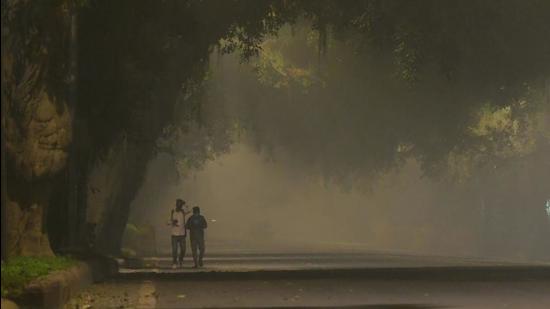
Weather forecasters said better wind speed from Saturday will help improve air quality by aiding the dispersal of pollutants. “Winds have started picking pace from Friday afternoon. On Saturday and Sunday both the wind speeds are expected to remain high, which will help disperse the accumulated pollution levels. While the direction of the winds blowing into Delhi will continue to be north-westerly, continuous high speed wind will ensure that the stubble smoke does not amass over the city,” said Mahesh Palawat, vice-president (meteorology and climate change), Skymet Weather Services.
IMD has also predicted a “visible improvement” in air quality starting November 7.
“The air quality is likely to improve further on November 6 and November 7, and settle in the ‘very poor’ category due to strong winds... The predominant surface wind is likely to be coming from west-northwest directions of Delhi at a speed of 10-20 kmph. The surface winds is likely to blow at a speed of 25-35kmph on November 6, with partly cloudy sky, and shallow fog in the morning,” the IMD said in its forecast for Saturday.
Senior India Meteorological Department (IMD) officials said on Friday, Delhi also recorded its first fog episode of the season as visibility fell to 350 metres at the Indira Gandhi International Airport. At Safdarjung weather station, that provides representational data for the entire city, visibility fell to 200 metres. On Thursday morning, the visibility fell to 600-800 metres and remained in the 800-900 metre range throughout the day, the officials said.
IMD scientists said the heavy load of pollutants from bursting of crackers on Diwali, particulate matter from farm fires in Punjab and Haryana coupled with moisture in the atmosphere also contributed to low visibility. They said such “fog” conditions, when visibility falls to the 200-500 metre range, are usually seen during mid-December and January, but Thursday-Friday’s condition was caused by high pollution levels in the city and high moisture content in the air.
“Such conditions are usually caused because of absence of wind and higher humidity. High pollution levels lead to poor visibility,” said RK Jenamani, senior scientist, IMD.
Earlier, in 2019, 2017, 2016 and 2012, visibility levels in Delhi fell to 200-500 metres during October-November, IMD data showed.
On Friday, a day after Diwali, Delhi’s air quality fell to 462, in the severe zone, according to Central Pollution Control Board (CPCB) recordings. This was the highest day-after-Diwali pollution recordings since 2015, when Delhi started AQI monitoring.
Experts attributed this steep fall in Delhi’s air quality to a blatant violation of the cracker ban in the Capital and the rising contribution of stubble fires to overall pollution mix in Delhi.
An analysis by Climate Trends, a strategic communications initiative on climate ambition and low carbon development pathways, said on Friday with the second consecutive La Nina in India, northwest region is gearing up for intense chilly weather this season.
La Nina is a weather pattern that occurs in the Pacific Ocean. In this pattern, strong winds blow warm water at the ocean’s surface from South America to Indonesia. It is usually characterised by harsh winters.
“While a lower number of crop residue burning incidents and widespread rain and snow in October kept pollution under check in the region until recently, the situation is already changing. With temperature dropping and other meteorological factors like wind speed slowing down, wind direction, haze setting in, pollution levels are again in the ‘very poor’ and ‘hazardous’ categories in most cities across the Indo-Gangetic plains (IGP). The seasonal factors of firecrackers and stubble burning have, as usual, added to the problem, as the peak of crop residue burning incidents coincide with Diwali,” the analysis said.

Stay updated with all top Cities including, Bengaluru, Delhi, Mumbai and more across India. Stay informed on the latest happenings in World News along with Delhi Election 2025 and Delhi Election Result 2025 Live, New Delhi Election Result Live, Kalkaji Election Result Live at Hindustan Times.


