Street stall owner Aqeel in Purani Dilli’s Pahari Imli administers his modest establishment of jaggery sherbet almost throughout the year, winding it down only during the brief Delhi winter. He then replaces the gur ka sherbet with a totally different thing—diaper!
Now the ironic part.
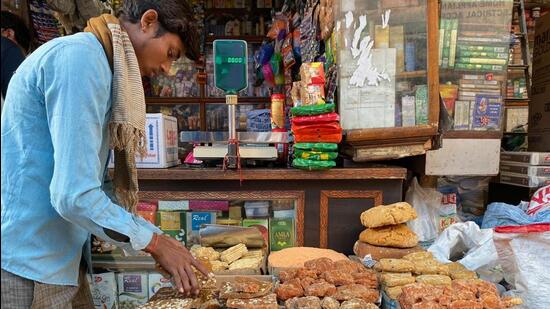
It is during this same brief Delhi winter when scores of groceries in the two Sadar Bazars of Delhi and Gurugram respectively start to stock many kinds of sweet jaggery. The fresh gur regularly arrives in Delhi around this period of the year, mostly from western UP villages, currently overseeing the harvest of sugarcane crop from which gur is made: Each gur variety, according to a shopkeeper, has its own distinct fragrance and flavour (although they all are in varying shades of the same brown). One variety is embedded with peanuts; one has the shape of a heart; and another looks like a fistful of solid mitti scooped by hand from freshy dug earth. Each variety has a name—chaku, batasha, moongphali, dahiya, paneer, papri, pedi, etc.
It has to be said that this ample selection rarely manages to acquire the rare gajar ka gur, rustled out of the winter-season carrot. This peculiar gur is sometimes spotted in the mobile stalls of bicycle vendors who specialise in this variety alone. The hawkers periodically come to Delhi from their villages during the cold months, replenished with a new supply of gur.
{{/usCountry}}It has to be said that this ample selection rarely manages to acquire the rare gajar ka gur, rustled out of the winter-season carrot. This peculiar gur is sometimes spotted in the mobile stalls of bicycle vendors who specialise in this variety alone. The hawkers periodically come to Delhi from their villages during the cold months, replenished with a new supply of gur.
{{/usCountry}}A typical village-made gajar ka gur is produced in a small ox-powered household mill called kolhu, which was traditionally used to produce oil. This way of production is timeless to the Indian countryside. A bonded ox is made to endlessly circle around the wooden kolhu, which, in turn, extracts the oil out of, say, mustard seed paste. Back in their villages, the gajar-ka-gur makers first extract sugarcane juice in their kolhu, then gajar ka juice, after which they combine both the juices, which is boiled for a couple of hours in a giant cauldron until it becomes… you know what.
Actually, all the village gur is made through kolhu, insists a retired PWD engineer in Ghaziabad, who is a descendant from generations of UP farmers.
The gajar ka gur will be sighted until March, so will most other gur varieties. That is the month when the aforementioned stall owner of Pahari Imli will wind down his business of diapers, and bring back his gur ka sherbet for the summer-opressed citizenry.
PS: The photo was taken in an earlier gur season at Pankaj Traders, a grocery since 1951 in Gurugram’s Sadar Bazar.
Stay updated with all top Cities including, Bengaluru, Delhi, Mumbai and more across India. Stay informed on the latest happenings in World News along with Delhi Election 2025 and Delhi Election Result 2025 Live, New Delhi Election Result Live, Kalkaji Election Result Live at Hindustan Times.
Stay updated with all top Cities including, Bengaluru, Delhi, Mumbai and more across India. Stay informed on the latest happenings in World News along with Delhi Election 2025 and Delhi Election Result 2025 Live, New Delhi Election Result Live, Kalkaji Election Result Live at Hindustan Times.