
 E-Paper



Delhiwale: Summer’s underground clubs
Boys jump into a baoli in Delhi, recalling summers past. Baolis, ancient stepwells, offer cool refuge in the city's scorching heat.


He raises his arms, lowers his head, stands motionless, seeming to take a deep breath, and—oh look—he is jumping down from his high perch! Splash. He plunges into the water. Another boy dives in, followed by another, and another, and another.
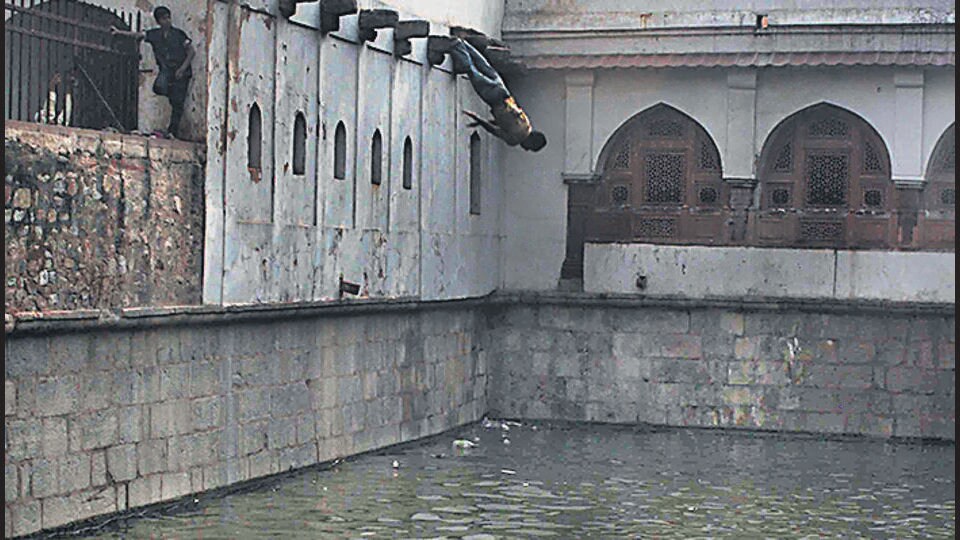
This is a baoli scene somewhere in Delhi. It is not from this year, for the stepwell stays locked these days.
The scene nevertheless recalls the Delhi of summers past. In the old days, long before the era of coolers and ACs, heat-stricken Delhiwale presumably headed to baolis in search of cool breeze. As the temperature rose and the water level progressively sank, the sweating citizens would clamber down the steps, seeking bearable refuges, plunging deeper into the shaded well. (In the monsoon, the same stone steps would sink under the rising water.)
A shrine to water, occasionally embellished with sculptured columns and lattice walls, baolis exist after the manner of a confidential space. They discreetly unite light to shade, earth to water. An elaborate baoli may consist of a stairway punctuated with landings of pavilions and chambers, the stone steps culminating at the bottom of the well.
Unique to India, about 3,000 baolis were built between the seventh and mid-19th centuries, most in dry Rajasthan and Gujarat — a few of these are spectacularly beautiful. Connoisseurs however don’t think highly of Delhi’s baolis. Whatever, this summer, every city baoli will be individually celebrated in these pages. Including Gandhak ki Baoli, which is Delhi’s oldest surviving stepwell, as well as the much-instagrammed baoli close to the high-rises of Connaught Place, and also the city’s biggest baoli in the Firoz Shah Kotla ruins, along with the five baolis in Tughlaqabad Fort, and the baoli each in Purana Qila and Lal Qila, and the two baolis in congested Old Delhi, and the baoli in Vasant Vihar, and the baoli behind Hindu Rao Hospital, and also the baoli in the dargah of Hazrat Khwaja Qutubbudin Bakhtiyar Kaki in Mehrauli. Some of these baolis are easily accessible, others are not.
To reach out to these wells will be simultaneously an excuse to offer homage to Delhi’s hidden beauty, for these monuments are denied the privilege of easy viewing, being exiled under the ground. Meanwhile, try to identify the baoli in which the boys in the photos above are jumping into. Hint: it is Delhi’s only surviving stepwell with an active underground spring.


