
 E-Paper



ED files fresh charge sheet against BRS leader Kavitha
The charge sheet against Kavitha was filed under sections of the Prevention of Money Laundering Act before a special court in Delhi


The Enforcement Directorate (ED) on Friday filed a fresh charge sheet in the Delhi excise policy case, naming K Kavitha, Bharat Rashtra Samithi (BRS) leader and daughter of former Telangana chief minister K Chandrasekhar Rao, an accused among other alleged associates, people familiar with the development said.
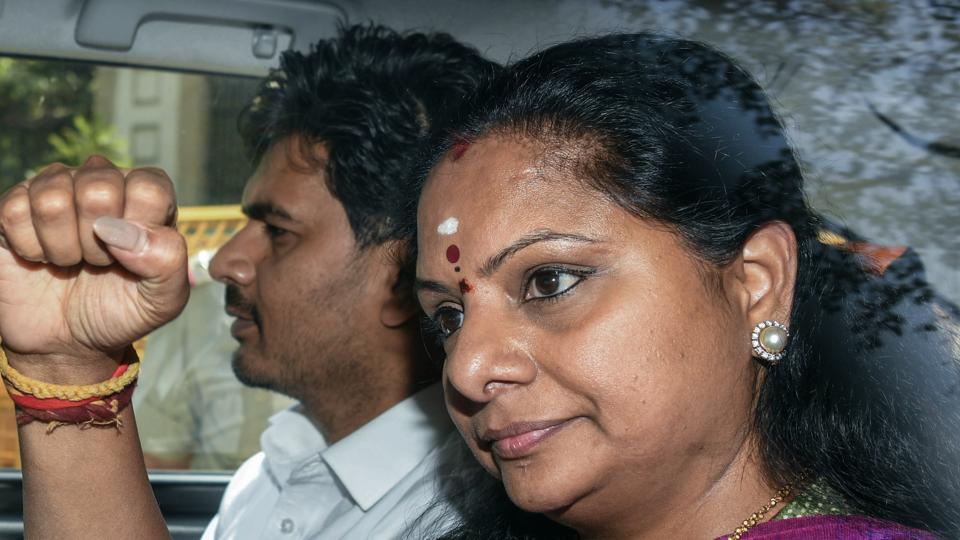
Friday’s charge sheet is the seventh in the case so far and Delhi chief minister Arvind Kejriwal, who got interim bail on Friday, has not been named in it. Officials said a separate supplementary charge sheet will be filed against Kejriwal by next week.
The charge sheet against Kavitha was filed under sections 45 and 44 (1) of the Prevention of Money Laundering Act or PMLA before a special court in Delhi, officials said. The court will hear the arguments on cognisance of the charge sheet on May 13.
The others named in the charge sheet include Chanpreet Singh, who allegedly managed the Aam Aadmi Party’s (AAP) funds procured through kickbacks in excise policy during the Goa assembly elections 2022; Damodar Prasad Sharma and Prince Kumar (employees in a firm allegedly used for routing of funds); and Arvind Kumar Singh (creative head of India Ahead news channel).
These four individuals were earlier named in a charge sheet filed by the Central Bureau of Investigation (CBI), which is conducting a parallel corruption probe in the excise policy case, in July 2023.
Kavitha was arrested on March 16 from her residence in Hyderabad. Five days later, on March 21, the agency also arrested Kejriwal alleging that a conspiracy was hatched by him, Kavitha and former deputy chief minister Manish Sisodia to benefit the “South Group” — a conglomerate of businessmen and politicians — in the Delhi excise policy 2021-22. Kavitha is currently in judicial custody and lodged in Tihar jail.
It is alleged that Aam Aadmi Party (AAP) leaders received around ₹100 crore in bribes from the South Group and that Kejriwal used his position to utilise the proceeds of crime worth about ₹45 crore from the kickbacks in AAP’s election campaign in Goa in 2022.
ED has so far arrested 18 people including four politicians — Kejriwal, Sisodia, Kavitha and Sanjay Singh; filed seven charge sheets against 34 people and entities; and submitted thousands of documents as evidence in the court in the excise probe.
Speaking about her role in the framing of the policy, an official said that Kavitha orchestrated a deal with Kejriwal and then deputy CM and the excise minister Manish Sisodia. “she, along with other members of the South Group, paid them kickbacks through a string of intermediaries and middlemen. In exchange for kickbacks paid to the leaders of AAP, Kavitha had access to the policy formulation and was offered provisions to ensure a favorable position to her,” said the official.
According to ED, there was a conspiracy by “some of the big political leaders of various political parties” to use “proxies, dummies and web of exchanges/transactions to conceal their involvement”.
The South Group comprising businessman Sarath Reddy, politician Magunta Srinivasulu Reddy and Kavitha got nine zones out of 32 in Delhi under the excise policy. The policy was brought out with an extraordinarily high 12% profit margin for wholesalers and almost 185% profit margin for retailers. As a scheme, 6% out of the 12% margin was to be collected back from the wholesalers as kickbacks to the leaders of AAP, ED has alleged.
“The South Group, however, paid this kickback of ₹100 crore in advance to Vijay Nair (AAP’s then communications in-charge), who was managing this scheme and conspiracy on behalf of the leaders of the AAP,” according to a second officer.
In lieu of this advance kickback payment, Nair ensured the South Group secured stakes in wholesale businesses as they had no hold/base in Delhi.
The Delhi government’s 2021-22 excise policy aimed to revitalise the city’s flagging liquor business. It aimed to replace a sales-volume-based regime with a license fee one for traders and promised swankier stores, free of the infamous metal grilles, ultimately giving customers a better buying experience. The policy also introduced discounts and offers on the purchase of liquor, a first for Delhi.
The plan, however, came to an abrupt end, with Delhi’s lieutenant governor VK Saxena recommending a probe into alleged irregularities in the regime. This ultimately resulted in the policy being scrapped prematurely and being replaced by the 2020-21 regime, and the AAP alleging that Saxena’s predecessor sabotaged the move with a few last-minute changes that resulted in lower-than-expected revenues.


