E-Paper



Encroachments led to Yamuna’s flooding in Delhi: Experts
Experts are calling for the removal of encroachments from Yamuna's floodplains

 Prefer HTon Google


With the Yamuna flowing above its evacuation mark of 206m for the second day in a row on Monday, experts urged authorities to demarcate the river’s active floodplain zone and remove major encroachments falling within it, noting that the mushrooming of encroachments had led to the path of the river becoming narrow in Delhi.
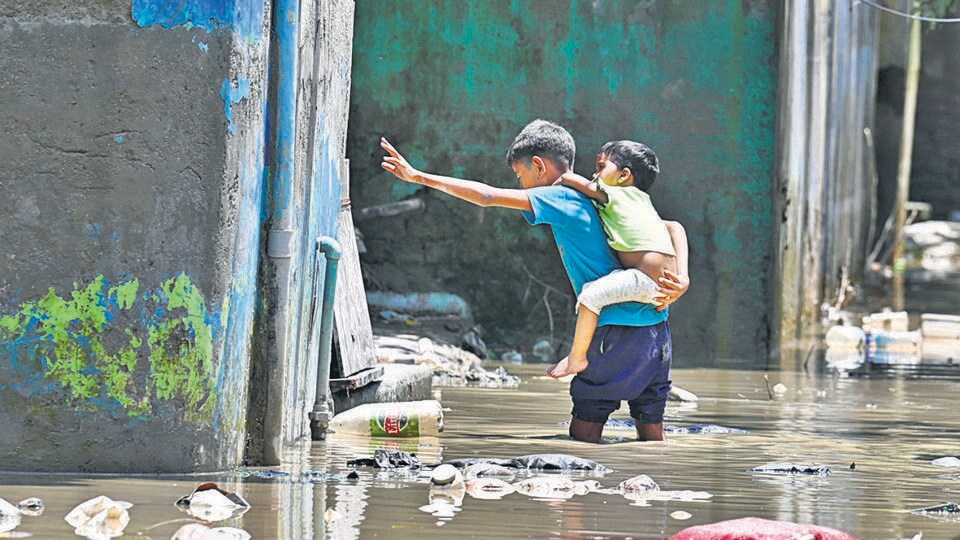
Looking at this year’s unprecedented flooding of the Yamuna, after the river touched an all-time high of 208.66m on July 13, the experts also suggested better utilisation of the canals which adjoin the barrages on the river.
The observations were made at a panel discussion organised by the citizens’ group Yamuna Sansad. The water level of the Yamuna was 205.94 metres on Monday.
AK Gosain from Indian Institute of Technology (IIT) Delhi, who worked on the Capital’s drainage master plan 2018, said two factors worked against the city — the poor design of its drains, and the increasing encroachments.
“Our drains are built wrong, as their escape levels are far lower than Yamuna’s water level during the monsoon season. The stop gates at these drains have to be closed, and this not only allows the drain water to go into the river, but also leads to inundation if it rains, as there is no way for the water to escape,” he said, adding that the drainage master plan prepared in 2018 was not accepted by the Delhi government, despite flaws in the existing plan.
“The long-term solution is to fix our drains and ensure the stormwater and sewage flows separately. Along the floodplains, we need to actively remove encroachments,” he said.
Conservationist Rajendra Singh, who is called the “waterman of India”, said rampant construction and encroachments in the Yamuna has gradually eaten away at the natural path of the river. “If there are a number of bridges in the river’s path, the silt that the river brings will get accumulated when it comes in contact with these structures. Once the riverbed starts to rise, such high levels will become more frequent,” said Singh, adding that dredging and not desilting was the solution for this high silt, but the long-term solution remains to remove major encroachments.
He further pointed to better usage of canals, stating the eastern and western canals adjoining the Hathnikund barrage in Yamunanagar district in Haryana can handle 27,000 cusecs of water combined, while the Gurugram canal — adjoining the Okhla barrage and capable of handling 50,000 cusecs — was also not used during this flood.
“If we plan better, water can be released into these canals before it crosses 100,000 cusecs. If the Gurugram canal was used, the situation could have been a lot better too,” he said.
Faiyaz Khudsar, scientist-in-charge of the Biodiversity Parks Programme of the Delhi Development Authority, said, “In order to maintain the health of the river and its flow, it is important to plant native grasses in the floodplain as part of ecological restoration.”