
 E-Paper



Experts refute state govt’s claim that 39% of land in Haryana constitutes ‘forests’
Two intervention applications have been filed in the Supreme Court stating that the state government is deliberately misinterpreting the Kant Enclave judgement


Haryana, the state with the lowest forest cover in the country (3.62% of the total area), is again mired in controversy with regard to the classification of what and how much land in the state constitutes “forests”.
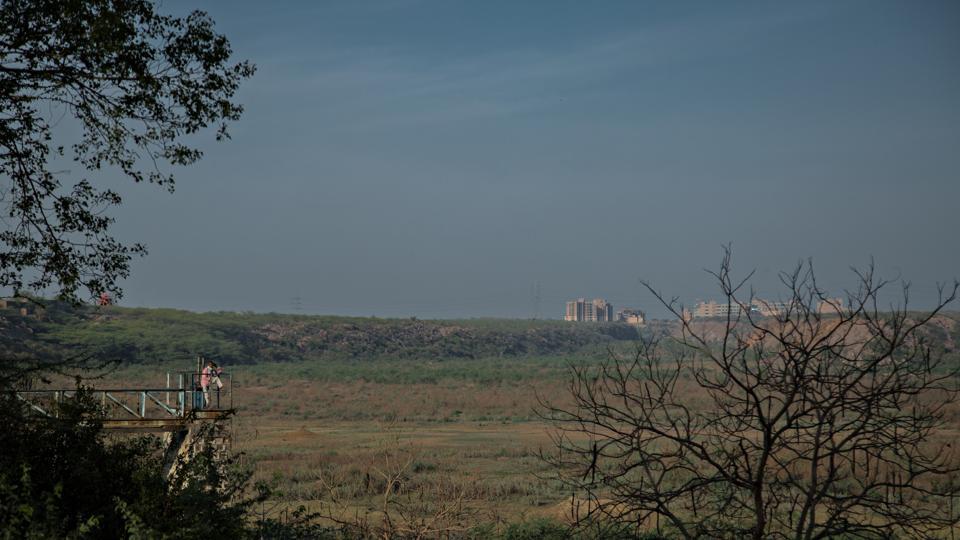
Last month, the Haryana government submitted an affidavit in the Supreme Court (SC) stating that 39.35% of the state’s total geographical area (4.4 million) and 100% of the area in 11 districts of the state is to be considered forest and hence, most buildings in Gurugram and other towns are to be demolished if the apex court’s 2018 judgement in the Kant Enclave matter is to be followed.
But now two intervention applications have been filed in the Supreme Court by Aravalli Bachao Citizens Group and Gurugram resident retired Lieutenant Colonel Sadavarman Oberoi respectively, stating that the state government is deliberately misinterpreting the Kant Enclave judgement to overstate the area notified in the Punjab Land Preservation Act (PLPA) by over 50 times to push for an amendment to the act, which would lead to loss of whatever little forest area in the Aravallis that is currently protected.
In its affidavit to the Supreme Court on October 20, in matters linked to the Khori Gaon demolition and Satpal and Others Vs Union of India, the Haryana government said that according to the Kant Enclave judgement of the SC dated September 11, 2018, areas notified under sections 3,4 and 5 of the PLPA are to be considered forest area and structures standing thereon are to be considered illegal. The affidavit urges the apex court to consider an amendment to the PLPA issued by the Haryana government on February 27, 2019 that was stayed by the SC on March 1, 2019.
“As it is, only 70% of the Aravallis in Faridabad and 60% of the Aravallis in Gurgaon are notified under section 4 and/or 5 of the PLPA (by special order) and are treated as recorded forests as per the 1996 Godavarman judgement of the Supreme Court. The SC was right to stay the amendment in 2019 within two days of its passing. If the stay is removed and the amendment is put to effect, there will be virtually no legal forest left in the Aravallis of Gurgaon and Faridabad. Earlier, the state had said there is nothing called ‘Aravalli’ in their revenue records. So, if there is no forest and no Aravalli, one can guess what will come there – only real estate,” said Chetan Agarwal, an independent Gurugram based forest analyst.
The Haryana government submitted that the areas notified under Section 4 and/or 5 (by special order) of the PLPA are treated as legal forest only because of judgements of the SC. Now, the 2018 judgement of the apex court has extended the forest cover from 31,738 hectare (0.72% of the state’s geographical area) to 1.7 million hectares (39.35%). In the amendment bill issued in 2019, the Haryana government claimed that 1.08 million hectares (25%) would become forest.
The PLPA has no provision to rectify, amend or denotify the order or notifications issued under it even when there is an inherent defect, mistakes, or certain land has been inadvertently included or found to have been issued in violation of prescribed procedure, said the government in its affidavit. The Haryana government also stated that there is no provision in the PLPA to provide reasonable opportunity of being heard before imposing restrictions and prohibition. The amendment proposed by the government is hence in conformity with the constitutional rights granted under Article 300-A (right to property) of the Constitution.
The intervention application filed by environmental lawyer Ritwick Dutta, on behalf on Aravalli Bachao Citizens Group, on November 13 states that wrong interpretation of the PLPA would lead to large scale deforestation in the state and aggravate the environmental conditions, thereby leading to deterioration of both water and air quality, which violates Article 21 (protection of life) of the Constitution.
“It is submitted that the affidavit dated 20.10.2021 filed by State of Haryana is not in accordance with the direction of the Hon’ble Court and rather a blatantly misguided attempt to override and negate the judgements of this Hon’ble Court and to justify the amendment being carried out by... the Punjab Land Preservation Act, 1900. In the interest of justice, and the ecological security of the Delhi NCR region, it is important that the real factual and legal positions with respect to the forest in Haryana with special reference to Punjab Land Preservation Act, 1900 is brought before this Hon’ble Court for proper adjudication of the matter,” states the intervention.
It points out that the Supreme Court has, in several judgements, dealt with what constitutes forest under PLPA. In fact, an affidavit filed by the Haryana government on December 8, 1996, shows the areas the government considered as forest land notified under sections 4 and 5 of the PLPA.
Dutta’s application states that in the Kant Enclave matter, the SC has interpreted that the notification under PLPA is to ensure that there is no non-forest activities, such as cultivation, pasturing of sheep and goats, construction of buildings, herding, etc. in areas notified specially under sections 4 and 5 of the PLPA.
“The Supreme Court’s Kant Enclave judgement widened the purview and said even general areas notified under certain sections of the PLPA are forests. The National Green Tribunal also started taking a similar view. Hence, the amendment to the PLPA is very important to secure areas, where we have utilities, HUDA enclaves etc,” said a senior official of the Haryana government, who did not want to be named.
The intervention applications make it clear that the Supreme Court only considers those areas--notified under sections 4 and/or 5 of the PLPA by special order --as forests. The areas are village specific and the forest department was already treating them as forests (the department has a record of the exact areas notified as forests).
All areas notified by special order in south Haryana are in the Aravalli hills, with the land type recorded as ‘gair mumkin pahar’ (uncultivable land).
Under Section 4 of PLPA, there are wide areas which are not notified and are considered to be in the general category, such as entire districts or part thereof like entire Gurgaon and part of Faridabad. One needs permission for tree cutting in these areas.
“The figure (39.35%) that the Haryana government is quoting as forest land is incorrect. Since 1964, when the state had formed the forest department, it has maintained that only certain areas notified under special orders under sections 4 and 5 are forests. Section 3 of PLPA is a general section, where restrictions on tree felling may or may not be issued. How did they suddenly discover 39.35% area is forest? The Kant Enclave judgement is pretty clear and there should be no confusion,” said R P Balwan, a former forest conservator of Gurugram.

Stay updated with all top Cities including, Bengaluru, Delhi, Mumbai and more across India. Stay informed on the latest happenings in World News along with Delhi Election 2025 and Delhi Election Result 2025 Live, New Delhi Election Result Live, Kalkaji Election Result Live at Hindustan Times.


