New Delhi: The India Meteorological Department (IMD) declared the onset of the southwest monsoon over Delhi on June 30 this year — a delay of three days compared to its normal date of June 27, which saw Safdarjung, Delhi’s base station for weather, receiving 117.2mm of rainfall in a 24-hour period between 8:30 am on June 30 and July 1.
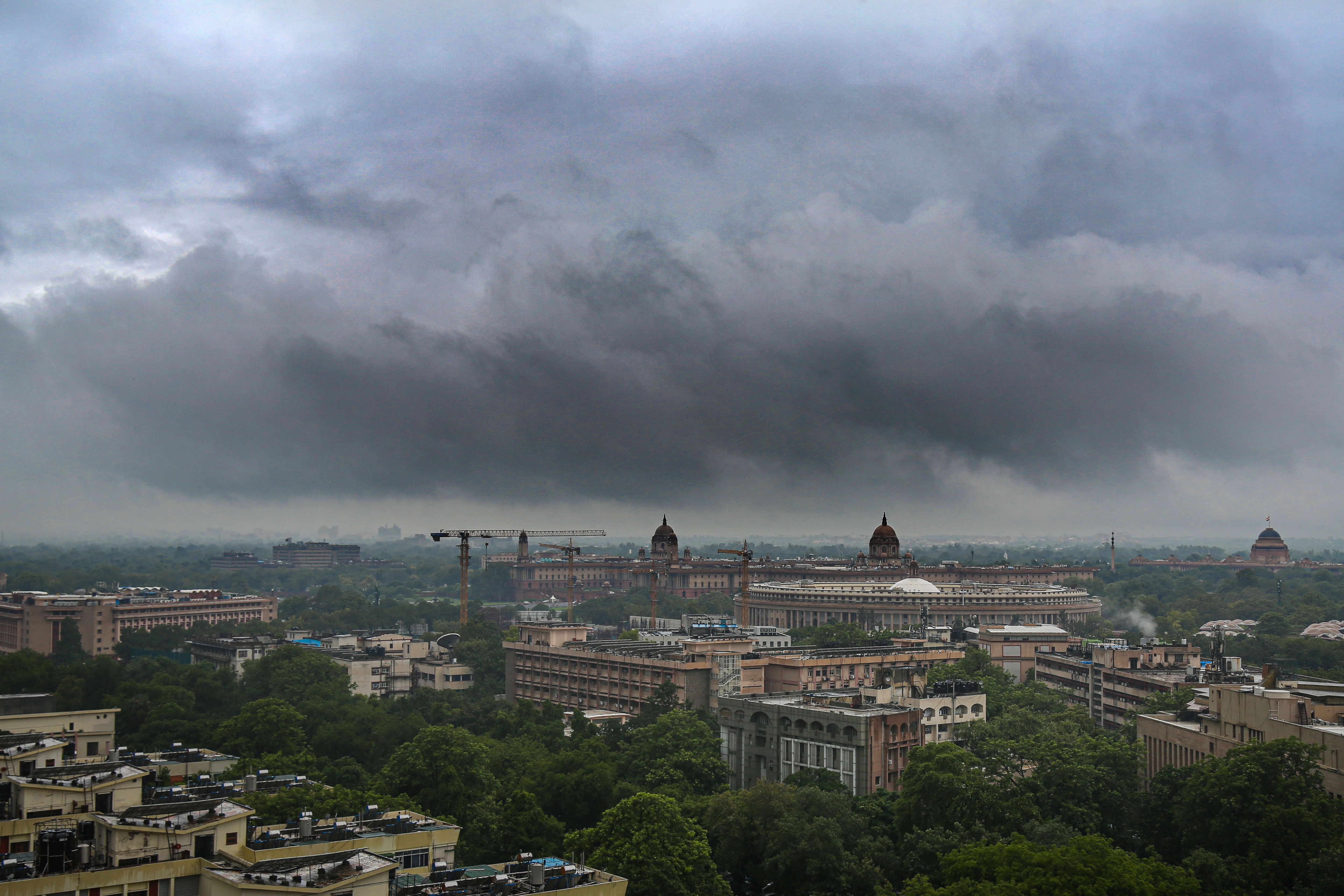
After receiving intense monsoon showers between June 30 and July 1, Delhi has only received convective rainfall. (Sanchit Khanna/HT Photo)
While this was a promising start, what followed in the subsequent days was spells of very light rainfall, with Safdarjung recording 1.9mm in the next 24 hours, then zero rainfall on July 3, 0.1mm on July 4, and 0.6mm on July 5, as the monsoon trough begin to shift south of Delhi-National Capital Region (NCR) and towards Central India. Meteorological experts say while it is the movement of this trough that largely determines the intensity of monsoon showers, impacting most in areas where the trough is directly overhead, however local weather factors such as the amount of moisture in the air, the wind direction and the temperature over a city can also cause localised ‘convective’ spells of rainfall.
After receiving intense monsoon showers between June 30 and July 1, Delhi has only received convective rainfall, which is largely characterised by a sudden formation of thunderclouds within a matter of hours, leading to intense but short spells of rainfall.
Mahesh Palawat, vice-president at the private weather forecaster, Skymet, says of the two significant spells of rainfall over Delhi this month, the first was due to the monsoon trough, with the second – bringing 30mm of rainfall to Delhi in a 24-hour window between July 16 and 17 – largely down to convective rainfall.
“If the monsoon trough moves away from a region, you will eventually start to see clearer skies and the temperature starts to rise again, however, if humidity levels are sufficient, this moisture starts to evaporate, rise and condense at higher levels to form thunderclouds, which are formed locally and lead to a short but intense spell of rain. Such spells generally don’t last long and therefore do not give enough rain as showers associated with the monsoon,” he said.
Delhi has so far received 154.9mm of rainfall in July, out of which 117.2mm was recorded in a single day. The normal monthly average for July is 210.6mm, which met officials say should be surpassed, with the monsoon trough once again returning towards north India.
What is the monsoon trough?
It is an invisible line of a low-pressure area passing through parts of India which can extend from Pakistan all the way up to the Bay of Bengal. Experts say while the trough generally passes through the Indo-Gangetic plains after the onset is declared over northern India, the creation of low-pressure areas in other parts of the country can determine where the trough moves next.
As per Palawat, three parallel low-pressure areas were created near the Arabian Sea and the Bay of Bengal over the last two weeks, drawing the trough towards Central India.
“If a low-pressure area is created over the Bay of Bengal, the easternmost arm of the trough dips southwards. Similarly, if there is a low-pressure formation near the Arabian sea, the western arm dips and this has led to strong rains over central India, particularly Gujarat over the last one week. With these low-pressure areas weakening, it should return towards northwest India in the next 24 hours, bringing sufficient rainfall to Punjab, Haryana, UP and Delhi in the next three to four days,” he says.
RK Jenamani, a scientist at IMD says the trough alone does not determine the amount of rainfall, stating suitable moisture needs to be driven towards the low-pressure area to bring moderate to heavy rainfall spells. “Generally enough moisture is attracted where the trough is, but if the trough keeps moving, then an area may not receive enough rainfall. We expect the monsoon trough to stay over northwest India for the next two to three days, so the moderate to heavy spells may occur,” he says.
In absence of a monsoon trough, humidity remains high during this period
Met officials say in the absence of the monsoon trough over an area, wind speeds remain low, while humidity levels are known to consistently oscillate between 40 and 50%, which causes peak thermal discomfort. On July 14, Delhi’s Heat Index (HI) or ‘real feel’ of the temperature – which combines humidity and air temperature to determine what the human body actually feels – came up to 58 degrees Celsius. This was when the actual maximum temperature was around 38 degrees, but humidity levels were around 67%, making sweating difficult.
Similarly, on Monday, Delhi’s HI was 56 degrees Celsius, making for another uncomfortable day as both temperature and humidity remained high.
A met official said humidity remains high during this period due to moisture-laden easterly winds driving towards northwest India, even when the trough could be far away, stating strong winds or overcast skies are generally needed for a cooling effect in absence of rain.
“Moisture is high, but if there is now a localised weather system, wind speeds are generally around 10-15 km/hr, which cannot provide a cooling effect. For that, one needs winds of 30-40 km/hr and those only occur when thunderclouds form, or when the trough is close by,” stating Delhi remains in a perpetual state of humid heat until late August and early September.

 E-Paper