E-Paper



Half of Delhi’s illegal colonies not part of sewage network
The Delhi government plans to increase its sewage treatment capacity to 814mgd by the end of the year, but many unauthorised colonies are not connected to treatment plants, leaving the Yamuna vulnerable to pollution. The government aims to connect 573 unauthorised colonies to the sewer network, but work is yet to commence due to pending construction or permissions. Local vendors often dump septage from these colonies in forests or subsidiary drains, further polluting the river. The government is also setting up decentralised treatment plants and cracking down on illegal sewage dumping.

 Prefer HTon Google


The Delhi government has pledged that it will increase its total sewage treatment capacity, from the current 632 million gallons per day (mgd) to 814mgd by the end of this year. This figure is beyond the estimated daily sewage generation mark of 792mgd, and the government plans to add new sewage treatment plants (STPs) to the sewage network, as well as upgrade the capacity of the existing plants.
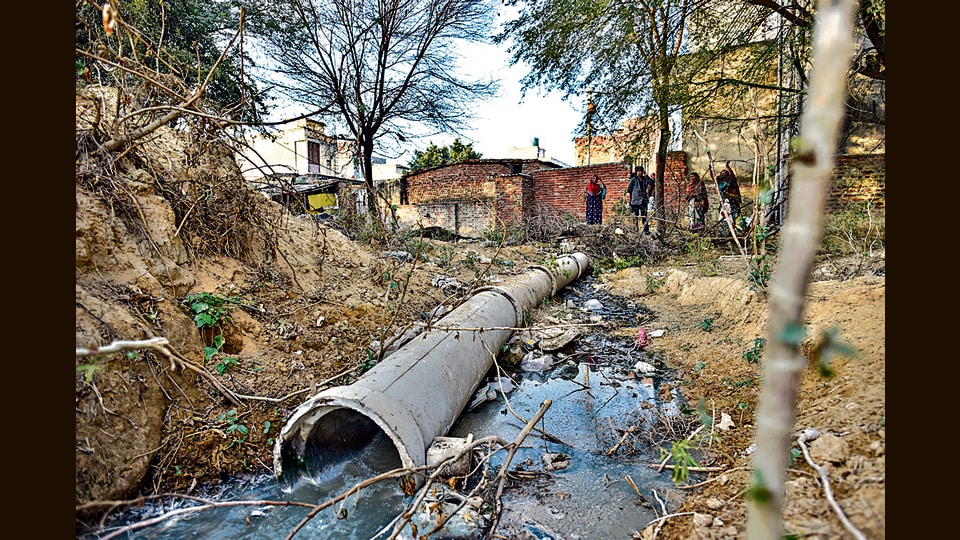
However, a large chunk of sewage does not reach STPs in the first place, leaving the Yamuna vulnerable to pollution. Of the Capital’s 1,799 unauthorised colonies, 823 — around 46% of the total — either don’t have a sewer network, or are not connected to STPs, meaning they are almost solely reliant on septic tanks, data presented by agencies in the latest high-level committee (HLC) meeting on the Yamuna shows.
The HLC was formed by the National Green Tribunal (NGT) through an order dated January 9, and consists of Delhi Jal Board (DJB), National Mission for Clean Ganga (NMCG), Delhi Pollution Control Committee (DPCC), Central Pollution Control Board (CPCB), Delhi Development Authority (DDA), Public Works Department (PWD), Municipal Corporation of Delhi (MCD), and the Delhi government’s forest and irrigation and flood control departments. The panel, headed by the Delhi chief secretary, has so far held six meetings to address pollution-related issues linked to the Yamuna.
DJB, which handles a large chunk of Delhi’s sewerage network and also manages the Capital’s STPs, informed the panel in its latest meeting on August 10 about its plans to connect 573 unauthorised colonies to its network of drains. Work is yet to commence though, with either construction work pending, or permissions still awaited in most cases.
The minutes of the August meeting say, “The chief secretary has directed DJB to expedite the work of providing sewerage system in unauthorised colonies and other concerned departments (forest, DDA and urban development) to issue NOC at the earliest. DJB to find out the number of people living in unauthorised colonies in which providing sewerage system is not feasible, so as to provide some other alternative solutions.”
At the meeting, several agencies pointed out that in most cases, septage from unauthorised colonies is collected by local vendors, who often end up dumping the waste in forests, or in a subsidiary drain that pollutes the Yamuna. In other cases, the pipelines laid down do not connect to DJB’s sewerage network or an STP, meaning the waste pollutes local ponds, or even the groundwater.
A Delhi government official, part of the HLC meeting, said in 318 colonies, decentralised STPs are to be set up to manage waste locally. In another 161 colonies — all located near the Yamuna, near monuments or Delhi’s Ridge, there are hurdles like delay in receiving a no objection certificate (NOC).
“In 161 of these cases, the NOC was still awaited from the forest department, Archaeological Survey of India, or a local body. Around 114 of these cases pertain to the forest department alone, since these colonies are located next to forest areas, and the pipelines have to be laid down through a protected or notified forest,” said the official, requesting anonymity.
However, both the forest department and ASI have put the blame on DJB for the delays.
A forest department official said in most cases, DJB was yet to provide a detailed alignment map of the sewerage network, based on which they could determine whether or not to issue an NOC. “This may possibly involve felling of trees too. A majority of these unauthorised colonies fall in Chhatarpur, Sangam Vihar and in Mehrauli,” the official said.
Similarly, ASI has informed DJB that while it issues an NOC for connecting an unauthorised colony in Mehrauli to the sewerage network, it could not give permission for another colony in Tughalaqabad, which was located near the Tughalaqabad Fort.
DJB itself, meanwhile, said it found it unfeasible to lay down pipelines in 12 colonies.
The existing capacity of Delhi’s STPs is just 632mgd, and several plants are not functioning at full capacity, which means that their operational capacity is only 547mgd — translating to gap of 245mgd sewage that ends up in the Yamuna without treatment.
Currently, three new STPs – Okhla, Sonia Vihar and Delhi Gate — are being constructed with a combined capacity of 47mgd. At the same time, 18 existing STPs are being upgraded to add a treatment capacity of 123mgd, and the government is in the process of setting up 40 decentralised STPs with a combined capacity of 90mgd. However, experts note Delhi is still missing the last link of connection.
“What we require is proper planning, as unauthorised colonies, unlike planned colonies, do not have a proper drainage or sewerage network. A key reason behind Yamuna’s pollution is this fact,” said Yamuna activist Bhim Singh Rawat, who is a member of the South Asia Network on Dams, Rivers and People (SANDRP).
Rawat said STPs and their expansion can only be planned once a proper sewerage network is laid out, which includes unauthorised colonies and JJ clusters. “We are upgrading plants and then thinking how we can connect the colonies. By the time that happens, more colonies have sprung up and the sewerage quantum has increased,” Rawat added, stating a focus towards decentralised STPs was more welcome, as it allows localised plants to be set up, without requiring a detailed network of pipes.
Depinder Kapur, director of Water Programme at Centre for Science and Environment (CSE), said it is easy to connect a small unauthorised colony to the main sewerage network, but for the larger colonies, it may take several years. “For Sangam Vihar, the process to lay down sewage lines has been going on for almost four years now and it is yet to be completed. Most unauthorised colonies have a sewage pipeline near it, as there are authorised residential colonies in proximity, so this needs to be tackled smartly. If land is available, DSTPs are a great option, but in dense areas, particularly east Delhi, it is simply not possible to set up one,” he said.
An environment department official said that over the last two years, around 400 colonies have been provided a sewage network. “The figure was 571 colonies in March 2021. This has increased to 747 colonies as of January 1, 2023. Till August, work has been completed across another 229 colonies,” the official said.
To crack another avenue of this sewage ending up from septic tanks to the Yamuna, DPCC through an order on March 27 said that it will impose a penalty of ₹50,000 on any vendor found discharging septage in undesignated areas across Delhi, or directly into drains or sewers. The order said the anti-pollution body will also confiscate the vehicles of such offenders.
The order added that any individual using the services of such unlicensed vendors will be fined ₹10,000, in a bid to crack down on illegal dumping of sewage.
A DPCC official said action can be taken by any officer not lower than the rank of naib tehsildar in the district magistrate office, sub-inspector in the Delhi Police, sanitary inspector in MCD, and junior engineers in DJB or the irrigation and flood control department. “We have also asked for monthly action-taken reports to be submitted by these agencies each month” the official said.