E-Paper



Merged MCD could slash top-level posts, may cause disputes, tussles
Until 2012, the unified MCD had 22 departments, each headed by a senior bureaucrat and one engineer-in-chief who reported to the commissioner. After the trifurcation in 2012, everything tripled.

 Prefer HTon Google


If the Centre goes ahead with the plan to unify Delhi’s the three municipal corporations (MCDs), each with their own bureaucratic chain of command, it may create a leaner organisation but also one that could lead to administrative headaches and litigation, senior officers who understand the workings of municipalities said.
Until 2012, the unified MCD had 22 departments, each headed by a senior bureaucrat and one engineer-in-chief who reported to the commissioner. After the trifurcation in 2012, everything tripled.
“Instead of 22 heads of departments, we had 66 department heads across the three MCDs. Three commissioners, three engineer-in-chiefs, three education directors, three municipal health officers, and their deputies. For some officials it meant rise in salaries, promotions, perks and official vehicles,” said Deep Chand Mathur, who worked as the MCD’s director of information, between 1980 and 2011.
One of the officials cited above said before the government finalises the plan to merge the three corporations into one, it will need to draw a seniority list of the officers to see who is given what responsibility. “There cannot be three engineers-in-chief,” he said.
These officials, most of whom spoke on condition of anonymity, said it might also lead to disputes as some of the officers will have to be demoted to be accommodated into the new set-up.
“It was easier to trifurcate as the number of departments, HoDs and senior positions tripled. People who were lower in seniority list became head of departments, deputies, and so on in the other two civic bodies. Now, when the process is reversed, will the directors and heads accept a junior designation? It may lead to hundreds of cases being filed in tribunal (Central Administrative Tribunal),” a senior South Delhi Municipal Corporation (SDMC) official in the personnel department said, asking not to be named.
Also Read | MCD elections: AAP looks to redraw its campaign, motivate party cadre
Several high-ranking officials in various departments also expressed similar reservations. “If a common cadre and seniority list needs to be implemented, then the designation should not be taken away. We can keep it as officer 1, 2 and 3. Otherwise it will lead to disputes,” a senior head of the department in north MCD said.
MCD was the second-largest civic body in the world after the Tokyo Metropolitan Area when it was trifurcated by the then Congress government, according to several serving and retired civic officials. It was headed by a commissioner, who was assisted by six additional commissioners, 22 directors and department heads overseeing key functions such as horticulture, education, engineering, sanitation among others.
Yogender Maan, retired director (information), MCD, said just by cutting down the bureaucracy into one-third of what it is today, would save the corporations nearly ₹200 crore per annum.
The civic structure
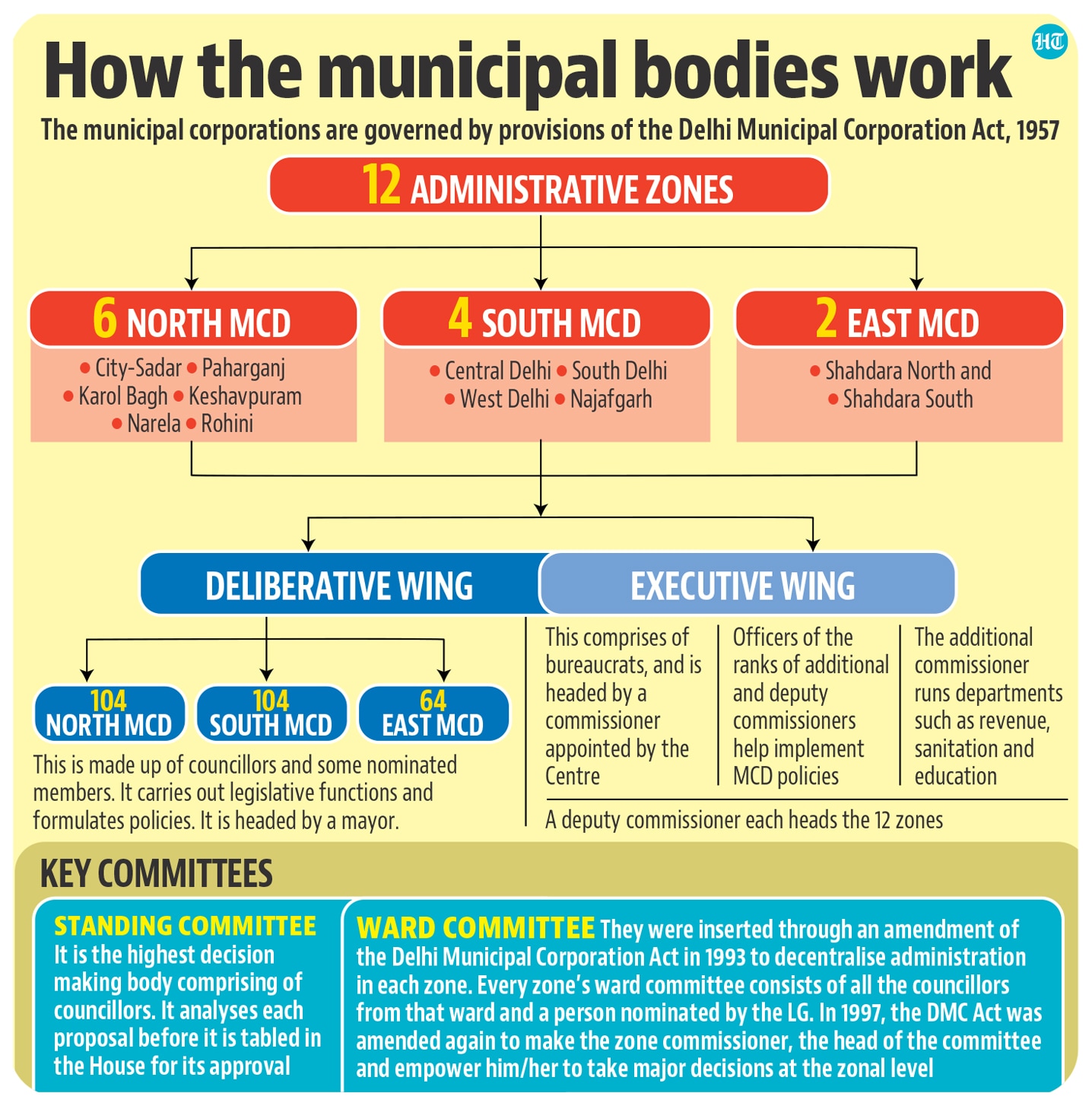
The municipal corporations in the city are divided into two wings -- deliberative and executive. The deliberative wing is involved in policymaking and comprises of elected councillors, their house (general body) and statutory committees. The executive wing headed by the municipal commissioner executes these policies and provisions of the Delhi Municipal Corporation Act, 1957, for the housekeeping of Delhi. There are 12 administrative zones, each headed by a deputy commissioner. The chain of command runs from the commissioner, additional commissioners to department directors and deputy commissioners at zonal level.
KS Mehra, the last commissioner of the unified MCD, said unification will lead to a more disciplined approach. “Unified MCD will be better off in terms of administrative structure with a common command. We had better discipline and much senior cadre officers at the helm of affairs before 2012. The MCD commissioner used to be a joint secretary rank IAS officer. It will be better for the capital,” Mehra said.
Former mayor and veteran MCD politician, BJP’s Subhash Arya, who has been associated with the municipal body for over 25 years, is among those who have been advocating for a unified civic body. He said it will ensure experienced officials as department heads and bring uniformity in rules.
“With dilution of MCD’s powers, the administrative oversight also got diluted. A common administrative structure will also bring uniformity of rules and regulations,” Arya said.
Former North MCD mayor and standing committee chairman Jai Prakash said under the current set up MCD levies and regulations could be different in the same area. “For example, in places such as Daryaganj, which is divided between North and South MCD, we have a situation in which different charges and license fee are being levied at different ends of the same road. Under a common set-up, we will have a common regime of parking fee, house tax, factory licence, advertisement charges, etc,” he added.
But several problems still remain.
Issues persist
Apart from hierarchical and organisational concerns, some of the issues that the unification process may have to deal with are reservation status of wards, allocation of office spaces, pending arrears owed by citizens in different parts of city based on different tax rates, rationalisation of personnel/human resources and deciding on the controlling authority for corporations.
The unified MCD will lead to a complete rejig of the reservation status of 272 municipal wards under three corporations. The State Election Commission on January 25 released a list of 160 wards that were be reserved for women and the Scheduled Castes (SC) based on the distribution of the people belonging to the SC community in different wards. According to the new arrangement, 46 wards have been reserved including 24 for women from the community while 50% of seats (114 wards) are reserved for women. “The reservation process for the wards is carried out in descending order of percentage of SC population in each corporation. The unified MCD will have a different order, and thus the process will need to start from scratch,” an official familiar with the matter said.
Then, a unified MCD will also have to thrash out a formula on the disposal of a cumulative liabilities of ₹11,800 crores, before it can budget its resources, a senior officer in the SDMC’s finance department said. The status of pending taxes, fee and arrears will also have to be taken into account, the official said.
“All three corporations have had different tax and fee rates in multiple categories. How a unified corporation will deal with these charges imposed over the last decade on a differential basis still remains unclear. It can invite legal challenges,” an official from North MCD said.
The reunion will also have to deal with the question of ‘controlling authority’. During the trifurcation, the Sheila Dikshit government allowed the Centre to have controlling powers under the post of a director (local bodies). But then the Congress was in power both in Delhi and at the Centre. However, with two different parties at the helm, the question will have to looked at again.
A retired Delhi government official who was involved with the trifurcation said the process is not going to be easy.
“Unifying the three MCDs again will take amendments to the DMC Act. During Sheila Dikshit’s time the bill to trifurcate the MCDs was tabled in the Delhi assembly, and then sent for the President’s assent. Since Congress was in power both in Delhi and at the Centre, it took place smoothly. However, in this case, since AAP has a majority in the Delhi assembly, the Centre might have gone for directly introducing a bill to amend the DMC act in the Parliament. This may lead to a confrontation between the two parties,” the official said.