
 E-Paper



PM Modi launches expanded T1 at Delhi’s IGI airport, capacity now at 40 million
The terminal will now expected to undergo a series of trials before being fully operational in May, officials said

 Prefer HTon Google


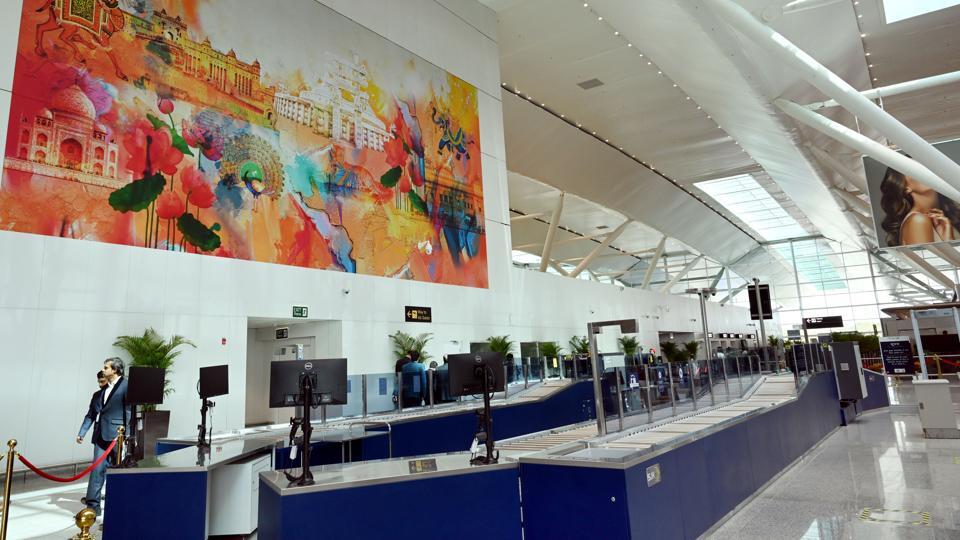
Prime Minister Narendra Modi inaugurated 15 new airport projects across the country virtually on Sunday, which included the new and expanded Terminal 1 (T1) of Delhi’s Indira Gandhi International (IGI) airport.
Read here: PM inaugurates 15 new airport projects including Delhi’s revamped Terminal 1
The terminal will now expected to undergo a series of trials before being fully operational in May, officials aware of the matter said. Presently, only a portion of T1 is operational, as it has been during the construction which began in 2019.
T1 will continue its domestic operations once fully operational but the shifting of airlines to the new terminal is yet to be decided, the Delhi International Airport Limited (DIAL) said.
The operational capacity at the expanded T1 has more than doubled — from the existing 17 million passengers per annum (PPA) to around 40 million PPA — also taking the overall capacity of the IGI airport to over 100 million PPA. The new T1 has brought both arrivals (T1C previously) and departures (T1D) under one roof, which has more than tripled its total.
The total area of the previous T1 was 55,740sqm, which has now been increased to 206,950sqm, DIAL said. The terminal was sliced into two parts with a 19-metre-high facade of puff panel. This facade shielded the operating part of T1 from dust, smoke, and rain during the construction.

“Terminal 1 enhances capacity and redefines the passenger experience while embracing sustainability. The expanded integrated terminal, a marvel of innovation and aesthetics, will serve 40 million passengers annually, double its previous capacity. Through this project, we have reimagined a seamless journey facilitated by facial recognition, self-service kiosks, and automated baggage systems. Spacious concourses bathed in natural light, offering a haven of comfort with prayer rooms, yoga areas, and quiet zones are its integral part,” said I Prabhakara Rao, group deputy managing director, GMR Group. DIAL is a GMR-led consortium that manages the airport.
Union civil aviation minister Jyotiraditya Scindia said that the new aviation projects have added a new chapter to passenger convenience. In a post on X, Scindia said: “These aviation projects worth ₹9,811 crore will not only connect people to people and country to country but will also develop every corner of the country.”
The other projects launched by Modi during an event at Uttar Pradesh’s Azamgarh include 11 new terminal buildings of Pune, Kolhapur, Gwalior, Jabalpur, Lucknow, Aligarh, Azamgarh, Chitrakoot, Moradabad, Shravasti and Adampur Airports, along with laying of the foundation stone for new terminal buildings of Kadapa, Hubballi and Belagavi airports. These terminal buildings also have state-of-the-art passenger amenities and are equipped with various sustainability features like double insulated roofing system, provision of canopies for energy saving, LED Lighting, etc.
Sharing details about the new T1, DIAL said passenger facilities were at the forefront of their revamp, which will include facial recognition systems or DigiYatra at all entry gates. There will be a total of 24 entry points to the terminal in total.
“There will be 20 Automated Tray Retrieval System (ATRS), Individual Carrier System (ICS), 108 Common Usage Self Service (CUSS), 100 check-in counters including 36 Self Baggage Drop (SBD) kiosks, among others. The seamless journey is complemented by a myriad of offerings, including expanded baggage reclaim carousels, multiple entry gates, and enhanced shop and dine facilities,” said a DIAL spokesperson, adding that to board the aircraft, T1 also has a smart-apron, with 22 contact stands.
The new T1 also has 10 baggage reclaim carousels — each 70 metres long. Earlier, there were eight baggage reclaim carousels in total, each being 52 metres belts. DIAL said with ample space between two baggage belts, the waiting time should be reduced for passengers.
“The capacity of the Baggage handling system at T1 has also doubled from 3,240 baggage per hour to around 6,000 per hour. The number of check-in islands has also been increased to five against four earlier. These would help in the easy flow of passengers and enhance passenger experience,” the spokesperson added.
The terminal will be connected with the Delhi Metro at both arrivals and departures via the Magenta Line.
Read here: To be inaugurated on March 10, new Pune airport terminal building to function after 3 weeks
DIAL CEO Videh Kumar Jaipuriar said with the multiplicity of agencies involved, final tests and trials have to be carried out before the new terminal can be operational. “Agencies and personnel have to get used to the new building and the facilities. We expect this to become operational by May. This will continue to run domestic flights, as earlier,” he said.
With this expansion, T1 has a capacity of 40 million passengers per annum (MPPA). Terminal 3 (T3) is around 45 MPPA and Terminal 2 (T2) can handle around 15-17 MPPA.
DIAL said the next plan of expansion will focus on T2, which will see it being demolished to make a new Terminal 4. .



