E-Paper



Delhi floods: At Nigambodh, a search for remains
Relatives of people cremated before the closure of the facility started returning to the complex to collect the remains, only to find them mixed with sludge

 Prefer HTon Google


At Nigambodh Ghat, the biggest cremation facility in the city on the banks of the Yamuna, the receding water level of the river has left behind a new set of problems — damaged equipment, non-functional hearse vans, missing records, and thick sludge covering the entire complex.
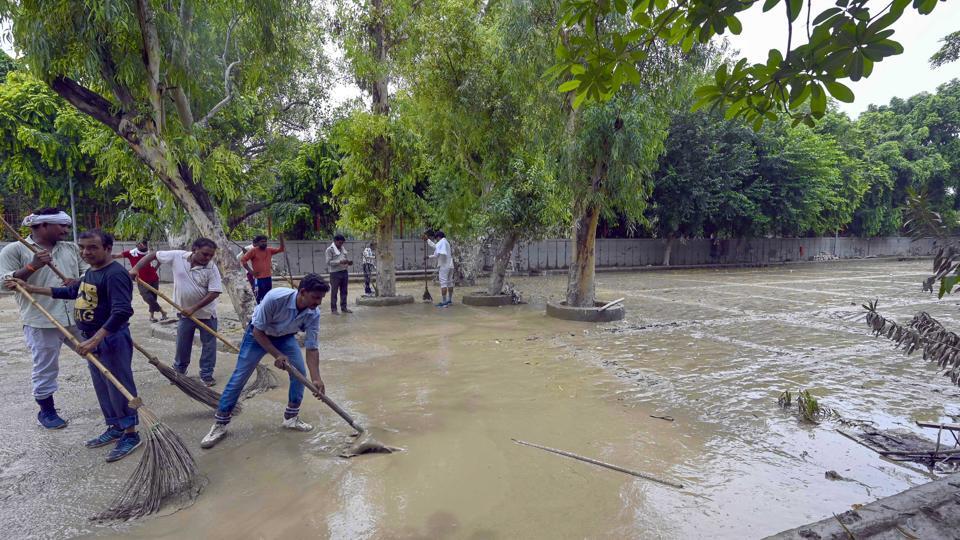
HT conducted a spot check on Tuesday afternoon and found that while the main entry corridor of the funeral complex was cleared, ankle-deep water and sludge were seen in the corridors, offices, and pathways leading to the raised platforms.
Relatives of people cremated before the closure of the facility started returning to the complex to collect the remains of their loved ones, only to find them mixed with sludge. Efforts were underway on Tuesday to clean up the 120 funeral platforms, the newly built parking lot, and offices of the Ghat.
Suman Gupta, general secretary of the managing committee of an NGO, Badi Panchayat, which manages the facility, said the municipal corporation had deployed 250 workers to clean up the slurry and mud. “Three jetting machines have also been put to use to clean the layers of mud and a section of the complex may be operational again by Wednesday,” Gupta said.
The newly constructed automatic multilevel parking was also inundated and damaged and its motors and panel may need complete replacement, a supervisor of the facility said. Similar damage was seen in six CNG-based furnaces.
Gupta said that the final estimates will only be made after the clean-up was complete but the losses may run into several crores. “All the air conditioners, electrical equipment, hearse vans, and vehicles are non-functional. We have also lost the written records of the last 5-7 years,” he added.
Meanwhile, families that carried out the cremations before the closure last Wednesday returned to collect the remains. Virender Maggo, 50, a resident of Shakti Nagar arrived with his family to collect the remains of his mother. He waded through the sludge to separate the remains and carefully collected them in a red cloth. “The cremation took place last Tuesday. The tradition says that ashes are to be collected two days later. We have been coming almost every day to see the situation,” he said.
Umesh Sharma, 43, a priest at the complex, said that many people have assumed the remains would have washed away but since the platforms were higher, some of it could still be recovered. Gupta said the remains in the lockers were also safe.
The NGO running the facility has also written to the Municipal Corporation of Delhi saying that the flood has damaged old records, computers, wood stock, and hearse vans. Meanwhile, waterlogging continued in the area abutting the Ghat near Yamuna Bazar, and pumps were deployed to drain the site.