Once again, it didn’t take a deluge – just a few hours of scattered showers on Friday – for Delhi’s fragile infrastructure to unravel.
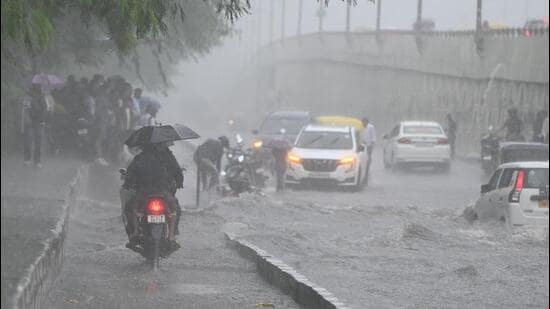
By late morning, the Capital was already groaning. Roads caved in, cars sputtered to a halt in waist-deep water, potholes swallowed cars, and endless traffic jams turned office commutes into hours-long trials of patience. It was a scene the city has come to expect every monsoon, where even “moderate” rain is enough to topple civic promises.
According to the India Meteorological Department (IMD), Safdarjung recorded 56.2mm of rain between 8.30am and 11.30am, 7.2mm between 11.30am and 2.30pm, and 0.3mm in the next three hours. While not extreme, the showers triggered a cascade of collapses — literal and figurative.
The most dramatic visuals came from Patparganj, where residents were seen wading through waist-deep water under a flyover. Buses stalled, cars were abandoned, and two-wheelers were dragged aside as stormwater swallowed the carriageway.
“Waterlogging here has been a problem for decades. Desilting drains is not enough. The entire drainage system of East Delhi needs an overhaul,” said BS Vohra, president of East Delhi RWAs’ joint front.
Then in south Delhi, near the Jamia Nagar Metro station, a portion of the carriageway from Holy Family Hospital caved in. A light goods vehicle, unlucky enough to be crossing at the time, was partially swallowed by the ditch. Traffic police scrambled to shut the road, further choking the critical Mathura Road, which connects Ashram Chowk to the Faridabad border.
Elsewhere, the situation wasn’t much better. The Outer Ring Road – the lifeline of city’s south – practically turned into a parking lot. On the New Rao Tula Ram flyover, cars stood bumper-to-bumper from Munirka to IIT; further south, traffic was frozen between Chirag Delhi and Kalkaji Temple.
{{/usCountry}}Elsewhere, the situation wasn’t much better. The Outer Ring Road – the lifeline of city’s south – practically turned into a parking lot. On the New Rao Tula Ram flyover, cars stood bumper-to-bumper from Munirka to IIT; further south, traffic was frozen between Chirag Delhi and Kalkaji Temple.
{{/usCountry}}Things were no better on the Ring Road: heavy jams from Dhaula Kuan to ITO, with snarl-ups reported at Moti Bagh, Bhikaji Cama, and Safdarjung flyover.
Frustrated commuters turned to social media. “@dtptraffic heavy traffic on a daily basis, no solution in sight,” one user posted on X, attaching screenshots of a blood-red Google Maps. Another, stuck in Sarita Vihar for two hours, complained of “no traffic assistance from police.”
By evening, the Pragati Maidan tunnel had transformed into a slow-moving snake of vehicles, while cars barely crawled on Vikas Marg, Bahadur Shah Zafar Marg, and near Kashmere Gate. In east and west Delhi — Rajouri Garden, Uttam Nagar, Paschim Vihar, Laxmi Nagar — it was the same story: choked intersections, honking horns, and no clear escape.
Traffic Police officials said they received 28 calls related to jams, five on potholes, and one about a fallen tree till 8pm. “We deployed additional personnel across 88 waterlogging-prone sites and coordinated with civic agencies to pump out water,” said Dinesh Kumar Gupta, additional CP (traffic). “But during morning and evening peaks, congestion was unavoidable.”
The list of waterlogged stretches read like an annual monsoon litany: Mehrauli-Badarpur Road near Sainik Farms, parts of Najafgarh and Rohtak Road, Lajpat Nagar, GT Karnal Road between Mukarba Chowk and Azadpur, Zakhira flyover, Saraswati Vihar, Trilokpuri, Keshavpuram, and Anand Parbat. Reports also came from Dwarka, Rohini, Badarpur, and Mangolpuri.
In Pitampura, residents in Saraswati Vihar wryly remarked that their streets now doubled up as “seasonal lakes.” In Vinod Nagar, children were seen splashing barefoot in puddles.
The civic bodies insist they are working to address complaints. The Municipal Corporation of Delhi (MCD) said its teams handled “minor waterlogging” in several areas. The Delhi Development Authority, meanwhile, pointed to ongoing upgrades.
As evening traffic thinned, the abandoned goods vehicle still lay wedged in the Jamia Nagar ditch, a symbol of Delhi’s broken civic backbone. In Patparganj, the water finally receded, leaving a film of mud and plastic wrappers behind. But the larger unease remained. For a city of over 30 million, Delhi’s relationship with rain has become one of dread.
Wettest August in 15 years
If Delhiites felt like the rains just wouldn’t end this season, the data backs them up. By Friday evening, Safdarjung observatory — the city’s base marker — had recorded 400.1 mm of rainfall in August, making it the wettest August since 2010.
That year, Delhi had received 455.1 mm, against a long-period average of just 233.1 mm. Since then, only three Augusts have crossed the 300 mm mark — 2012, 2013, and 2024. The driest in recent memory was August 2022, when the city saw barely 41.6 mm.
This time, the intensity has come in bursts, often overwhelming already fragile infrastructure. “It isn’t just the total rainfall,” said an IMD official. “Short spells of heavy showers, combined with poor drainage, lead to the worst urban flooding.”
According to forecasts by the IMD, generally cloudy skies are expected to persist throughout the weekend, with possibility of very light to light rain along with thundershowers during the morning hours of Saturday.
“Active monsoon conditions are likely to prevail over Delhi during next five days, with possibility of moderate rain on Sunday,” an IMD official added.
Stay updated with all top Cities including, Bengaluru, Delhi, Mumbai and more across India. Stay informed on the latest happenings in World News along with Delhi Election 2025 and Delhi Election Result 2025 Live, New Delhi Election Result Live, Kalkaji Election Result Live at Hindustan Times.
Stay updated with all top Cities including, Bengaluru, Delhi, Mumbai and more across India. Stay informed on the latest happenings in World News along with Delhi Election 2025 and Delhi Election Result 2025 Live, New Delhi Election Result Live, Kalkaji Election Result Live at Hindustan Times.