
 E-Paper



Delhi: Rainfall deficit of 54% in August so far
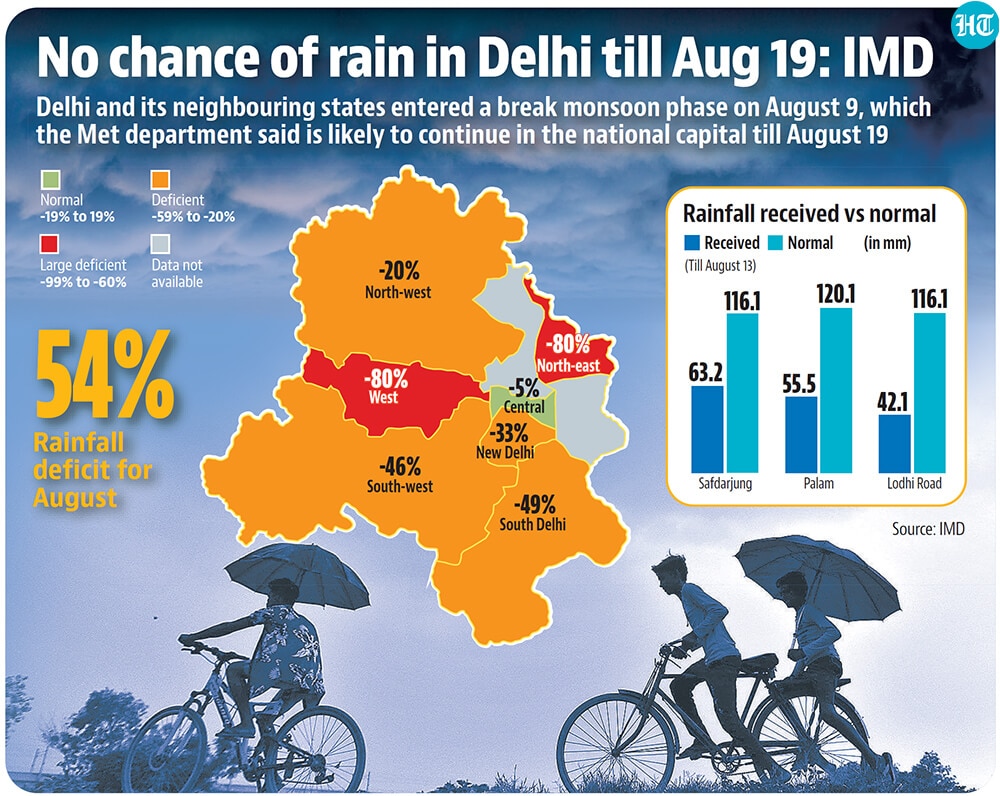
Till August 13, the Safdarjung weather station recorded 63.2 mm rains, close to half the 116.1 mm which is the normal for the month

 Prefer HTon Google


After experiencing above average rains in July, Delhi has fallen back to recording a rainfall deficit of nearly 54% in the first half of August, India Meteorological Department (IMD) recordings showed. Met officials and private weather forecasters, however, said that despite a dry start to the month, August is likely to cover its rainfall deficit in the last 10 days and it is likely to be a “near normal” monsoon month.
IMD recordings show that this July, the rainfall at 507.1 mm was more than twice the average of 210.6 mm for the month. As August began, the showers relented.
Till August 13, the Safdarjung weather station recorded 63.2 mm rains, close to half the 116.1 mm which is the normal for the month.
Analysis further showed that south Delhi is standing at a 49% rainfall deficit, southwest Delhi is at a 46% deficit and New Delhi recorded a 33% rainfall deficit. Northwest Delhi saw a 20% rainfall deficit, west Delhi saw an 80% deficit and northeast Delhi recorded an 80% rainfall deficit.
While this is partly because of the ‘break monsoon’ phase that the northwest and central India are experiencing currently, weather experts said that even before the Capital went into the break phase, it only recorded three rainy days. Even in these three days, the city recorded only light to moderate showers.
According to weather experts, break monsoon is a phase typical of the southwest monsoon. This pause could last a couple of days or even a fortnight. Break monsoon is categorised by the trough shifting northwards and closer to the foothills of the Himalayas.
While rainfall decreases in parts of north, northwest and central India, this weather phenomenon results in an increase in showers along the Himalayan foothills, in northeast India and also along the southern peninsula.
Delhi and neighbouring states entered a break monsoon phase on August 9 and according to initial forecast this pause was likely to continue till August 16. However, in a recent forecast, the Met officials said that Delhi is likely to come out of this break phase only after August 19.
Kuldeep Srivastava, head of IMD’s regional weather forecasting centre, said, “There are no chances of rains till August 19. Revival of monsoon with only light rain is expected around August 19 and August 20.”
While half the month has already gone in a dry spell, forecasters are still hopeful that August is likely to cover its deficit. “The monsoon trough is expected to shift southwards after August 15, but that will result in rainfall around Punjab and Haryana. While there could be patchy rains in Delhi, but it will take a few more days for rains to be more consistent in this region. However, the forecast says that after August 19, rains will become intense and we can get a near normal monsoon month,” said Mahesh Palawat, vice-president (meteorology and climate change), Skymet Weather Services, a private weather forecasting agency.
Weather officials also stressed that this was another example of erratic weather patterns Delhi has been recording over the last few years. This year, such extreme weather events were particularly jarring and this could be the larger impact of climate change, experts said.
“It is true that the rainfall patterns are changing in the entire country. Delhi some 10 years back used to get an average of 15-20 rainy days, but now we are observing that the number of rainy days have reduced to only around eight to ten. This means that the rain spells are shorter and more intense. It is only natural that if the same amount of rain is received in a matter of a week as opposed to being uniformly distributed through the month, it will lead to incidents of flooding,” said a senior Met official, asking not to be named.


