
 E-Paper



Rampant construction leaves Delhi choking on dust
Despite Delhi's severe air quality, small and mid-scale construction persists, worsening pollution as enforcement of regulations falters amid manpower shortages.

 Prefer HTon Google


New Delhi
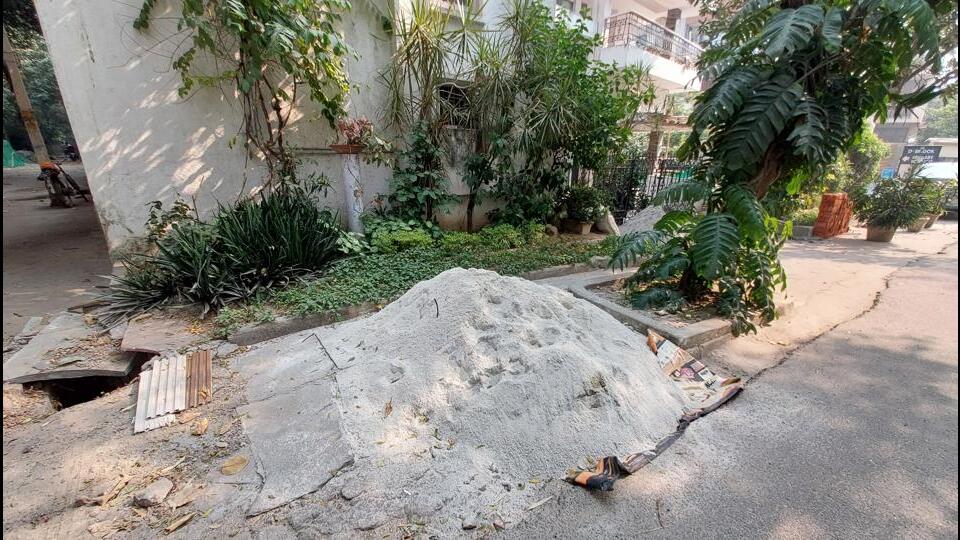
On the day Delhi’s air quality index (AQI) slipped into the “severe” category, prompting the imposition of Stage 3 of the Graded Response Action Plan (Grap), spot checks by HT found rampant small and mid-scale construction ongoing across the city, leading to widespread release of dust.
To be sure, curbs on private construction come into effect under the Grap Stage-3.
Piles of debris, heaps of sand and uncovered construction materials could be seen scattered across roadsides from south to east Delhi. Illegal digging work, dust-spewing trucks and makeshift repair projects continued unabated, exacerbating the ongoing pollution crisis.
At multiple locations, residents said that despite repeated complaints, civic teams have failed to act. Officials from multiple agencies admitted that enforcement is proving difficult due to manpower shortages and poor coordination between departments.
At the busy Sarojini Nagar market, a thick haze hung over the area as construction activity went on behind half-drawn barricades. Trucks carrying cement and sand, without any covering, moved in and out.
“The entire Vinayak Road is always covered in dust due to ongoing construction. Work at a school near the metro station started recently, but there’s no protective cover. All our shops get coated in dust by the evening,” said Ashok Kalra, president of the Sarojini Nagar Shopkeepers’ Association.
Near the main Sarojini Nagar bus stop, where piles of debris had been dumped by the roadside, workers were seen mixing cement in the open, even as the nearby air quality monitor flashed readings above 420 in the “severe” category.
Not only market zones, but such offences were also reported from residential sites of Vasant Vihar and Defence Colony. At a site in Defence Colony, workers had cordoned off a lane for relaying tiles, while debris and construction waste spilled onto the carriageway.
At a construction site near the Oberoi flyover, workers were seen carrying out piling work without any dust-control measures. A steady stream of dumpers unloaded sand and gravel onto the side of the carriageway, covering parts of the road in a thin film of dust.
In Jangpura, adjacent to the metro station, tiles were being laid along a footpath with open bags of cement and sand stacked along the road. None of the materials were covered, being strewn around.
PK Paul, of the Chittaranjan Park residents’ welfare association, said, “Every part of Delhi is riddled with violations, including multiple construction and demolition sites. As per rules, construction materials are supposed to be covered when being transported or stored, but we see so many instances of this not happening. The dust because of this affects every citizen of the city and we see the result every winter, when breathing becomes a privilege.”
In east Delhi, violations were rampant at Preet Vihar, Laxmi Nagar and Karkardooma. Several small-scale projects, from house demolitions to private reconstructions, were underway. Near the Preet Vihar Metro Station, a residential plot was being rebuilt, with dust swirling from an uncovered debris pile. In Laxmi Nagar’s narrow lanes, workers were cutting marble in the open.
Residents said that the situation is no different in parts of north Delhi. “Construction dust is a big problem, with metro construction and building construction being the maximum contributors of dust in the area. If you go to certain areas, such as Ghantaghar Chowk at night, you cannot breathe. This is especially bad for small children,” said Ashok Bhasin, the president of a federation of North Delhi RWAs.
“Additionally, I have rarely seen water being sprinkled. Many environmental norms are also flouted, as construction materials such as sand and bricks are always kept on the road. If 100 people come to meet me in a day, almost 90 of them will be complaining about the dust due to construction projects,” said Ashok Bhasin, the president of a federation of North Delhi RWAs.
Under Stage-3 of Grap, all non-essential construction and demolition activities are banned, except for critical public projects, such as metro work, hospitals, and infrastructure related to national security. However, enforcement has been weak on the ground, with multiple agencies sharing responsibility but rarely coordinating.
“Each zone has only a few teams to inspect hundreds of sites. Many small-scale projects start and finish before we can even act. We have been told to increase vigilance, but with our manpower it is difficult to check every road and lane unless there are complaints filed,” said a PWD official.
The Delhi government has already halted demolition work at large project sites and ordered agencies to intensify monitoring, but residents say the real problem lies with hundreds of small private constructions that continue unchecked. Experts add that a better strategy is needed to improve enforcement at the city level.
“With the pollution levels crossing 400, the air is seriously hazardous and the pollution sources like construction dust, construction waste and garbage burning can really impact local pollution at neighbourhood level. In such situations, government agencies cannot keep complaining of manpower shortage as no agency can ever have enough people to monitor every lane and bylane,” said Sunil Dahiya, founder and lead analyst at the think-tank, Envirocatalysts.
He said that while big infrastructure projects have a streamlined information dispersal mechanism, most residents do not get to know immediately about the AQi levels and Grap stages being implemented. “In such situations, bodies like neighbourhood watch are important that can inform residents of such developments and also inform civic agencies about any violations, based on which action can be taken,” Dahiya said.


Stay updated with all top Cities including, Bengaluru, Delhi, Mumbai and more across India. Stay informed on the latest happenings in World News along with Delhi Election 2025 and Delhi Election Result 2025 Live, New Delhi Election Result Live, Kalkaji Election Result Live at Hindustan Times.


