
 E-Paper



Steady decline in revenue from water bills: DJB data
The Delhi government has argued that more than 1,050,000 households received faulty bills and a one-time settlement scheme would allow residents to clear their pending water bills

 Prefer HTon Google


The water and sewage reports of the Economic Survey of Delhi 2023-24, which was tabled by finance minister Atishi on Friday, highlighted the rapid expansion of water supply infrastructure in unauthorised colonies and expansion of the installed capacity of the Delhi Jal Board (DJB) over the last decade which now supplies 1,000 million gallons per day (MGD) water — 290 MGD less than the projected demand of the city.
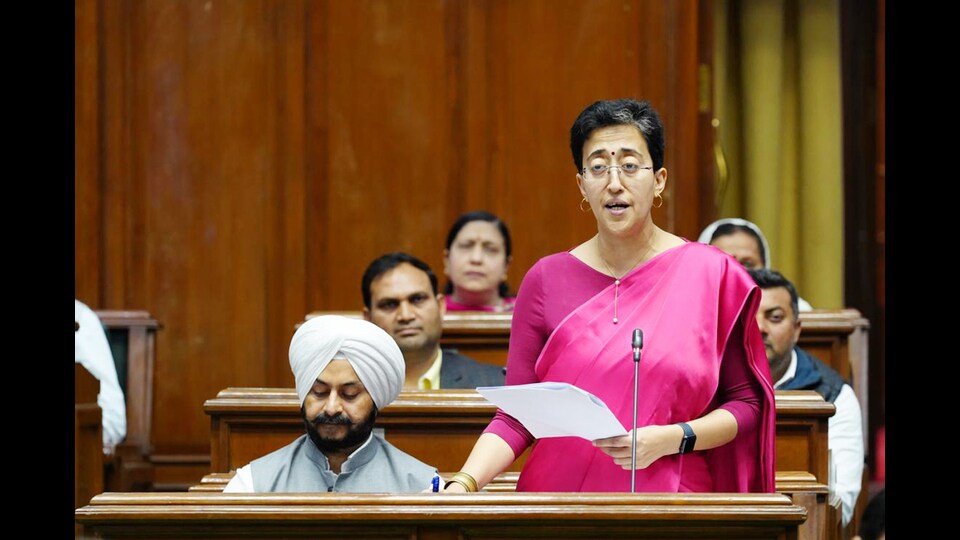
At a time when there is an ongoing tussle over the implementation of the one-time settlement scheme for water bill waivers, the economic survey said that DJB’s revenue collection from water bills has dropped to ₹1,294.86 crore during 2022-2023. In the previous years, the surveys said the collections were ₹1,530.6 crore during 2021-22, ₹1,773 crore in 2020-21; ₹1,637 crore in 2019-20 and ₹1,819 crore in 2018-19.
A government spokesperson attributed the decrease in revenue collected by to inflated bills and they non-payment by consumers. “If the one-time settlement scheme is passed, DJB will unlock a revenue of more than ₹2,000 crore,” the spokesperson added.
Over the last month, the Delhi government has argued that more than 1,050,000 households received faulty bills and a one-time settlement scheme would allow residents to clear their pending water bills after paying substantially reduced amounts that would be recalculated based on their usage pattern. The planned move would offer relief to over a million consumers who had complained of inflated water bills for several years, especially since the Covid-19 lockdown when meter readings became erratic, the government said.
While tabling the economic survey on Friday, Atishi said that when the Aam Aadmi Party (AAP) first fought the election in 2013 it started with the promise of free power and water and the government has provided free water up to 20 kilolitres benefiting approximately 24,720,000 consumers. Atishi added that besides providing water for free, the government has also expanded the supply network. “The speed with which this work has happened over the last nine years is unprecedented... 97% of the total unauthorised colonies in Delhi now have water supply lines and 93.5% households have access to piped water supply,” she added.
Lowering demand
Based on the current norm of 60 gallons per capita per day (GPCD), the present requirement of water for Delhi is 1,290 MGD for an estimated population of 21.5 million. The survey said that to reduce the requirement of potable water for future planned developments, toilet flushing requirements shall be met from the treated recycled water and availability of potable water will be restricted to a maximum of 40 GPCD.
“Water requirement for toilet flushing purposes in residential and non-residential developments is assessed to be 75 LPCD, which shall have to be met by use of non-potable recycled water with dual piping system. It is estimated that per capita potable water requirement will reduce to 55 GPCD by 2031 and 50 GPCD by the year 2041,” the report added. Accordingly, the potable water demand for domestic use in Delhi is projected to be 1,364 MGD by 2031 and 1,500 MGD by 2041.
The installed capacity of water treatment in DJB has been augmented by 16.79% over the last 15 years. The capacity, which was 810 MGD in 2009 rose to 906 MGD in 2014 and it was increased to 946 MGD in 2023. The data in the survey showed that the increase in water is primarily coming from groundwater resources even as the supply from tubewells and ranneywells has gone up from 80MGD in 2018 to 120 MGD in 2023. DJB now has 5,169 functional tubewells in Delhi and 11 functional ranney wells along the Yamuna.
Sewage treatment gap
Atishi added that the sewage treatment capacity has increased from 402.40 MGD in 2001 to 632.26 MGD in 2023. “Jal Board has a branching and peripheral sewage network of 10,000 km and a main network of 200 km of trunk sewers,” she added.
However, the survey said that the sewerage treatment plants are not functioning up to their optimum level due to various reasons such as low flow of sewerage to sewage treatment plants, trunk and peripheral sewer lines still to be connected to these STPs, rehabilitation of silted and settled trunk sewer lines not yet to be completed. “The percentage of utilisation of sewerage treatment plant in Delhi as of March 31 2023 was about 87%. The sewage generation, at present, is estimated to be around 792 MGD and treatment is around 550 MGD only,” it added.
Meanwhile, the leader of the Opposition in the Delhi Assembly, Ramvir Singh Bidhuri, said that the water supply situation has been deplorable in Delhi. “Most of households are getting dirty water, in many unauthorised colonies pipelines are yet to be laid and people are living on the grace of Delhi government-sponsored taker mafias. On the one hand, it says the water is free, but even people living in 50 yards houses have been given water bills of ₹50,000, ₹100,000 by the Delhi government,” Bidhuri said.


