
 E-Paper



Stench and eyesore define Delhi dhalaos
Delhi generates 11,328 tonnes of waste every day, with 4,000 tonnes ending up at oversaturated landfills

 Prefer HTon Google


For decades, Delhi’s neighbourhood garbage dumps, or dhalaos, have been at the centre of a public tug of war between residents and the Municipal Corporation of Delhi (MCD). These brick-lined enclosures, once designed as primary collection points for household waste, are now seen as obsolete -- raising a stink and proving incompatible with the city’s vision of a cleaner, modern capital.
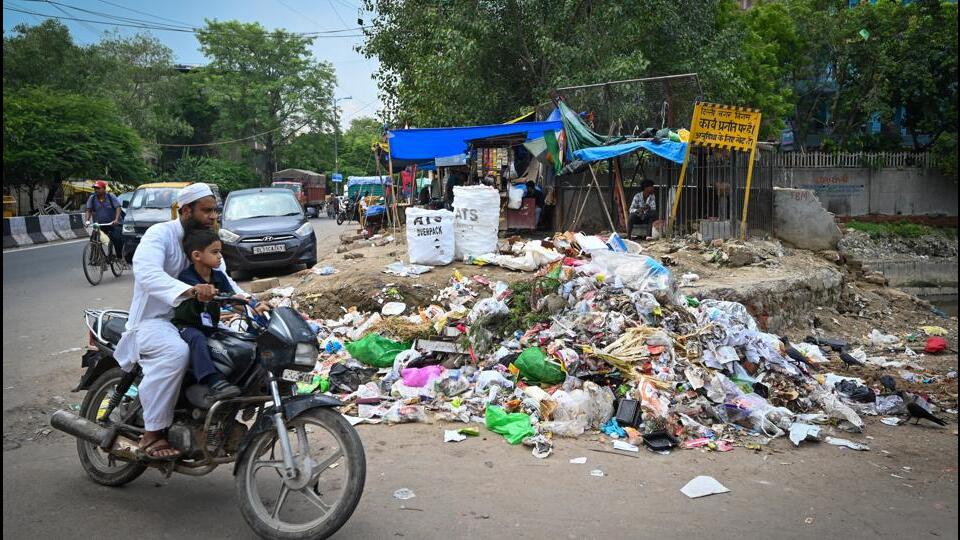
The dhalao, typically a three-walled open structure where sanitation workers tipped in daily waste before loading it onto larger trucks, was a fixture in nearly every colony. But over time, the system came to symbolise neglect: overflowing waste, no segregation, and public health hazards. As Delhi grew into a metropolis producing over 11,000 tonnes of waste every day, the dhalao system cracked under pressure. In its place, officials promised a new model based on door-to-door collection, mechanised compactors, and decentralised processing facilities.
Why and how they were to be phased out
The Delhi government and Municipal Corporation of Delhi (MCD) decided nearly a decade ago to eliminate dhalaos entirely. The aim was twofold: reduce the multiple handling of waste that led to spillage and stench, and align with Solid Waste Management Rules, 2016, which stress segregation at source and direct transport to processing facilities. Beginning 2016, the city invested in Fixed Compactor Transfer Stations (FCTS) and mobile compactors – machines that compress large volumes of waste before transporting it straight to treatment plants or landfills. The plan was simple – each compactor could replace several dhalaos, cutting down secondary dumping points. By 2022, officials had pledged that every dhalao would be shut. The final deadline was extended to December 2024.
Yet, despite repeated assurances, Delhi is still dotted with hundreds of operational dhalaos, many of them overflowing. The failure to fully mechanise and the gaps in door-to-door collection have meant that residents, shopkeepers and even sanitation workers fall back on the old system.
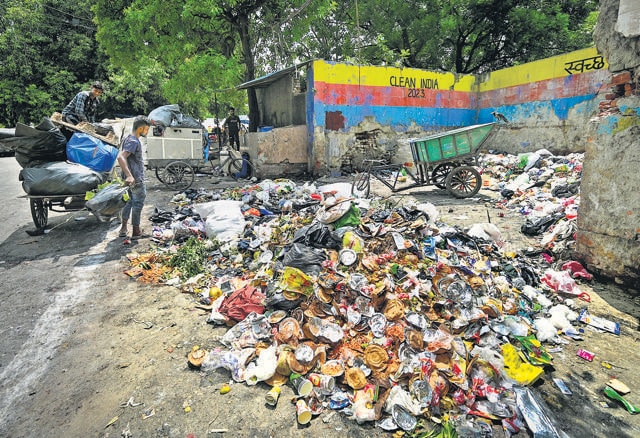
Meanwhile, Delhi continues to generate around 11,328 tonnes of waste every day: 11,000 tonnes from MCD areas, 256 tonnes from NDMC, and 72 tonnes from the Cantonment Board. Nearly 4,000 tonnes of this unprocessed waste ends up daily at the already oversaturated landfill sites in Ghazipur, Bhalswa and Okhla. Overall, the city has a 27.5% gap between the waste it produces and the waste it processes. The systemic flaws in collection and transportation have created a paradox -- Delhi wants to bury its dhalaos, but cannot imagine life without them.
Garbage mess and the courts
In South Extension, residents say the problem is impossible to ignore. “Every time the wind picks up, the stench hits you right in the face. It is unhygienic and embarrassing to have this near one of the country’s premier hospitals,” said a local resident, pointing to a dhalao just 120 metres from AIIMS’ Gate 6.
A local has filed a plea in the National Green Tribunal (NGT) seeking closure or relocation of the dhalao. MCD’s response: the site cannot be shifted, but it will be covered with gates and a roof.
In Jangpura Extension, residents approached the NGT earlier this year with an execution plea, complaining that three dhalaos continued to attract dumping despite being declared shut. Photographs placed before the tribunal showed garbage spilling onto the road. MCD countered that it had officially closed the dhalaos and even installed a Portable Compactor Transfer Station (PCTS) nearby, but locals kept dumping waste illegally.
“Despite placing signage, people are dumping waste here. We have now got security guards to prevent illegal dumping,” said an MCD official.
The pattern repeats itself across the city. In West Delhi’s Hari Nagar, a dhalao sits next to a park, with a Delhi Pollution Control Committee (DPCC) inspection recently finding waste spilling onto the road. In southeast Delhi’s New Friends Colony, the dhalao has been shut, but another at Maharani Bagh is now overloaded.
Even dhalaos converted into EV charging points or milk booths continue to be ringed by piles of trash. “Door-to-door collection is irregular. If you miss the garbage van, there is no option but to dump waste at the nearest dhalao. There needs to be an alternative solution if a dhalao is being shut down,” argued Om Chaddha, a resident of Jangpura’s D Block.
Most recently, the NGT upheld a ₹25 lakh penalty against MCD for allowing a dhalao to operate for decades outside a school for the visually impaired in Raghubir Nagar. “The dhalao was closed just four days before the judgment. Closure will have no effect because compensation has been imposed for past violations. The school existed since 1971, the dhalao came up in 1984-85. Visually impaired students have suffered for decades,” the bench noted.
School officials said while the dhalao has been removed, residents continue to throw waste at the same spot. “The dhalao has been shut, but people still dump waste here. We have sought a solution from the NGT and MCD,” said Devendra Singh Rathore, general secretary of the school.
Delayed waste mechanisation
The mechanisation of waste management project began in October 2016 when then LG Najeeb Jung inaugurated the first five fixed compactor stations. At the time, Delhi had 1,494 dhalaos: 550 in north Delhi, 350 in south, and 309 in east.
A fixed compactor station works on a hydraulically operated compression system that reduces garbage volume, turning it into compressed blocks for easy transport. Each station is capable of handling the waste of four dhalaos.
By December 2024, all dhalaos were to be phased out. But according to the MCD’s July status report, 985 have been closed while 509 remain operational. Of the closed ones, 87 have been turned into milk parlours, 103 into attendance stations, 133 into compactor stations, 71 into material recovery facilities, and 20 into EV charging points. Others have been converted into libraries, senior citizen seating areas, or other public utilities.
Currently, 309 operational compactor stations serve the city, but 250 of them are used mainly to store street-sweeping waste. An MCD official admitted that scarcity of land and funds has slowed the project. “In many areas, private concessionaires deploy mobile compactors that reduce the need for dhalaos. But operational difficulties and contract renewals are major hurdles,” the official said.
South, central and west Delhi: where things fall apart
Despite a month-long sanitation drive this August, filth and mixed waste heaps are visible across large parts of south, west, and southeast Delhi. These areas are struggling with transition phases, delays in hiring new contractors, and a shortage of bins.
Councillors have questioned the effectiveness of the drive. Raj Pal Singh, councillor from Sriniwaspuri, said waste management in the central zone was in disarray despite a six-month concessionaire being appointed. “A former Chief Justice has sent videos of waste dumps seen during his morning walks. Residents are protesting at our homes. The company cannot collect waste properly and the whole area is suffering,” he said.
Waste collection in 12 MCD zones is outsourced to private companies under long-term contracts. But in south, west, and central zones, these contracts expired in 2022. Despite two extensions, new operators could not be hired due to the non-formation of a standing committee. “As an interim measure, a contractor was deployed for six months, but they lack bins, auto tippers and loaders. For a short contract, they cannot invest resources meant for 10 years,” anofficial from the central zone said.
Councillors said the number of tippers in wards have dropped from 15-17 units to just 4-5. Officials told the standing committee that ₹3,500 crore would be needed to resolve the mess. “Instead of paying ₹90 crore per month, we are paying ₹70 crore to concessionaires,” the commissioner admitted.
The second official said that with the previous contractors withdrawing their machinery, the situation on mechanization of waste collection has gone back to the old era. “The same amount of waste is being collected, but it is now spread out and poorly managed,” another official said.
A systemic failure
Atul Goyal, who heads United RWAs Joint Action (URJA), a collective of resident welfare associations, said the system has collapsed. “Both people and agencies are failing the city. Door-to-door collection and segregation are claims on paper. Delhi has accepted that segregation has failed, which is why the focus is on more incineration and burning it all,” he said. Goyal argued for a decentralised model of processing as the only sustainable solution.
Even as Lutyens’ Delhi, managed by NDMC, was ranked among the cleanest in the Swachh Survekshan 2024–25, MCD areas ranked 31st out of 44 urban local bodies. An NDMC official pointed out the contrast: “Our area is fully dhalao-free. The garbage is taken directly to secondary sites. If door-to-door collection fails, people will inevitably dump waste at the nearest collection point. That is why MCD continues to struggle.”
Delhi’s dhalao problem is a symptom of its larger waste crisis. Until the city finds a way to guarantee consistent door-to-door collection, invest steadily in mechanisation, and push decentralised processing, the promise of a dhalao-free capital will remain on paper.
For now, the city of more than 20 million is still living with neighbourhood garbage dumps -- relics of another era, but stubbornly, still very much a part of everyday life.


Stay updated with all top Cities including, Bengaluru, Delhi, Mumbai and more across India. Stay informed on the latest happenings in World News along with Delhi Election 2025 and Delhi Election Result 2025 Live, New Delhi Election Result Live, Kalkaji Election Result Live at Hindustan Times.


