
 E-Paper



Supreme Court seeks plan to tackle pollution in 4 weeks
“There can be no doubt that these long-term measures are to be given effect to without any delay,” said the bench in its order

 Prefer HTon Google


The Supreme Court on Wednesday directed the Centre and the governments of Delhi, Punjab, Haryana, Uttar Pradesh and Rajasthan to submit concrete action plans within four weeks for implementing a set of long-term measures proposed by the Commission for Air Quality Management (CAQM) to combat air pollution.
A bench comprising Chief Justice of India Surya Kant and Justices Joymalya Bagchi and Vipul Pancholi made it clear that it would not entertain any objections to the measures proposed by the statutory pollution watchdog, and would only examine the method of execution placed before it by the agencies concerned.
“There can be no doubt that these long-term measures are to be given effect to without any delay. We are not inclined to entertain any objection to these measures,” said the bench in its order.
The court directions came after the CAQM submitted a status report dated January 20, pursuant to the court’s January 6 order reprimanding the commission for a “complete failure of duty” in not clearly identifying the causes of air pollution and their relative contribution.
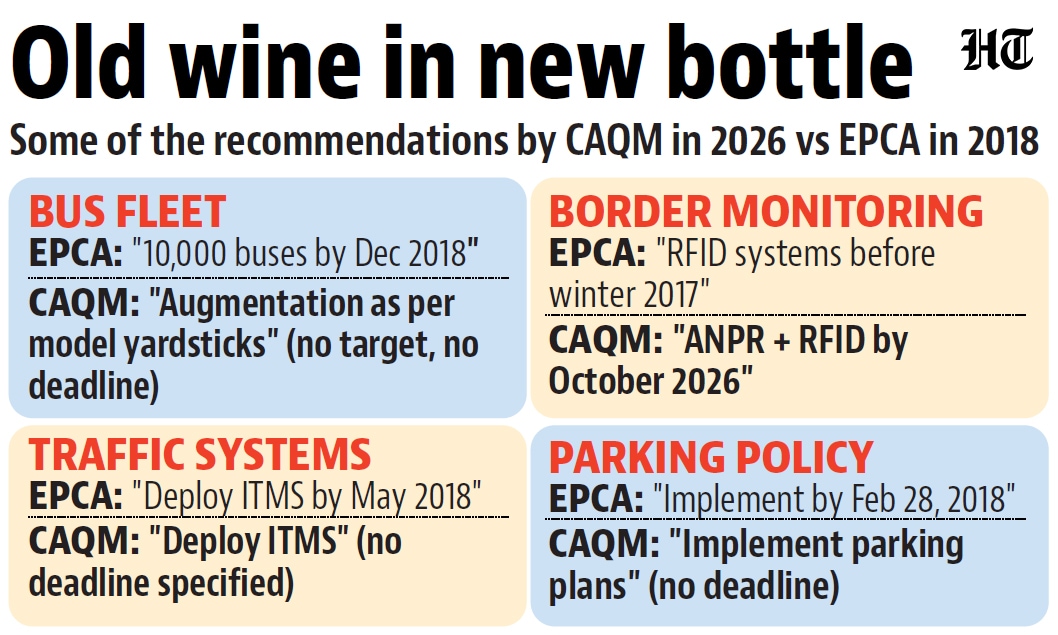
Recording the CAQM’s findings—which were based on a meta-analysis of source apportionment studies identifying transport, biomass burning and secondary particulate matter as the dominant pollution sources — the bench said the identified long-term measures had to be implemented “without any delay”.
It clarified that senior advocate Aparajita Singh, assisting the court as amicus curiae, could propose additional measures which the CAQM would consider. However, the bench ruled that the court would not reopen the question of whether the recommended steps were required at the instance of any government or agency.
The court specifically flagged recommendations relating to toll congestion and the environmental compensation charge (ECC) at Delhi’s border entry points. Referring to the CAQM’s observation that toll and ECC rates had not been revised since 2015 and had lost their deterrent effect, the bench directed the Municipal Corporation of Delhi (MCD) and other agencies to explain why these measures should not be implemented.
“We make it clear again that we would not entertain any objection but we would only peruse the action plan to implement these directions,” the court said.
It also asked the CAQM to consider suitable revisions to recommendations on toll and ECC rates, and directed the Delhi government to submit a plan for the utilisation of unspent ECC funds, which the commission said needed urgent attention.
Wednesday’s order marks a shift from judicial censure to enforcement. On January 6, the bench had rejected the commission’s plea for more time and insisted on transparency and expert-driven solutions. The matter will be taken up again after four weeks, when the court is expected to examine the submitted action plans.


Stay updated with all top Cities including, Bengaluru, Delhi, Mumbai and more across India. Stay informed on the latest happenings in World News along with Delhi Election 2025 and Delhi Election Result 2025 Live, New Delhi Election Result Live, Kalkaji Election Result Live at Hindustan Times.


