
 E-Paper



With Delhi’s AQI forecast to worsen, CAQM rolls out Grap Stage 3
The CAQM invoked Stage 3 of the Graded Response Action Plan in NCR due to worsening air quality, enforcing strict measures to combat pollution

 Prefer HTon Google


The Commission for Air Quality Management (CAQM) in NCR on Friday invoked Stage 3 of the Graded Response Action Plan (Grap) amid forecasts suggesting the air quality index (AQI) in the city and surrounding areas will see a further deterioration over the weekend.
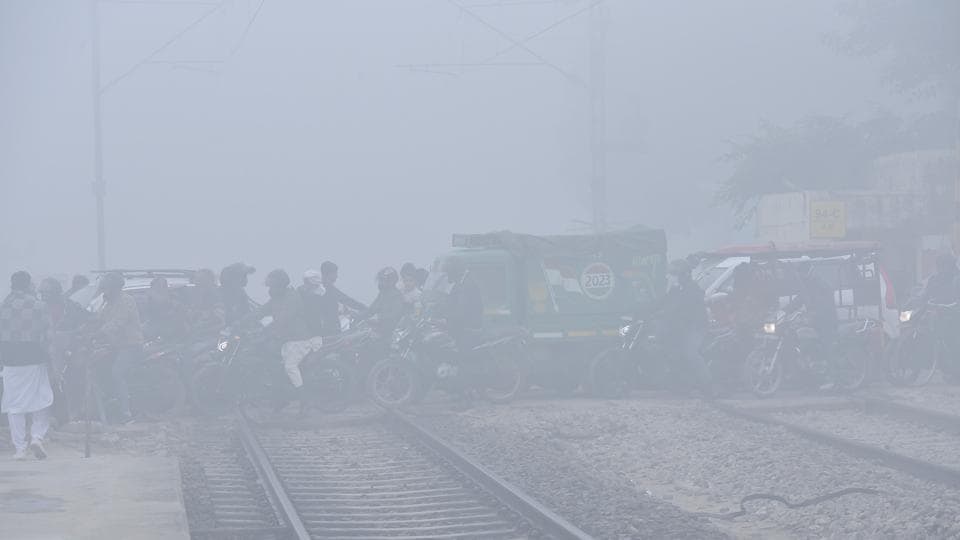
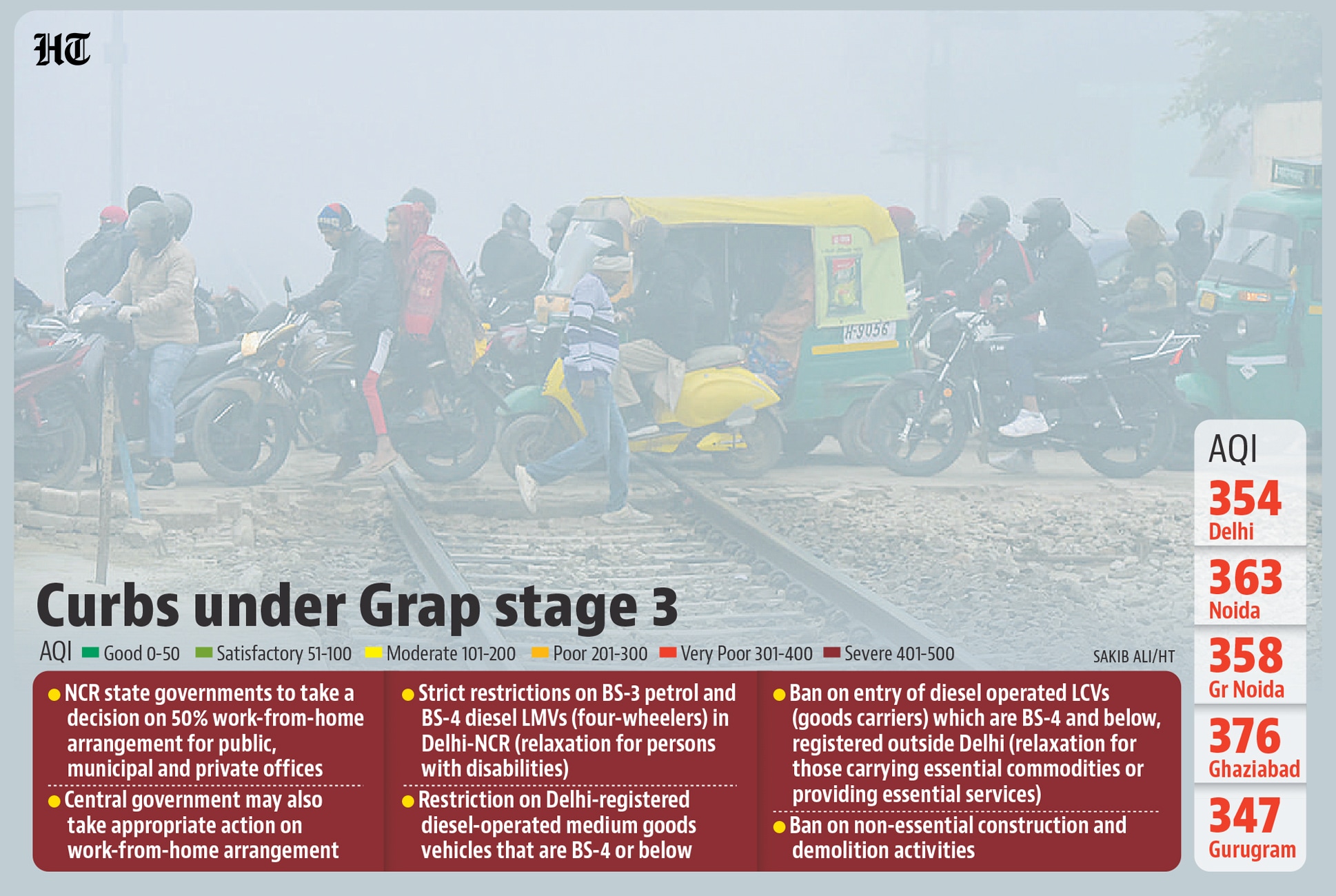
Delhi’s 24-hour average AQI was recorded at 354 (“very poor”) on Friday afternoon, worsening from 343 the previous day.
“Keeping in view the prevailing trend of air quality, and in an effort to prevent further deterioration of air quality in the region, the sub-committee has taken the call to invoke all actions as envisaged under Stage 3 of Grap … with immediate effect in the entire NCR, as a proactive measure,” a CAQM order issued on Friday stated.
Grap has four stages, invoked as precautionary measures to battle air pollution: Stage 1 is invoked when the AQI crosses 200; Stage 2 when it crosses 300; Stage 3 at 400; and Stage 4 at 450. To be sure, this comes after increased public criticism, including protests, as well as scrutiny by the legislature and judiciary in the last two months, which have pressured CAQM to review the implementation of curbs.
The invocation of Stage 3 – triggered when the AQI is projected to cross 400 – brings immediate and widespread curbs. A ban on the plying of Bharat Stage-III petrol and BS-IV diesel four-wheelers is now in force in Delhi, Gurugram, Faridabad, Ghaziabad, and Gautam Buddh Nagar.
All private construction and demolition activity across the region has been suspended, with exemptions only for essential public projects. Operations of stone crushers and mining activities are also halted. Additionally, schools for students up to Class 5 in Delhi and neighboring districts must shift to hybrid online-offline classes.
The move comes amid forecasts by the Air Quality Early Warning System (AQEWS) warned that the AQI is expected to deteriorate to the severe category by Saturday. “The air quality is likely to be in the severe category from Saturday to Sunday. The air quality is likely to be in the very poor category on Monday. The outlook for the subsequent six days is that the air quality is likely to be in the very poor category,” the AQEWS bulletin said on Friday evening.
Meanwhile, Delhi chief minister Rekha Gupta chaired a high-level meeting to finalise a comprehensive, long-term strategy to combat air pollution, with a push on expanding public transport, strengthening last-mile connectivity and tightening enforcement.
The centrepiece is a major expansion of Delhi’s bus fleet, aiming to reach 14,000 buses by March 2029. The rollout will be phased, targeting 6,000 buses by December 2026, 7,500 a year later, and 10,400 by March 2028. Of these, 500 will be smaller 7-meter buses intended to improve last-mile connectivity from metro stations.
“Pilot integration of e-autos, bike taxis and feeder cabs at 10 major Metro stations is scheduled by the end of January,” said CM Gupta. The government also plans to launch ‘EV Policy 2.0,’ focusing on incentivising electric two-wheelers and commercial vehicles through subsidies, scrappage incentives, and a quadrupling of public charging points from 9,000 to 36,000.
To ease traffic congestion, improvement works have begun at 30 of 62 identified congestion points, while 1,200 additional DTC personnel have been deployed to assist traffic police.
Road dust control will be strengthened through mechanised sweeping, water sprinklers and anti-dust machines, while large-scale road redevelopment and underground utility ducts aim to reduce recurring construction dust.
“For the management of construction and demolition waste, an additional 250 debris spots will be immediately created in all wards of Delhi,” said environment minister Manjinder Singh Sirsa. An app-based system will manage debris collection and disposal.
The plan further includes industrial emission monitoring, large-scale tree plantation, construction waste processing, smart parking management and installation of ANPR cameras at border entry points to identify polluting vehicles. Officials said citizen participation and behavioural change would remain key to achieving sustained improvements in air quality.
Respite from the cold
The city, however, saw a slight reprieve from the cold wave conditions that had gripped it for the past five days. The minimum temperature at Safdarjung, Delhi’s base weather station, rose to 4.3°C on Friday from 2.9°C a day prior. Thursday’s minimum was the lowest minimum temperature since January 18, 2023.
The India Meteorological Department (IMD) forecasts a further rise in minimum temperatures to 6-8°C by Saturday and 8-10°C by Monday, due to a shift to warm easterly winds. IMD has, however, issued a fresh yellow alert for Saturday, warning of moderate to dense fog.


Stay updated with all top Cities including, Bengaluru, Delhi, Mumbai and more across India. Stay informed on the latest happenings in World News along with Delhi Election 2025 and Delhi Election Result 2025 Live, New Delhi Election Result Live, Kalkaji Election Result Live at Hindustan Times.


