E-Paper



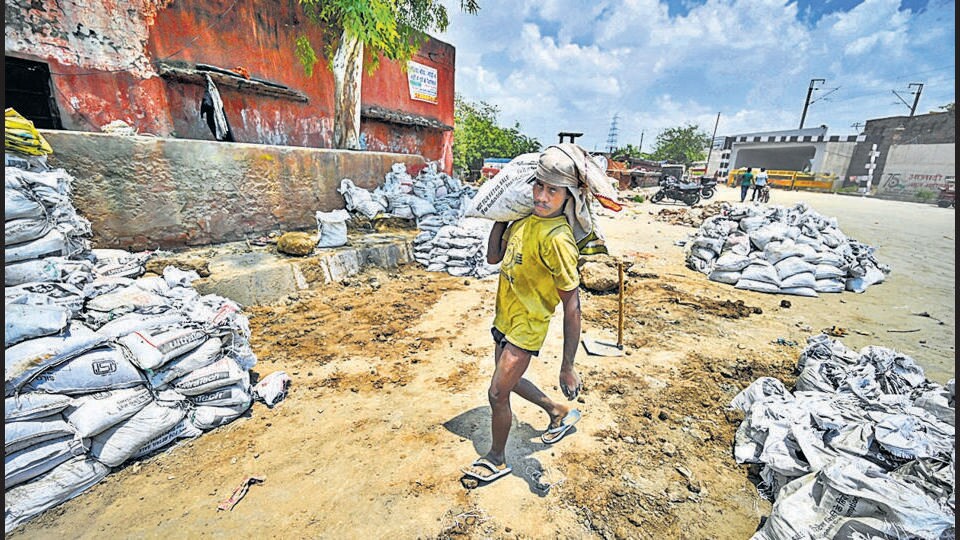
Sandbag embankments set up in Delhi to keep Yamuna at bay
On Monday, water started entering some localities again, prompting authorities to evacuate residents from the Yamuna Bazar ghat area.


The Yamuna flowed above the danger mark of 206m for a second day in a row on Monday, prompting authorities to create sandbags embankments at vulnerable and low-lying sites along the river, even as water started entering some neighbourhoods located at its floodplains.
Also Read | Encroachments led to Yamuna’s flooding in Delhi: Experts
The Yamuna had earlier breached the embankments on July 12, and with the water level of the river rising to a record 208.66m on July 13, floodwaters inundated parts of the city, but the water slowly receded, leaving muck and silt behind.
On Monday, however, water started entering some localities again, prompting authorities to evacuate residents from the Yamuna Bazar ghat area. Akash Kashyap, a resident of the locality, said the agencies were making announcements, urging people to evacuate, and several people have shifted to a shelter at Mori Gate. “I stayed back with my brother to look after the house. A large number of people are still staying on the first floor of their houses,” he said.
Also Read | GB Nagar warns people of possible flooding as Hindon, Yamuna waters rise
Vikas Kashyap, a local priest, said the sandbag embankments are proving to be ineffective and the government should consider raising higher concrete barriers to increase safety of the area.
The Delhi government said 60 monitoring teams have been deployed along the floodplains to keep vigil around potential points where the river could overflow onto roads, but announced no major policy change or structural modifications to prevent flooding of the city.
Meanwhile, water also entered the premises of Nigambodh ghat, Delhi’s largest crematorium. Authorities cordoned off the area abutting the Yamuna with a wall of wooden planks and sandbags, and as the crematorium received 34 bodies by noon on Monday, two suction machines were deployed to prevent drain water from backflowing into the facility.
Suman Gupta, general secretary of the managing committee of NGO Badi Panchayat, which oversees operations at the facility, said all gaps along the ghat have been sealed but the wall along a nearby night shelter has collapsed, exposing the complex to the river from one side. “We have written to the Municipal Corporation of Delhi to help get this wall reconstructed with help from the Public Works Department,” he said.
During a spot-check on Monday, HT witnessed that the river remained just a few metres away from the Outer Ring Road at some critical sites such as Yamuna Bazar, Nigambodh ghat, Majnu Ka Tila and Chandgiram Akhara. Several teams from the Delhi government’s irrigation and flood control (I&FC) department were deployed along a 5.5km stretch of the road between Majnu Ka Tilla and Old Yamuna Bridge, with sandbag embankments being set up at areas such as Khyber Pass, Metcalf House, Aruna Nagar sewage pumping station, Monastery Market, Vasudev Ghat, and Chandgiram Akhara, among other places.
A four-member team was deployed near the exit point of the Khyber Pass drain. An official said, “We have kept three-four sandbags at periodic distances along Outer Ring Road wherever there is a stormwater drain opening so that it can be blocked if the river decides to overflow once again.”
Meanwhile, shopkeepers at Monastery Market near Kashmere Gate were in a panic — the market had just become operational after being inundated by floodwaters last week, and many feared that the water may return, bringing more losses. Gaganjeet Singh, a shopkeeper, said the government placed a batch of sandbags at the market on Sunday night. “The river water is yet to enter the market, but people are in a panic. It has taken a lot of effort to restart the shops and it could all be in vain,” he added.
Some areas like Majnu Ka Tila were inundated with backflow from drains due to the rise in the Yamuna’s water level. Local resident Mukesh, who only goes by one name, said the sewage system failed on Sunday night, leading to backflow from the river. “This may lead to an outbreak of diseases in the area,” he said.