
 E-Paper



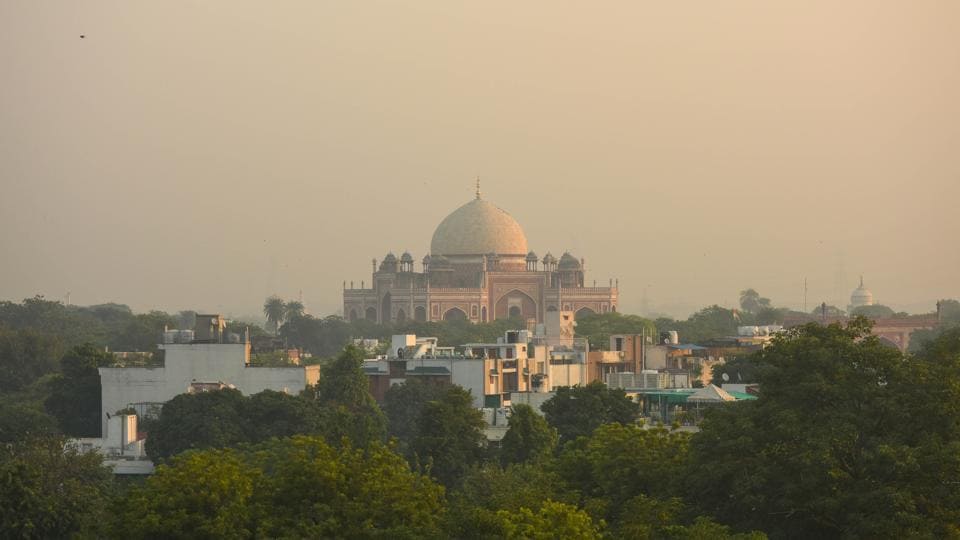
Dust bowls drown Delhi in pollution haze
On Tuesday, Delhi’s overall air quality index (AQI) was recorded at 300, in the poor category, according to Central Pollution Control Board’s evening bulletin.


On a day Delhi’s air quality index (AQI) plunged to 300, just one point short of slipping into the ‘very poor’ category, major construction sites were spotted flouting pollution-control norms, enveloping the surrounding areas in clouds of dust, Hindustan Times found during a spot check.
Despite directions issued by Delhi environment minister Gopal Rai to agencies and private individuals carrying out construction and demolition activities to follow guidelines or face action, work continued in blatant disregard of the rules and the dust generated, HT found during a visit to major construction sites across the city.
On Tuesday, Delhi’s overall air quality index (AQI) was recorded at 300, in the poor category, according to Central Pollution Control Board’s evening bulletin. Data shows the prominent pollution on Tuesday was PM 10 (particulate matter with diameter less than 10 micrometres), which is primarily dust.
Data from the Union ministry of earth sciences’ air quality monitoring centre, System of Air Quality and Weather Forecasting and Research (SAFAR), showed that the average PM 10 levels in Delhi touched 239ug/m3. In India, the acceptable mark of PM 10 levels is 100ug/m3.
The rules mandate covering of the construction site with nets and 10-metre-thick metal sheets to stop the dust from spreading to neighbouring areas, covering of the construction material in transit and regular sprinkling of water at the spot and on the roads outside.
At Mathura Road, where the public works department (PWD) is building a tunnel road to ease traffic, metal barricades placed to separate the worksite were unevenly placed and were not enough to hold the loose dust and construction material from blowing all over the area.
The constant movement of fast-moving vehicles on Mathura Road led to a cloud of dust, making matters worse.
“From a few metres away, you can see the difference in the air around this area. It is hazy and dust keeps flying around. You cannot keep your window pulled down because of the dust,” said 38-year-old Meera Mehta, who commutes on Mathura Road every day.
The reporter noticed that while the main construction site was covered, the peripheries had mounds of loose soil, concrete waste and debris, which had become a cause of pollution.
The nearby Ashram intersection -- one of the busiest roads in the city, where the PWD is constructing the 750-metre underpass that connects the Nizamuddin Railway Bridge -- was no different.
The site was covered with metal barricades but the loose soil that was piled up was flying around, becoming a bane for commuters. While parts of the construction site were covered with green sheets, they were barely enough to cover the excavated soil. There were no signs of water sprinklers anywhere at the site.
“We have directed all our contractors to ensure that all dust-control measures ordered by the environment ministry are followed. Water is being sprinkled regularly to ensure the dust does not fly around. Since we have a few sites where construction work is going on in full swing, there might have been some slip-ups. But if there are any lapses at any site, we will rectify that,” said a senior PWD official, on the condition of anonymity.
At Bhairon Marg near Pragati Maidan, where India Trade Promotion Organisation’s (ITPO) building is being constructed, all dust-control rules went for a toss, with parts of the site along the main road left uncovered and dust flying around.
As the excavator dug through the ground, forming knolls of soil, only a torn piece of a green cloth was seen—which lay as an ornamental piece on the side. Most construction sections adjoining Bhairon Marg were not covered with metal barricades.
The construction agency, NBCC (India) Limited, did not respond to HT’s queries on the measures being taken by them to abide by the Delhi government orders.
Rai said the government will take action if rules are violated. “We are going to be very strict in ensuring that dust-control measures are followed at all construction sites, government or private. If we find that the listed norms are not being followed at any site, we will take stringent action and work will be stopped,” Rai said.
Over the last four days, Rai has been inspecting major construction sites as part of the government’s efforts to check dust pollution.
During these inspections, big agencies such as the Federation of Indian Chambers of Commerce and Industry (FICCI), National Capital Region Transport Corporation (NCRTC) and the North Delhi Municipal Corporation have been slapped with hefty fines.
An analysis by the Council on Energy, Environment and Water (CEEW), a Delhi-based think tank, showed that road dust was the second-largest source of air pollution in Delhi (18-38%), while construction contributed towards 8% of the city’s pollution load. However, experts said these two were not mutually exclusive.
Siddhartha Gauda, a Bengaluru-based air quality researcher, said uncovered roadside construction activity becomes a primary reason for increased dust or PM 10 levels in an area.
“Cement, concrete particles and loose soil not only remain suspended in the air but when they slip onto kerb sides and onto the roads, the movement of vehicles keeps them suspended in the air. Vehicular movement keeps breaking this dust into smaller and more fine particles,” Gauda said.
While these big sites are in the government’s radar, in many parts of the city, small-scale, private construction activities are also contributing to localised pollution.
In parts of Laxmi Nagar, New Ashok Nagar and Seelampur, local residents and business owners were seen constructing houses or repairing shops.
“For over three months, labourers could not be found and now many people are constructing houses or building additional floors or repairing shops. In these narrow roads, how do you expect us to put on metal sheets or cover construction material with nets?” said Sardar Harinder Singh, a shop owner in east Delhi’s Laxmi Nagar.


