
 E-Paper



Water purifying plant selling fake bottled water sealed in Gurugram’s Palam Vihar
The plant was allegedly drawing groundwater from an unauthorised borewell and filtering it with a reverse osmosis purifier, officials said. The staff at the plant have allegedly admitted that they also filled untreated groundwater in bottles meant for sale, police officers said.

 Prefer HTon Google


A water purifying plant in Palam Vihar, allegedly operating without valid licences and supplying bottled water under fake labels, was sealed on Wednesday, officials said, adding that they are presently drawing up a lost of all such units and a crackdown is planned in the days ahead as the demand for bottled water is set to soar during summer months.
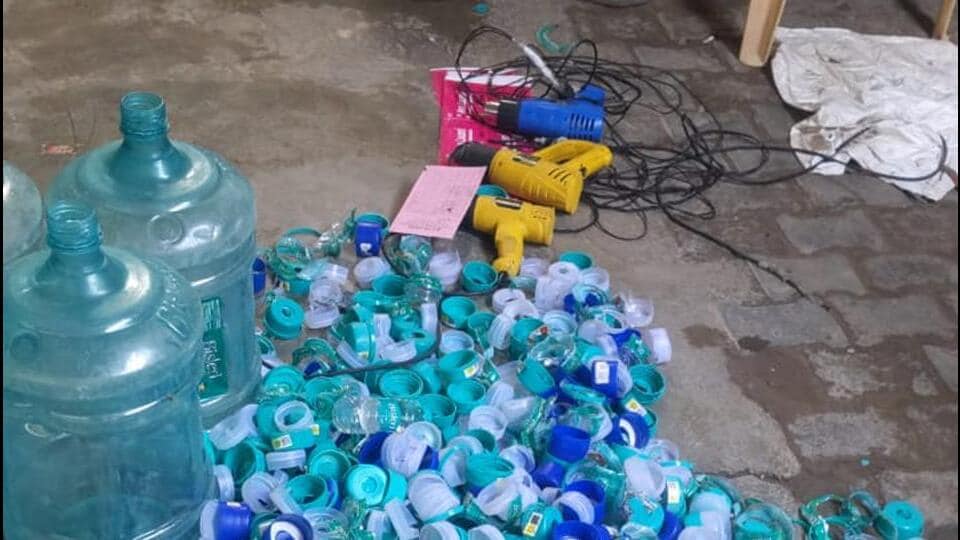
Further, the plant was allegedly drawing groundwater from an unauthorised borewell since the past year and a half and filtering it with a reverse osmosis (RO) purifier, officials said. The staff at the plant have allegedly admitted that they also filled untreated groundwater in bottles meant for sale, police officers said.
The plant, which extracts and process about 500 litres of groundwater daily, supplied drinking water canisters to residential, commercial, and industrial units.
Police have identified its owner as Sukha Singh, a resident of Sirsa, and said an investigation has been initiated in the matter, and appropriate action will be taken.
“We received a tip-off that a house in Block H of Palam Vihar was being used for processing water illegally. We formed a joint team of officials from the electricity department, food and safety department and the Municipal Corporation of Gurugram to conduct a search at the plant,” said Inderjeet Yadav, deputy superintendent of police.
According to the officer, they found a large number of fake labels of companies such as Bisleri, Aquafina and Kingfisher, which were allegedly being used to sell the packaged water. Police also found two vehicles filled with water bottles parked at the spot. The search was part of the district administration’s crackdown against such units in the city.
“The plant owner, Sukha Singh of Sirsa, was running the illegal RO plant since the past year and a half. The land was taken on a monthly rent of ₹15,000,” the DSP said.
“The units were found supplying drinking water bottles without any clearance or permission. They also had machines to seal bottles and thousands of printed labels,” said Harish Kumar, inspector, chief minister’s flying squad, which conducted the search.
Kumar said the plant was selling 20 litre bottles for ₹60-90 in residential, commercial and industrial areas. “They used to supply at least 700 bottles daily to consumers and their clientele included confectionary shops and establishments in upscale localities. The quality of water is never inspected at these units and they do not have any clearance to sell groundwater,” he said.
The search team collected water samples from the spot, the officer said, and these will be sent for further testing.
Police said the plant was also using a domestic electricity connection for commercial purposes.
MCG commissioner PC Meena said action will be taken against the owner after a notice is served on him. “We are awaiting results of the samples and are verifying facts based on which the land owner will also be served a notice for renting property for illegal activities,” he said.
Gurugram, which has always depended heavily on groundwater for want of clean drinking sources in its vicinity, is now in a crisis because its groundwater table has been declining rapidly – from half-a-metre per year until four years ago to 1m per year since then--shows data from the hydrology department.
According to a study conducted by the Centre for Science and Environment (CSE), Gurugram’s water table is shrinking by 1-3 metres a year due to unchecked extraction.
One of the staff working at the plant said 500 litres of groundwater is extracted daily and sold in the market from the unit. “We sell a 20 litre bottle to shopkeepers for ₹60 and directly to residents for ₹90 and we pose as distributors. The demand has increased in the past two months,” he said, asking not to be named.
Gurugram deputy commissioner (DC) Nishant Kumar Yadav said they have formed a team to examine the water situation across the city and will take action against such illegal water purifying plants.
“We will collect data from the Haryana water resources and verify the number of licences they have issued to bottling plants in Gurugram. Also, the pollution control board will be the nodal agency to crack down on these illegal establishments. We will prepare a list of all such units area wise after verification,” he said.
According to experts, the exploitation of groundwater for construction, a rapid population growth and the absence of rainwater harvesting systems in the city have led to a gross imbalance between groundwater extraction and regeneration, leading to the alarming decline in the water table
Vaishali Chandra Rana, a city-based environmentalist, said Gurugram is already a water stressed district with groundwater table dipping by the year. “The Central Ground Water Authority (CGWA) declared Gurugram as an overexploited zone about a decade ago. At this rate, very soon, there will be land subsidence here too, with all the underground water drawn out,” she said.


