E-Paper



Haryana farmers fret as basmati prices fall to ₹1,800 per quintal
Farmers blame it on lack of proper pricing policy as private traders have been making the most of it by procuring the variety at their own prices.

 Prefer HTon Google


For the first time in past several years, the PUSA 1509 variety of Basmati is being sold at ₹1,800 per quintal in Haryana, which is far less than the Minimum Support Price (MSP) of ₹1,888 fixed for the Parmal varieties procured by government agencies.
There is no fixed MSP for the Basmati variety.
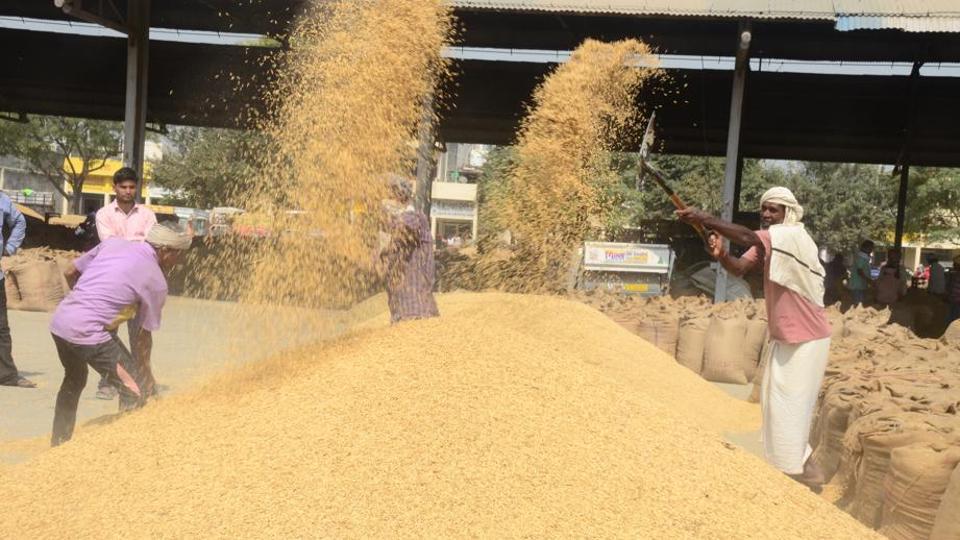
Raj Kumar, a marginal farmer from Ladwa, has been visiting the Kurukshetra grain market daily for last three days to sell the PUSA 1509. However, private traders are not ready to procure his produce above ₹1,800 per quintal. Several other farmers have also been left crestfallen since the prices of this premium aromatic variety of rice is ₹1,100 less than last year.
Farmers blame it on lack of proper pricing policy as private traders have been making the most of it by procuring the variety at their own prices. Last year, farmers had fetched ₹2,700 to ₹2,900 per quintal for this Basmati variety. Farmers, however, say this year they will have to sell it below ₹1,800 since they have to repay their debts.
Ram Kumar, a farmer from Yamunanagar’s Radaur said, “After waiting for three days, I had to sell my produce of two acres to a trader at ₹1,815 per quintal. I feared that the prices may fall further since there are no buyers. Therefore I sold it even below the MSP of parmal.”
Lack of pricing policy
Due to the lack of a pricing policy for the Basmati, farmers are left with no option but to sell their produce at prices fixed by private traders. On the other hand, growers of Parmal are not concerned about the prices since the government has fixed the MSP for this variety.
Farmers say the per acre yield of Parmal is around 30 to 35 per quintal and they easily get ₹60,000 per acre. However, the yield for PUSA 1509 is around 18 to 22 quintals and the growers get below ₹40,000 per acre.
Mahinder Singh, a commission agent at Nilokheri grain market, said, “It is because of the MSP. The difference between the earning from Parmal and Basmati is over ₹20,000 per acre. Farmers have been fighting to get the MSP for Basmati since the private traders have been buying the variety at their own prices.”
People associated with the rice industry have also blamed the lack of proper pricing mechanism for the Basmati. Vijay Setia, former president of the All-India Rice Exporters Association, said, “There is no ban on export of Basmati and the government has also reduced the market fee and rural development fee from 2% each to half a percent. Still, the farmers are not getting any benefits and are left on the mercy of traders.”
On more than 50% fall in the prices of Basmati, additional chief secretary, food, civil supplies and consumer affairs department, PK Das said, “Earlier, there was a policy decision that the government agencies will procure the PUSA 1509 on the MSP of Parmal if farmers are forced to sell at lower prices. However, in past couple of years the prices of PUSA 1509 had gone up. We stand by our decision to buy Basmati on the MSP of Parmal variety if farmers are not getting fair prices.”