
 E-Paper



IIT Ropar researchers design doffing unit for healthcare workers
The unit was developed taking into consideration the safety of healthcare workers who spend a lot of time in close proximity with patients and are involved in high-risk activities such as placing patients on ventilators and collecting and handling samples


Researchers at the Indian Institute of Technology (IIT), Ropar, have designed a doffing unit for healthcare workers. The special doffing unit, which is separated from the donning or clean room, has been designed by a team of researchers, including Khushboo Rakha, assistant professor at the department of metallurgical and materials engineering, Dhiraj Mahajan, associate professor at the department of mechanical engineering and senior scientific officer Naresh Rakha.
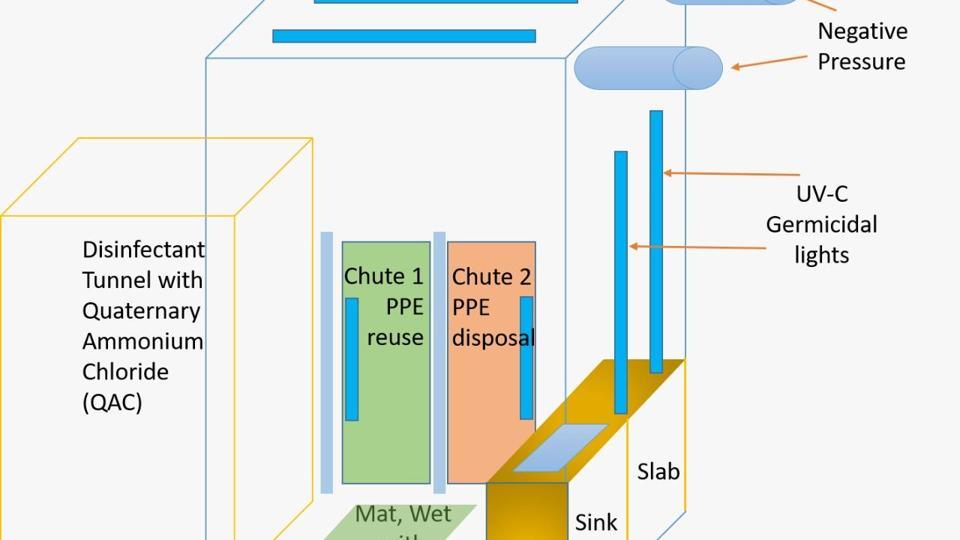
Rakha said the unit was developed taking into consideration the safety of healthcare workers who spend a lot of time in close proximity with patients and are involved in high risk activities such as placing patients on ventilators and collecting and handling samples.
She said that personal protective equipment (PPE), including masks, gloves and gowns, that keep nurses and doctors safe need to be fitted, worn, and removed in a specific way. “However, it has been reported in the past that healthcare workers make mistakes while wearing and removing PPE, which exposes them to pathogens,” she added.
Rakha said it was imperative to maintain sterile conditions in the doffing station, the place where healthcare professionals remove their PPE at the end of their duty. Explaining the model of the doffing station, the researcher said, “The unit involves use of three well established and documented germicidal technologies; chemical disinfectants, negative pressure rooms and ultra-violet germicidal irradiation (UVGI). The unit begins with a disinfection tunnel using a safe and effective disinfectant recommended by World Health Organisation (WHO).”
“After doffing/removal of PPE (through prescribed procedure), healthcare workers should place the PPE in one of the two chutes for reuse or proper disposal. Both the chutes will be attached with UV-C germicidal tubes for disinfection before further removal. The unit will be maintaining ‘Negative pressure outlet,’ which will significantly lower the risk of virus transmission through air,” she said.
Rakha said that UV-C type germicidal bulbs/tubes will be installed in the entire space to disinfect the room after every doffing session or alternatively every 2-3 hours and that no person would be allowed inside the station during UV-C disinfection session.
The researchers also recommend the use of copper or brass-70%Cu to be used for door knobs/handles and taps in this chamber because of its anti-microbial properties.


