
 E-Paper



Bengal teacher arranges for ‘vaccine rath’, gets 500 tribal women vaccinated with 1st dose
Deep Narayan Nayak counselled the women, got them registered on the CoWin app and took the responsibility of their commute to and from the nearest vaccination centre.


A 34-year-old primary school teacher from West Bengal’s Paschim Bardhaman district single-handedly ensured that at least 500 women, including lactating mothers and senior citizens, from a remote tribal village, get their first dose of Covid-19 vaccine.
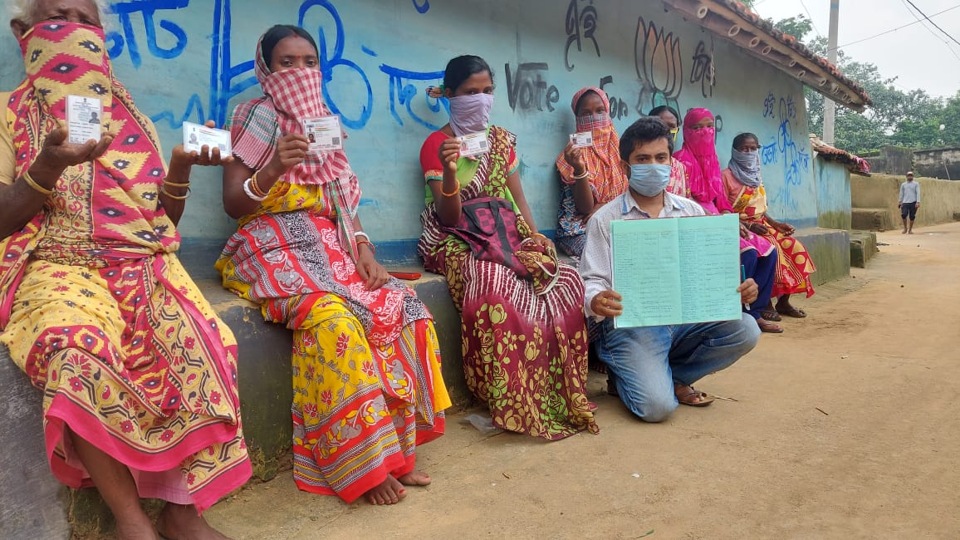
To accomplish this daunting task he not just counselled the women, but even arranged for a few hundred mobile numbers from his friends, relatives and neighbours to get more than 1,000 women registered on the CoWin app. He turned a bus into a ‘Vaccine Rath’ to help women reach the nearest vaccination centre from the village.
“I regularly go to some of the tribal villages in Jamuria block to teach a few hundred students and their parents free of cost. There, I found that even though the government was pressing for everyone to take the vaccine, particularly women, as there is an apprehension of a third wave, none of the tribal women in the villages was vaccinated. This, not only made them vulnerable, but even their children were at risk,” said Deep Narayan Nayak, who works as a teacher in a state-run free primary school for tribal children.
Fondly called ‘Rastar Master’ (teacher of the street) and respected by young and old in the villages, Nayak started collecting the names and found that the number was huge – more than 500 in Joba Attpara and its adjoining three to four villages. They were all from tribal communities like Munda and Tudu.
Then came the challenge of registering the women on the CoWin app. Coming from very poor families, the women didn’t have any smartphones. Nor can so many women be registered on one mobile.
“At the most, only four persons can be registered through one mobile number on CoWin. I had three numbers. So, I started gathering numbers from my friends, relatives, neighbours and anyone in the villages where I go to teach. Initially, I registered around 500 women,” said Nayak.
On the day of vaccination, he hired a school bus and named it ‘Vaccine Rath’ on which 500 women were picked up from the village in phases and taken to the Akhalpur Block Primary Health Centre, around 10 kilometres away, to vaccinate them. They were again dropped back to the village after their vaccination.
“Had it not been for ‘master’, a few hundred women like me would have never gone to the vaccination centre to get the first dose. Now that we have received the first dose, the fear is gone and I would definitely go when I need to take the second jab,” said Belmuni Marani, mother of a year-old child and resident of Joba Attpara village.
Seeing these 500 women, more women from adjoining villages started coming forward with their fear fading away. So far, Nayak has registered around 1,160 women for vaccination. Now they don’t need any bus or ‘rath’. Many have started going to the vaccination centre on their own to get the jab.
“Earlier, I used to fear that I may die if I take the vaccine or I may fall sick. But when the master told us that nothing of that sort would happen and the vaccine was necessary for me and my child, I took the first jab. I am fine and didn’t fall ill. I would definitely return for the second dose,” said Kiran Tudi, a resident of an adjacent village named Joba Kathalpara. Tudi is the mother of one of Nayak’s students.
The job didn’t end after just vaccinating these women. For the next three days after the first jab, Nayak enquired with the village women to find out if there were any complaints of adverse events following immunization (AEFI).
“It was really a challenging task. Nayak single-handedly counselled the tribal women as they were afraid of taking the vaccine, registered them on the app and arranged a vehicle to ensure that at least 500 get the first jab. Now, more women from adjoining villages are coming,” said Dr Abinash Besra, Block Medical Officer of Health at Jamuria Block – I.


