E-Paper



A century on track: ‘Chhoti line’ celebrates its steam-era past
Established on February 15, 1926, the station, once a key hub of the city’s narrow and metre-gauge network, has completed a century of service. The Lucknow division of the North Eastern Railway (NER) is commemorating the milestone with exhibitions, vintage displays and installations that trace the station’s journey from a modest narrow-gauge stop to a busy junction connecting several parts of the country.

 Prefer HTon Google


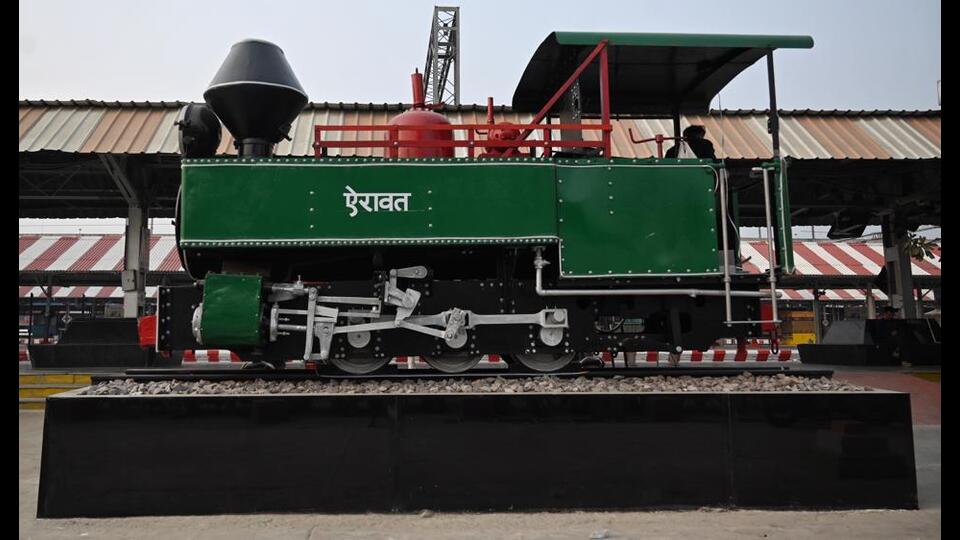
A century ago, long before diesel and electric engines dominated the tracks, Lucknow Junction reverberated with the whistles of steam locomotives running on the city’s ‘chhoti line’ network. As the station celebrates its centenary, a vintage steam engine named ‘Airavat’ now greets passengers as a tribute to that era.
Established on February 15, 1926, the station, once a key hub of the city’s narrow and metre-gauge network, has completed a century of service. The Lucknow division of the North Eastern Railway (NER) is commemorating the milestone with exhibitions, vintage displays and installations that trace the station’s journey from a modest narrow-gauge stop to a busy junction connecting several parts of the country.
“At the heart of the celebrations is a heritage photo exhibition installed at the station’s main entrance. The exhibition presents a visual timeline of Lucknow Junction’s evolution over the past century through rare archival photographs. The images highlight the station’s early architecture, railway operations during the steam-era and key development milestones. Many passengers pause at the display panels, revisiting memories while younger visitors get a glimpse into the past,” said Gaurav Agarwal, divisional railway manager (DRM), NER.
“Another highlight is the installation of a vintage steam locomotive named ‘Airavat’, placed prominently at the cabway area of the station. The 102-year-old narrow-gauge engine has quickly become a major attraction, with passengers stopping to photograph the historic locomotive,” said Mahesh Gupta, public relations officer, NER, Lucknow.
Railway officials said the engine was originally used in 1926 on the 14-mile narrow-gauge tram line of the Nautanwa branch, which ran between Lakshmipur station and the Nagwa and Sonari forest areas. The locomotive played an important role in transporting forest produce from the region and continued to operate for several decades before being retired around 1982-83. The engine was manufactured by John Fowler & Company in England, reflecting the engineering legacy of early railway expansion in India.
Adding to the nostalgic theme are departmental exhibition stalls set up by different railway wings displaying equipment once commonly used in railway operations. The engineering department has showcased vintage tools such as metre-gauge inspection trolleys, sleeper tongs, rail cutters, gauge-level instruments and fish-plate spanners.
The signal and telecommunications department has displayed mechanical lever frames, semaphore signals, block instruments and the token system that was once crucial for managing train movement on single lines. Meanwhile, the electrical department has put up old button switches, analogue energy metres and filament bulbs that were widely used in earlier decades.
The commercial department’s stall features traditional printed card tickets, ticket punching machines, reservation charts, parcel weighing machines and sealing pliers, offering visitors a glimpse into the pre-digital era of railway ticketing.
Other departments, including operating, mechanical and personnel, have contributed exhibits such as guard whistles, hand signal lamps, vintage cameras, ABC couplers and old railway passes preserved in official records.
To engage younger visitors, the mechanical department has also installed a toy train, complete with a miniature engine and two open wagons. The moving model has become a favourite among children and families visiting the station.
In addition, LED screens at the concourse are displaying clips from films and web series shot at stations across the Lucknow division, highlighting the cultural presence of railways in Indian storytelling.
The station has been decked up with decorative lighting, colourful flower beds and water fountains, giving the century-old junction a festive look.